
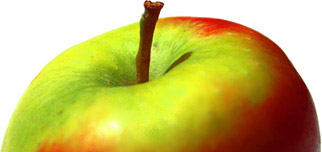

This is the classic English apple, often regarded as the finest of all dessert apples, and the inspiration for this website. It arose in England in the 19th century as a chance seedling, and has inspired apple lovers ever since. It remains unsurpassed for its richness and complexity of flavour.
Two characteristics tend to be apparent in its offspring to a greater or lesser extent. Firstly the relatively pronounced and complex "aromatic" flavour which elevates it above most other varieties. Secondly, the striking and attractive orange-red colouring.
It is the range and complexity of flavours which makes Cox's Orange Pippin so appealing to enthusiasts of the "English" style of apple. This is a variety for the connoisseur, who can delight in the appreciation of the remarkable range of subtle flavours - pear, melon, freshly-squeezed Florida orange juice, and mango are all evident in a good example. Almost all other apples taste one-dimensional alongside a good Cox's Orange Pippin.
Although Cox is often considered a variety to keep for a few months, we suspect this is a hangover from Victorian tradition before the invention of modern controlled atmosphere storage techniques, because it does not really keep that long. The authorities may not agree but in our opinion it is at its best when picked fully ripe straight from the tree, or within a few weeks at most. In this respect, Cox is not really a "late" apple variety and is perhaps better considered a late-picking mid-season variety - and some of its offspring such as Ellison's Orange are definitely mid-season varieties.
The term "orange" in the context of apple varieties commonly refers to an apple with an orange flush. Many of these varieties such as Kidd's Orange Red, Ellison's Orange and Tydemann's Late Orange are related to Cox, but it can be applied to others such as Blenheim Orange.
Not surprisingly, Cox has been frequently used in breeding programmes, with growers seeking to marry its unique flavour with desirable characteristics from other varieties. Whilst some might argue that none of its offspring achieve the unique blend of flavours that Cox does, many of these varieties are nonetheless excellent in their own right - and to many people are more appealing than the more "serious" nature of the Cox. We list many of these further down this page.
There are a great many variants and forms of Cox's Orange Pippin, many of which are self-fertile (a characteristic which seems prevalent in the Cox genetic make-up although the original is not self-fertile). The self-fertile forms tend to be more widely-available from garden centres because they are easier for the gardener who just wants one tree.
Unfortunately England's greatest apple is not particularly easy to grow. It needs a relatively cool maritime climate and is also prone to diseases.
Although quite widely available in UK supermarkets, either from UK or New Zealand suppliers, in our experience these apples often have an empty flavour and can be very disappointing, given the legendary reputation of this variety. Therefore, growing your own may be the only answer, inspite of the potential difficulties. After picking, the apples can either be eaten straight away or stored in a cold dark place to allow the flavour to develop - but best eaten before Christmas. Alternatively, Cox can often be found at farmers's markets.
Whilst the reputation of Cox's Orange Pippin is known and respected worldwide, many apple enthusiasts outside its native home in England who have tried growing it are sometimes left unimpressed with the results. It seems that the true flavor of Cox's Orange Pippin is only achieved in the marginal cool temperate climate of England, although the climates of the Pacific North West of the USA and Canada, and Nova Scotia in eastern Canada come close.
If you live in an area with a continental climate you may be more succcessful with some of the close relatives, of which Rubinette is probably the best example. Although still not particularly easy, Rubinette can be grown successfully in many areas of North America where Cox's Orange Pippin does not seem to work, and crucially, when you bite into a Rubinette you are coming very close to the flavor of Cox's Orange Pippin.
Flavour is a very personal thing but Cox's Orange Pippin is essential reading for anyone interested in apples, because the insight it gives into the breadth of flavor that can be achieved. It is unquestionably the benchmark against which all others are measured, as well as being (along with Golden Delicious) one of the most influential apples for the development of other varieties.
Cox's Orange Pippin apple identification images
All images copyright Orange Pippin unless otherwise stated.


USDA identification images for Cox's Orange Pippin
The identification paintings in the USDA Pomological Watercolor Collection span the years 1886 to 1942.
Citation: U.S. Department of Agriculture Pomological Watercolor Collection. Rare and Special Collections, National Agricultural Library, Beltsville, MD 20705.
Parents and other ancestors of this variety
- Margil (parent)
- Rosemary Russet (parent)
Offspring of this variety
- Alkmene
- Allington Pippin
- Bountiful
- Charles Ross
- Eden
- Elise(distant descendant)
- Ellison's Orange - Ellisons Orange comes close to Cox for flavour
- Epicure
- Evelina(distant descendant)
- Feltham Beauty
- Fiesta
- Flamenco(distant descendant)
- Freyberg
- Gala(distant descendant)
- Golden Nugget
- Herefordshire Russet
- Holstein(distant descendant) - Cox is a possible ancestor of Holstein
- Ingrid Marie - Ingrid Marie has a blander flavor than Cox
- Jupiter
- Karmijn de Sonnaville - Cox Orange Pippin is the female parent of Karmijn de Sonnaville
- Kent
- Kidd's Orange Red - Noticeably sweeter than Cox's Orange Pippin, a great apple in its own right
- Laxton's Fortune
- Laxton's Superb
- Meridian
- Merton Charm
- Merton Prolific
- Merton Russet
- Merton Worcester
- Pinova(distant descendant)
- Pixie(distant descendant)
- Red Windsor
- Rival
- Rubens (UK NFC)
- Rubinette
- Saint Everard
- Suncrisp(distant descendant)
- Sunset - Sunset is probably a seedling of Cox
- Suntan
- Tydeman's Late Orange
- William Crump
- WineCrisp(distant descendant)
- Winston
- Winter Gem
Sports of this variety
Sports are natural genetic mutations of the original variety.
See also
- Ribston Pippin - Ribston Pippin was long considered a parent of Cox's Orange Pippin but recent genetic tests have disproved this.
Visitor reviews
- 18 Apr 2025My favourite apple since a child, when my grandparents grew some along with Bradley’s, conference pears, gooseberries and other soft fruits. I look for these apples in normal supermarkets and never see them. My memory is of a juicy, sharp and sweet apple, incomparable to what’s generally on offer. I had not thought of growing my own, and probably have left it a bit late.
- 14 Oct 2024Possibly the apple I have disliked the most. My sample was Picked and verified by a renowned pomologist, so I know it was as it should be. I found the mealy flesh sweet but in a way that seemed like it had been heat drawn, like it was plucked from a pie. The thinner skin was more peely than convenient. Hard pass from me.
- 15 Sep 2024This was my fathers & mines favorite. He used to buy a box for Xmas every year.
- 17 Nov 2023I think there might be a typo in the last paragraph! Might you mean essential “eating” instead of essential reading??!! I adore Cox’s Orange and buy them from a farmer in Nova Scotia.
- 09 Oct 2023My favorite apple! I get it from an orchard in Rhode Island.
- 06 Oct 2023I've had mine for a few years and this was the first year it produced like crazy. I'm in the WIllamette Valley, Oregon. Flavor is excellent, at its peak now in early October. Skin's a bit thick but palatable, flesh is superb.
- 18 Sep 2023How do I know when it’s ripe
- 23 Aug 2023It grows very well here in Vancouver, British Columbia.
- 23 Jul 2023I just bought my Cox Orange Pippin tiny tree last fall, planted right away hoping it will survive.This Spring starts blooming and now 3 apples are hanging on little branches. So happy!
- 19 Feb 2023Quite the best apple just a pity they are difficult to find in the supermarkets. I’ve looked up the big orchards that’s produce apple juice and they seem to go for much lesser flavour and prefer trees that give large harvests. So quantity wins over quality..
- 10 Feb 2023It is the apple of apples. It's hard to describe its wonder: it's not very crisp, or wet, or sweet. Its flesh should be yellow, rather than green, with a texture and flavour all its own. A perfect Cox - all shades of red and yellow - is the original apple of Paradise. Nothing else comes near it. It is one of the things I most miss about England.
- 13 Nov 2022I was brought up in England so kwow the coxes orange pippin very well. I found the closest thing was a Fuji. But even the Fuji has changed over the last few years and doesn’t quite measure up.
- 23 Oct 2022The supermarket ones are hopeless grown to look even sized and “pretty “. Cox’s for me are small, irregular and with an uneven colour and “rust” marks. They are marketed as Cox. Not the full name. Someone should market the proper version with the proper full name!
- 19 Oct 2022Golden Delicious is neither golden nor delicious - it's name contravenes the Trades Description Act and should never be mentioned ion the same sentence as a Cox's Orange pippin.
- 02 Oct 2022Always loved them cannot buy the quality anywhere in England now . only found good ones in London borough market
- 04 Jul 2022I grew up in England eating Cox’s orange pippins. When they are fresh they are the best eating apple in the world. Sadly, supermarkets do not know how and when to sell and store them. I recently tasted and apple in Australia called Envy which is a cross between a Raeburn apple and one other and it was the first time that I had tasted anything that came anywhere near as good as a Cox’s.
- 02 Mar 2022I used to get bags full of these apples from an orchard a few doors along from my grandparents place in Claiton on Sea back in the 1950’s. I have loved them ever since they are the best ever and I have tried many varieties over my nearly 80 years Mr Dorby used to wrap each apple separately in newspaper and store in trays in the dark in his shed. The apples lasted all year as fresh as when they were first picked
- 22 Nov 2018 WA, United StatesHave two dwarf cop trees in NW Washington State (San Juan islands), purchased about 30 years ago. They're so tasty, not so pretty; just shook a couple and yes, the seeds rattled! Thanks for that info! Trees look kinda ratty but producing and thriving.
- 24 Jan 2018 NETHERLANDS, NetherlandsCox is a tasty tiny apple with a GREAT subtle taste. By far my favorite but now i found another apple that's also very tasty "Karmijn de Sonnaville" The apple's bigger than a cox ,sweet,juicy,aromatic>>more enjoyment.
- 01 Oct 2016 NYC, United StatesI have two apple varieties growing on my roof in NYC: Cox’s Orange Pippin and Macoun. I have successfully grafted onto the Macoun a scion of Calville Blanc d’Hiver and plan to graft onto both trees the following additional varieties: Ashmead’s Kernel, Gray Pearmain, Moses Wood and Wickson. But I do not know if they will blossom simultaneously as to pollinate each other. Can anyone advise on this? Thank you.
- 25 Sep 2015 MARYLAND, United StatesI recently had the pleasure of tasting my first Cox's Orange Pippin, which I bought at a local organic market. Wonderful flavor, excellent crunch and juicy. It had a definite citrus-like tang and an effervescent quality that only few other apples (like Pink Lady) possess. Didn't taste any of the aniseed flavor attributed to this variety. Just a great tasting apple. The only rub is the difficulty in finding the fruit in the States, the slightly higher price, and obviously, the tree's difficult growing habits. To be perfectly honest it tasted to me a whole lot like a Pink Lady, which is a much more common apple. Still, Cox is definitely in my top picks for best flavor and texture. I'd probably rank it after Jonathan, tied with Pink Lady for second place. I have no idea how COP does as a cooking apple as I wasn't about to waste any of them in a pie.
- 01 May 2015 NSW, AustraliaExcellent flavour. Highly recommended. I have a small tree growing in Katoomba, NSW, Australia. However, a word of caution. I recently visited a nearby orchard where to my surprise the owner was pulling out his grove of cox's orange pippin. He said that they produced rather mealy apples, and he thought his source of trees was inferior.
- 29 Sep 2014 OREGON, United StatesAfter a trip to an orchard in the "fruit loop" near Mt. Hood, Oregon, I finally got to try some COP and I am disappointed. Perhaps these were picked too soon, but they are quite tart with a bland flavor, though a nice enough texture. My experience with apples grown in Oregon indicates that Honeycrisp and several modern varieties are better fresh-eating apples than COP or so many other "heritage" cultivars.
- 12 Sep 2014 United KingdomWhen it's good it's very very good. But sadly almost all shop-bought cox are not good. Indeed I can't remember the last time I had a decent cox. The shop-sold ones tend to be flabby and dull and give the true fruit a bad name. Why Oh Why don't shops seek out the real thing instead of palming us off with rubbish?
- 18 Jul 2014 OREGON, United StatesCox's Orange Pippins are one of the best things about our planet.
- 17 Sep 2013 WISCONSIN, United StatesI bought two Cox's Orange Pippin's 9 years ago from Fedco Trees in Maine. It has grown well through our hard winters in Wisconsin and has delicious nice sized apples. It seems to have good flavor - it's one of my favorites but I'm not sure if it's the "old" or "new" variety. Mine is on a standard rootstock so it has been a little slower to get bearing - and last year we had a devastating late frost that decimated our areas apple trees. But I wish I had planted a few more rather than just the two I have.
- 16 Sep 2013 OHIO, United StatesCOP is exceptional but I have found it to be a shy bearer. As I have some 80+ varieties there is no shortage of pollinators. I have seen no comments relative to its keeping ability. Ripening date here about Sept 15. Brix tested 18.4
- 01 Sep 2013 IL, United StatesI planted a Cox's Orange Pippin and just tasted my first one. (I have the others to see if the flavor changes each week.) All I can say is it is the best tasting apple I have ever had. I thought some of the newer supermarket varieties were pretty good but these little guys are outstanding!
- 06 Jun 2013 HALLUM, NetherlandsHello Marc, Our "Plus"Supermarket sells them at the end of the year (oktober-december), but the problem is they never are picked ripened well from the tree, and so they never get their perfect flavour and aroma.
- 30 May 2013 OVERIJSSEL, United StatesThe apple with the best flavour! Last few years, I don't see it anymore in Dutch supermarkets. That's a big shame.
- 22 Aug 2012 CAMBRIDGESHIRE, United KingdomIt's true that cox's are the best flavoured apple. At our fruit farm we grow about 10 acres of this sort. Some of the orchards are quite old, and all planted with the original orange pippin; we plan to make new plantings of this sort and keep it going! Very popular in the farm shop too. Variety needs thinning, renewal and containment pruning to maintain quality; leave 1 year old shoots to 'bud up' for fruiting in their 3rd summer, prune them then or thearafter. Scab can be a problem, when weather is very wet you may have to spray.
- 11 Oct 2011 FLORIDA, United Stateswant to purchase a box of cox pippin apples or does anyone know of any orchard that does sell them and ships them. Gordon J Kelly 850 871 2847
- 01 Oct 2011 WASHINGTON, United StatesMy COP does great here in W Wa. I came to this site to research if the apple could be picked a bit early. Most of the large crop will be used for cider/blending [28 apple varieties allows choice of uses.] Excellent but long ways from one of my favorites...in my opinion overrated as 'best' apple ever.
- 28 Jul 2011 BRITISH COLUMBIA, CanadaI once lived on a ranch in the interior of British Columbia, Canada. The land had been settled and cleared by English settlers before 1900. Two old COP trees survived in the lower field but were past their prime and very overgrown. I pruned them back and they produced a limited supply of delicious but small Pippins. They were prone to "watering" or whatever it is properly called where the flesh has water spots inside...this was possibly in part due to the land not being properly drained. The old name for the creek was Crosdaile...an old English name no doubt!
- 12 Jul 2011 HEREFORDSHIRE, United KingdomI am very interested in the comments by John Cox, New Jersey on the 30th May 2011, regarding the origin of the C.O.P, Richard Cox was my Great Grandfather. If Yoy read this please get in touch.
- 30 May 2011 NEW JERSEY, United StatesCox's Orange Pippin is an apple cultivar first grown in 1825, at Colnbrook in Buckinghamshire, England, by my incle a retired brewer and horticulturist Richard Cox. Though the origin of the cultivar is unknown, the Ribston Pippin seems a likely candidate. The variety was introduced for sale by the 1850s by Mr. Charles Turner, and grown commercially from the 1860s, particularly in the Vale of Evesham in Worcestershire, and later in Kent.
- 24 Apr 2011 TN, United StatesLooking for information regarding growing the Cox Orange Pippin. They have a rep for being hard to grow. I put one in the ground along with several other varieties last Fall and they seem to be the least vigorous of the lot.
- 16 Mar 2011 WAIRARAPA, New ZealandI have a Cox's tree in my garden which I believe to be about 10- 12 yrs old. When we first moved into this house the tree was smallish, and I grafted Sturmer Pippin on to half of it and last year I put a few grafts of Golden Delicious and Fuji on to it. I have had good crops of Cox's, last years total being 520 plus 150 Sturmers. This year I have picked perhaps half the crop of Cox's so far and have had well over 250. The only problem I have had this year is with Codlin Moth - my control was badly timed!! I would say that my tree is about 10ft tall and a diameter of about 8ft. We do get some good frosts here in the lower half of the North Island of N.Z. ( well, I think they are good! about -5 or6 deg C or 24 - 25 F, and usually warm days after a frost. Winter lasts about 3 - 4 months here which is bearable!! Hope this is of interest. Terry
- 23 Jan 2011 BRITISH COLUMBIA, CanadaWe live on a heritage farm mid-vancouver island and have enjoyed and delighted in the abundant supply of Cox's Orange Pippin for many years. We are now looking to share and ensure the longevity of our heritage garden species. Advise on recommended root stock is msot welcome ~ The products of our labour will also be made available for others to enjoy. Note: we have not had any problems with this wonderful heritage variety. Regards and Enjoy!
- 31 Dec 2010 NEW BRUNSWICK, CanadaI have propagated and sold 'Cox's Orange' trees for over 20 years. We are living where temperatures can drop to -40 but have never lost any trees as they are grafted on very hardy Russian rootstocks. If anyone in Canada is looking for a source they can order them at www.cornhillnursery.com Unfortunately we cannot ship fruit trees outside of Canada. The 'Cox's Orange' is the stuff of legend and they seem to enjoy our Maritime climate. At one time Nova Scotia used to ship barrel loads to England and I believe they were high quality as the conditions are not that different from England.
- 24 Oct 2010 CAMBRIDGESHIRE, United KingdomAlison. - Are you certain that the damaged branches are a result of animals? Cox's is quite prone to canker, which causes various types of bark damage - varying from sunken areas of bark, to missing bark and exposed underlying wood, through to an appearance of unzipping and peeling of the bark. However, if you still think that the damage is being caused by animals, it may well be squirrels, or possibly deer.
- 24 Oct 2010 BIRMINGHAM, United KingdomAfter searching the web decided to buy a self-fertilising dwarf apple tree , and settled on Orange Pippin because of its reputation. The first year there were about 12 apples, but this second year we've had a bumper crop of around 40 apples! The only gripe is that the branches have sagged down under the weight, and some (unknown) animal/s have bitten chunks out of them. As it's at the end of the garden we'd forgotten about getting our harvest in. They're sweet and juicy. Any suggestions as to the guilty animal? Hope it isn't rats, which are found everywhere.
- 08 Oct 2010 MAINE, United StatesIn '06 I planted two full sized Cox's Orange Pippins. One was girdled by voles the other is doing moderately well. I planted comfrey as a companion plant and use cardboard topped with seaweed as a mulch to keep down the grasses. We're the, "easternmost town in the U.S." Plenty of high winds off the Atlantic, snow, and lots of fog in spring and early summer. We'll see how it does. Dick Hoyt Lubec Maine DickH@wwsisp.com
- 27 Jul 2010 WASHINGTON, United StatesSo happy to find the note from Axel, March '08. I have a Queen Cox, in the ground three years and looking forward to a very first taste in a few months. My tree does well until we exerience hot temps (90F+) which came a few weeks ago and again for at least a week at the end of July'10. Spokane is fairly high and dry; no matter how I water around it, the leaves curl and lose elasticity. Perhaps I dwell at the upper extreme of what this tree can withstand. If the fruit comes through as so many exclaim, I'll keep on, for the tree otherwise grows well and is problem free.
- 26 Apr 2010 CAMBRIDGE, New ZealandI own ahouse in New Zealand and with it came a 50 year old tree which had deliceous apples. The tree was blown over but I took a number of cuttings and had them grafted. This was 3 years ago I picked my first apples from all accounts taste etc they are Cox's orange pippings. I have photographs etc and they are disease resistant no codling moth eg
- 20 Mar 2010 LEICS., United KingdomEnglish-grown Cox's, perhaps a little acid at times but can't be beaten. I have eaten NZ Cox's a few times and have assumed that they were a different variety "borrowing" the name as they have had a less complex flavour and have been uniformly more acid.
- 03 Feb 2010 ALABAMA, United StatesMany years ago found this apple in the Boston Farmer's Market when I was visiting there, and bought a few. Went back the next day and bought a huge bag full. One of the best apples I have ever eaten, and the one I will plant if I get land in the next few years.
- 24 Nov 2009 IRELAND, IrelandMy great great grandfather was the very first to introduce the cox orange to the canterbury area in New Zealand. Arrived on the The Randolph 1850.
- 20 Oct 2009 IRELAND, IrelandIt annoys me so much to see Cox apples from Holland etc when we can just as easily grow it in Ireland, or at least import it from England.
- 18 Oct 2009 ENGLAND, United KingdomI've always been mystified by this idea that Cox's Orange Pippin is the best apple in the world. I've eaten many over the years (both commercially-grown and home-grown), and I consider it a tasty but unremarkable apple. I don't even consider it the best British variety, which I think is the Egremont Russet.
- 17 Oct 2009 ROCHESTER, NY, United StatesYou can find 1 yr seedlings of this variety from Miller Nurseries in Canandaigua, NY. They have an online catalog.
- 15 Oct 2009 E SUSSEX, United KingdomCan you explain why it is that, after the Cox's season has passed, we get in the shops Cox's from New Zealand which don't look like Cox's have a different skin from Cox's and certainly don't taste like Cox's? What are these horrors? Paul Marsh
- 11 Oct 2009 IL, United StatesI am SO happy to read your post and that your farm has it's own website. I look forward to seeing you at the Saturday market in Lincoln Park!
- 12 Sep 2009 B.C., CanadaI was looking around for info on the cox orange apple and saw your post. I live in North Van as was given a Cox Orange about 20yrs ago this is the first year it has produced fruit. How is yours doing?
- 08 Sep 2009 DELTA , BC , CanadaWhere can I buy COP trees in Vancouver , BC , Canada or vicinity ?
- 28 Aug 2009 EAST ANGLIA, United KingdomI have a four-year-old C.O.P. It cropped from year one and this year has the heaviest crop of big fruit so far. It has grown very straggly (my fault?); any tips on pruning please?
- 25 Aug 2009 LONDON, United KingdomHas anyone tried cider made from the Orange Pippin or have an orchard? If you do, what sort of difficulties are there cultivating them? - Pests etc.
- 21 Aug 2009 OVIEDO-ASTURIAS-ESPAÑA, SpainEstoy de acuerdo en que es una variedad de gusto agradable. Yo tengo un hermoso árbol en Asturias. No tiene enfermedades y es muy productivo pero la manzana es excesivamente blanda y no se conserva bien y aunque el arbol produce mucho no se aprovecha porque la manzana se estropea muy rápidamente. otras variedades se conservan mucho mejor y se pueden aprovechar más. Saludos . I agree that it is a variety of pleasant flavour. I have a nice tree in Asturias. It doesn’t have illnesses and is very productive but it is excessively soft and doesn’t conserve well and although the tree produces alot it isn’t an advantage because the apple damages very quickly. Other varieties they conserve a lot better and you can get more advantages.
- 22 Jul 2009 NT, AustraliaCox's are by far the best eating apples,is it possible to purchase these apples in Australia
- 13 Jun 2009 WEST WALES, United KingdomI agree with comments made about Cox's Orange Pippin (especially Phil's!). Just bought a bag of them with UK stamped on it, but the flavour is not the true Cox's. Other Cox's I've bought I've traced to N.Z. They don't have that unique flavour of those grown in the UK. Must be our weather! I have no room for a tree in my present garden but am trying to locate a good source of a patio one, as there is no apple to beat it!
- 07 May 2009 LONDON, United KingdomThe real cox's orange pippin of my childhood is no more. Where can we buy them now?
- 10 Apr 2009 Indiana, United StatesAnother source for these trees in the USA is Trees of Antiquity in Paso Robles, CA. Their phone number is: (805) 467-9909. Their web site is: www.treesofantiquity.com. I got my first one from them this year, Spring 2009. They shipped excellent stock with good root systems. Unfortunately, they are now sold out of Cox's Orange Pippin for Spring 2009.
- 06 Apr 2009 MELBOURNE,, AustraliaI would love to be able to graft a branch on to one of my existing apple trees. It was my favurite apple when I was a chld. Any locals able to oblige?
- 23 Jan 2009 MARENGO, IL, United StatesWe have been growing Cox Orange Pippin at out orchard in Marengo, IL for 25 years now and I agree they are the best apple ever. The density of flavor and flesh makes this one truely stand out. Its not just sweet, but has a complex flavor that words do no justice. Nicholsfarm grows over 170 varieties and this one is my favorite. We also attend 18 Chicago farmers markets so if your in the area you can get them end of August through September fresh off the tree.
- 02 Jan 2009 CENTRAL HIGHLANDS VICTORIA, AustraliaI have an espalierd cox on dwarf rootstock. It produced fruit in its second year, its now 4 years old and is laden with fruit.
- 29 Dec 2008 OSHAWA, ONT., CanadaTry this place, it is where I got my Pippin trees, great place to deal with. mail@siloamorchards.com
- 08 Oct 2008 ESSEX COUNTY, MASSACHUSETTS, United StatesI have just purchased my first Cox Orange Pippin last night in the grocery store I frequent (a "Whole Foods" store). They had a small number of specialty apples for sale, including this one. I have long wondered about its taste, knowing how popular and famous it was in the UK. My own favorite is an American apple named "Jonathan". I will be most interested in comparing the two! Jonathan has a gently spicy flavor. To bite into a Jonathan apple is to take a bite of apple cider! Unfortunately THAT apple I can't seem to find in this part of the world! :-(
- 04 Oct 2008 NEW YORK, NY, United StatesIn our NYC greenmarkets, varieties abound, there are a number of orchards that have limited amounts of "gourmet" apples. Of note, Rubinette, Calville Blanc, Court Pendu Platt are some that I have come across, but rarely. Finally, I found Cox, and wow, what a treat. I am an apple fanatic, eat 4 a day, and now i see why all the hubbub. Anyone in the UK who knows how I can some shipped, let me know: rolsto@yahoo.com. thanks brad
- 02 Oct 2008 ST DIDIER (84), FranceLa cox orange était une vapeur du passé. Je n'en ai goûté qu'une dans ma vie... mais quelle empreinte elle a laissé sur moi... Pendant des années je n'ai plus mangé de pommes (il est vrai que nos pommes françaises manquent d'esprit), hanté par la chanson acidulée de la cox... la croyant espèce détruite et fantômatique... Je la retrouve aujourd'hui après 20 ans... apprends que vous, mes amis anglais, en êtes blasés... Tout va tout de suite mieux... CD
- 30 Sep 2008 EASTERN TOWNSHIPS QUEBEC, CanadaGrowing up on 35 acres of apple trees in the Eastern Townships of Quebec Canada, we were fortunate enough to have a couple of trees of what I believe were true Cox's Orange Pippin, that would even make Bernard from England happy. Complete with rattling seeds, these were and always will be my favourite. When my Dad sold the orchard, the new owner from what I understand, removed the trees. I have not had one since, which is very sad indeed. We are hoping to find and plant one or two of these trees on our property soon.
- 16 Sep 2008 MISSION,KANSAS., United StatesI lived in norfolk england. We had a orhard of 70 cox's and also other apples such as egmont russet,red rome,cordon's just the cox's went to market. I never thought this apple could be grown here in the States!. I had a hand in looking after these tree's from spraying, pruning,picking,gradeing and so on.
- 14 Sep 2008 BURLINGAME, CALIFORNIA, United StatesI grew up in England and remember with great pleasure the Cox's Orange Pippin tree in my grandfather's garden. That was in the 1940's, 50's and 60's. I wonder if the tree is still there. I have never since eaten an apple to compare. Absolutely delicious.
- 29 Aug 2008 JAMAICA PLAIN, MA, United StatesChris from Long Island. In North east MA there is a family run orchard that grows Cox's orange pippins - Greenwood Farm, 265 Millers Falls Road, Rt 63 Northfield, MA 01360 Website: www.greenwoodnursery.com; perhaps they would give you a source for trees. I live in Boston and have a converted urban lot now producing some apples including a Cox's orange pippin tree (I grew up in Scotland and was reared on these great tasting apples). To be honest this is the first year in about seven it has been truly productive. My source was Millernurseries.com but I am not so sure about the quality of their stock; though it may just be that fruit trees are not a breeze to grow. I've heard of a weekend class offered in New Hampshire by a the writer of the book The Apple Grower, Michael Philips (his focus is organic) http://www.herbsandapples.com/classes.php#apple.
- 29 Aug 2008 TRANSYLVANIA / NORTH CAROLINA, United StatesWe are looking for a Cox's Orange Pippin apple tree for a special client from the UK. We would like one that is bearing say 7 to 8 feet high. Would appreciate your help.
- 12 Aug 2008 RUGBY WARWICKSHIRE, United KingdomI have a cox's orange pippin tree, there is no better tasting apple anywhere in the uk, you can't buy them from supermarkets you can buy cox's (imported) sometimes english but not the orange pippin with its own flavour and crispness, just pick and enjoy.
- 19 Jul 2008 LONDON, United Kingdomi agree they are wonderfull apples i have a tree in my garden and think people who cant get them or never tasted them are missing out on such a wonderfull apple i have been told they were started by a gardener in harrow middx 2miles from me but dont now if its true keep eating the best apple in the world regards roy hollis uk
- 17 Jul 2008 OREWA, New ZealandWhen a young kid my father had a small orchard, and of all the different fruit the taste that sticks in my mind by far the most is that of the Cox's Orange. Though on the wrong side of 80 have just shifted house and since I have the space have planted another one -a bit hard to come by, but still available. Just hoping it is self fertile? and that I live long enough to pick and eat some straight off the tree!
- 03 Jun 2008 COAL HARBOUR, BC, CanadaI just planted a dwarf 'Cox Orange Pippin' apple tree in the front yard of my new home. I wanted to plant a tree the day I took possession of the place and this was the tree I selected. I had never heard of this varietal, but found the tree at a garden centre. Now I'm really excited to try one of these apples! I'm wondering if it's too rainy were I live. We'll see what happens. :)
- 18 Apr 2008 RENO, NV USA, United StatesQueen Cox and six of the Cox's progeny are offerd through raintreenursery.com in the U.S. Applesource, a mailorder distributor of numerous apple varieties told me that Cox's Orange Pippin preferred to be sited next to a body of water for the temperature and humidity moderating effects. I ordered a dozen different apples to decide what to plant back of the house, and although Applesource told me the Cox's were past their prime, I insisted on trying them. What a gem! It had real competitors in Ashmead's and others, too.
- 26 Mar 2008 SANTA CRUZ, CALIFORNIA, United StatesSomeone had what turns out to be the not so brilliant idea to have the viruses removed from the cox orange pippin (this is often done in the lab by regrowing the wood in vitro). Well, it turns out that the cox's orange pippin that has been cleaned of all viruses is reputed to be rather poor in flavor compared to the old cox. (The virus free version is available from Dave Wilson, who acknowledges it's lack in flavor compared to the regular diseased one.) Yes, cox orange pippin is very disease prone, and apparently, this is desirable in order to get the original, richly flavored and ugly, warty cox orange pippin. Here in California, we have to grow it with afternoon shade, otherwise the fruit gets fried. So it's not all that warm loving after all.
- 08 Mar 2008 NEW YORK, NY, United StatesI lived in England for 8.5 yrs. This is the best apple I ever tasted & will always be my favorite.
- 27 Feb 2008 COLNE, LANCASHIRE. ENGLAND, United KingdomAs I've just put on another site I don't think there is any comparison between Cox apples and Cox's Orange Pippins and if they are not the same is there a case for ASA or Trading Standards intervening. I think we are being conned.
- 25 Feb 2008 SAVANNAH GA, United StatesTHIS APPLE ROCKS!!!
- 23 Feb 2008 Australiacox's orange pippins are da best ya Know
- 04 Feb 2008 CALIFORNIA, United StatesHaving called a local nursery I thought may have the Cox's apple and didn't, I decided to browse the internet and found an orchard in Virginia that grafts and stocks old fashioned apples or vintage apples, Cox's orange pipin was among their rootstock. I end up buying it from this orchard, called "Rural ridge orchard" its a 1 year old, so I have no idea when it will bare fruit. Anyone out there know how old they are when they bare fruit?
- 03 Feb 2008 CALIFORNIA, United StatesI just wanted to ask Steve from Orange Vale Ca, where he purchased his Cox's apple tree? I phoned the nursery nearest me that USED TO USE DAVE WILSON'S and she told me she would see what she could do, but that she now uses different suppliers. I was told that I couldn't buy the tree from Wilson's because he's a whole seller. I would gladly buy it through a web page, but haven't found one yet that has them. Anyone with suggestions ?
- 03 Feb 2008 CALIFORNIA, United StatesI had forgotten that I had left a comment on this board before, because to my delight I received an e-mail today letting me know that a local nursery near me can order a Cox's apple tree. I will definitely pursue this lead, and thank Steve that informed me of this, thanks Steve, I will let you know what I find out, Laraine
- 03 Feb 2008 CALIFORNIA/Sacramento County, United StatesLaraine- I just bought a Cox's Orange Pippin. Your local nursery can order it from Dave Wilson Nursery, a wholesale nursery in central Cal.
- 26 Jan 2008 ATHENS,GREECE, GreeceI grew up in Sussex, England inthe 50's and always remembered the exquisite Cox's orange pipins my grandfather grew{yes,the seeds rattled] A few years ago in England I bought some so-called Cox's,but there was no comparison,neither in appearance or flavour. There is however a very tasty Greek variety traditionally from Tripolis,with an similar uneven,rough appearance. It seems that the growers who develop "attractive"apples for the supermarkets are unable to combine looks with flavour.
- 25 Jan 2008 LONG ISLAND, NY, United StatesI grew up on a farm in Somerset, England and we had four or five orchards the apples of which were never picked. We also had just three Cox's Orange Pippin trees in the kitchen garden which were always picked bare for the house! One great apple it was, and you never wanted anything else. I'd love to find out if same can be grown in Long Island, NY which lately has had fairly mild Winters but Summers are fairly hot. Does anyone know if this apple tree is wind/soil/temperature sensitive (or a combo?) I had no idea they were prone to disease or tricky to grow. Also where can I get starter trees/cuttings in NE US? Also, any basic growing "do's" and "don'ts would be much appreciated?"
- 21 Jan 2008 ALDERSHOT, United KingdomCox's are my favourites,(except for lovely Ashmead's Kernel, which don't come into the equation because they are hardly ever grown commercially) We are lucky, we have a Cox's tree--- Pick your Cox's when they come easily into your hand---if they don't give way at the lightest twist, they're not ready!
- 31 Dec 2007 CALIFORNIA, United StatesI'm from England originally and cox's apples were my favourite. I guess we could try and find a nursery that perhaps owns the root stock ? I have never ever heard them called orange pipin's, nor have I ever seen a cox's apple in a supermarket here,or in the midwest where I had lived many years ago, oh well I guess I have to make do with Braeburn and Gala apples
- 16 Dec 2007 NORTH OF TORONTO, ONTARIO, CanadaI have been looking for orange pippens in Ontario. Are they available anywhere near here?
- 22 Nov 2007 SO. ROYALTON, VERMONT, United StatesSteve Parkes asked about Cox apples in Vt. I recently purchased some from Scott Farm who have a Dummerston, Vt address but are, in fact, near Brattleboro. There's a very nice article about them at http://www.theheartofnewengland.com/Heirloom- Apples.html I love old varieties of apples and Scott Farm has a wide range of them. Poverty Lane Orchard just across the river in Lebanon, NH has one tree of Cox. In both cases I would call regarding availability before driving there. If you wish you may contact me directly at AV62@Localnet.com.
- 21 Nov 2007 VERMONT, United StatesAbner. Can you contact me with details on where to find them in Vermont? My family were given a box of them for Christmas in England in the early 70's.
- 05 Nov 2007 SO. ROYALTON, VERMONT, United StatesI agree that the flavor of the Cox is unsurpassed, as is the aroma. I have lived in London where I often purchased Cox apples. Also in Pennsylvania USA where I previously lived I had a Cox tree. Now in Vermont I can purchase them from two different specialty orchards. The ones I currently have do indeed have seeds that rattle. I have never heard that with any other apple. The Cox apples we have here may or may not be precisely like the English one but they're very close.
- 01 Nov 2007 LOUISVILLE, KENTUCKY, United StatesDo you have any info on where I might find this apple in this area?
- 20 Oct 2007 NASILSEA SOMERSET, United KingdomIs the coxs orange pippin the same as a coxs orange. My friend says they are different true or false? [OP: They are the same]
- 20 Oct 2007 PROVO, UTAH, United StatesI adore pippin apples but cannot purchase them here. I would like to grow them, but don't know if I can. Is there anywhere that I can go for information?
- 18 Oct 2007 MICHIGAN, United StatesI remember my father talking about this apple variety and he had looked for it up until his death. Afterwhich I took the task of finding it just by visiting various growers and poking around. After a nearly 40 year quest between us, I finally located it. It is everything my father said it was and more. Wow, so flavorful with wonderful hits of orange. Do anyone know where I can get a tree. I have been saving seeds from the bushel of apples I bought, but know it will take far too long to wait and enjoy this apple variety again! You help is apprecaited. daffyslanding@yahoo.com
- 18 Oct 2007 CASTRO VALLEY, CA, United StatesA friend imported a dwarf Cox's in 1968 and gave me a twig. I have been growing it ever since. The fruit is ugly, often with corking at the stem end, but its flavor is incomparable. Some years ago, coming out of the British Museum, I crossed the street and found the Museum Pub, with a little old lady standing beside a display of her pies, made that morning with apples from her son's orchard in Kent: Cox's Orange Pippin. Best pie I ever ate.
- 17 Oct 2007 WEST WALES, United KingdomI'm sure the modern cox isn't the true, traditonal one of my childhood. A proper cox has a superb taste, but the imported, supermarket "cox's" are imposters. They don't look like a cox's orange and they don't taste like one either.
- 02 Oct 2007 IL, United StatesApples on Oak in Joliet, IL is an hobbyist's orchard that has over 100 varieties of apple. You can pick your own, but it is getting late, and they don't have many apples left. The owner sold me an apple he described as "Cox-like," and it is indeed delicious and aromatic. I don't think I've ever had a more flavorful apple.
- 01 Oct 2007 ILLINOIS, United StatesI used to enjoy Cox's orange pippins while living in the state of Michigan, but after moving to Illinois I was unable to find them in any farmer's markets here -- most market apple dealers had never even heard of them. Are they available anywhere here?
- 20 Sep 2007 VANCOUVER-CANADA, CanadaI have a 3yr old tree that is now giving us some super good looking apples. I would love to know When we can start to pick them...my mouth is watering already in anticipation ;)
- 16 Sep 2007 ISLE OF WIGHT, United KingdomThe above description of the Cox is accurate. I have a tree which is a derivative and has in some years given me delicious aromatic fruit. But I have difficulty knowing when to pick as birds seem to like them too and fruit picked too early is too tart and dense to be edible. How should I know the point of ripeness?
- 12 Sep 2007 HERTFORDSHIRE, ENGLAND, United KingdomI stumbled across some cox's orange pippins, in garden centre in Royston , my husband and i had actually given up trying to locate them .We were immediatley transported back about 20, 30 years , this is what apples should be like , please try to grow more for us .they are the best apple ever
- 03 Aug 2007 United KingdomThe Cox's Orange Pippins that I grew up with in England in the 60s and 70s weren't shiny, rosy-cheeked, photogenic, cookie-cutter supermarketapples. They were often deeply orange in patches, yes; but they were just as likely to be brown all over. They were rough, warty, often wrinkled, often lopsided. They were the apples that would be passed by without a second glance by the poor unfortunates who didn't know what they were. Cox's Orange Pippins don't do shiny and photogenic. They weren't just anther variation of picture-perfect Stepford apples. They had personality and individuality. The thought of Cox's Orange Pippins becoming just another apple analogue of the overblown and flavorless American beefsteak tomato, along with Golden Disgustings, even blander Red Disgustings, and Australian Watersaps, is too terrible to contemplate. Some of these supermarket-tuned wonder-varieties haven't the texture of decent sawdust or the flavor of a properly aged plastic bag. It'll be an irretrievable loss if the true Cox's Orange Pippin has been sacrificed, like so many other wonderful heritage varieties of fruit and vegetables, on the altar of picture-perfect produce-department homogeneity.
- 03 Aug 2007 United KingdomI now live in Quebec the home of the Mackintosh of which I have become very fond. My wife insists on them though I am also fond of Famous when picked in the cold at the verger. I can remember the Cox's from the uncared trees at Goodmanham Wold Farm (Yorkshire, England) where I stayed with my Uncle about 1953 and I wish that they could be grown here. Like you say not too much to look at but one really great taste."
- 03 Aug 2007 United KingdomI agree with your tasting notes about this variety - but I am 60 years old. How does anyone younger know when they are tasting a genuine one? I have the impression that imported ones are not the true variety and should not be allowed to be so named. Am I wrong? It used to be a diagnostic of the Cox's Orange Pippin that the seeds rattle when it is shaken. Those which often appear in the supermarkets labelled "Cox's apples", though English, do not rattle and do not taste like Cox's Orange Pippin. Are we being conned?
- 03 Aug 2007 United KingdomI dislike the imported Cox’s or for that matter most of the imported apples – to me they are not the same; there is something about our climate that makes our apples the best!!!
Tree register
- United States160
- United Kingdom145
- Belgium 2
- Denmark 2
- France 5
- Germany 1
- Greece 1
- Ireland7
- Italy 1
- Netherlands 2
- Poland 1
- Spain 1
- Sweden 1
- Canada21
- Australia17
- New Zealand12
- Japan2
- Poland1
- Iran1
United States
- Aaron r Ely in Fairmont, WV
- Adam Dupps in Lawrenceburg, IN
- Albany Appleguy in Castleton, NY
- Alex in Freeland, WA
- Alicia in RUTLAND, MA
- angiehauri@yahoo.com in Westmoreland, NEW HAMPSHIRE
- Anne Van De Kamp in Bellingham, WASHINGTON
- Aurie Bradley in Kensington, CA
- Axel Kratel in Santa Cruz, CALIFORNIA
- Barry Ecker in New Prague, MINNESOTA/SCOTT
- Ben Carter in Decorah, IOWA
- Beverley in Ilminster, SOMERSET
- Bill Snotherly in Eastover, NORTH CAROLINA
- Brad in Cumberland, ME
- Brian Phillips in Saint Johns, MI
- Brian Pruiett in CARLSBORG, WA
- Brian Van Erem in Green Bay, WI
- Brian Wilt in Jackson, OHIO
- Bryan m in TRENTON, NJ
- Cathleen Pfister in Arlington, MASSACHUSETTS
- Chris Mastrangelo in Smithttown, NEW YORK
- Chris Thomas in Federal Way, WASHINGTON
- Christine Pielenz in Half Moon Bay, CA
- Christoph in RENO, NV
- Clayton Preston in Danbury, CT
- Crazyeddie in Lombard, IL
- Dallin in Syracuse, UT
- Dallin in Syracuse, UT
- Dan Spratlen in Camano Island, WASHINGTON
- Dan Wombles in New Canton, IL
- Daniel Sims in Richmond, IN
- Darren Peters in Rock Spring, GEORGIA
- Dave in Pasco, WA
- Dave Beamer in Santa Barbara, CALIFORNIA
- Dave Dangelo in Augusta, MAINE
- David Black in Bentonville, ARKANSAS
- David Shaffer in Harrod, OH
- Don Mcivor in Twisp, WA
- Donald Smith in Harwinton, CT
- Elizabeth Otto Hamel in Menlo Park, CA
- Eric in Meridian, IDAHO
- Eric in Seabeck, WA
- Florian Deisenhofer in Brush Prairie, CLARK COUNTY WA
- Gary in Pleasant Hill, CA
- Gary Brandstetter in Snohomish, WA
- Gary Hegler in Chesaning, MICHIGAN
- Gina Colver in EPHRATA, WASHINGTON
- Gina Cook in SOUTH BEND, INDIANA
- Gini in Greenwich, NY
- Glen in COUPEVILLE, WA
- Glenn Grossman in Vancouver, WASHINGTON
- Glenn Tremble in Trail, OREGON
- Grace in Portland, OREGON
- Grace in Portland, OREGON
- Grace in Portland, OREGON
- Heidi Pocklington in Suffolk, VIRGINIA
- Herdie Baisden in STOCKHOLM, WI
- James Dierberger in Hebron, CT
- James Nichols in La Luz, NEW MEXICO
- James Roden in Estacada, OR
- James Wargo in SOUTHBURY, CT
- Jarad Giese in Longmont, CO
- Jason Whitehorn in Sand Springs, OK
- Jeannie Berg in Scio, OR
- Jeff Fournier in Alger, MI
- Jeffrey Cottrell in Saginaw, MI
- Jen in Menlo Park, CALIFORNIA
- Jerry Hilson in Everett, WASHINGTON
- Jerry Hudgins in Point Reyes Station, CALIFORNIA
- Jessica Preece in Provo, UTAH
- Jim Nelson in Mequon, WI
- Jimj in San Francisco, CALIFORNIA
- Jo Elsmore in BLOORS,
- Joachim Peters in Palatine, ILLINOIS
- John Betz in Vineland, NEW JERSEY
- Jon Shannon in Shaw Island, WA
- Jon Shannon in Shaw Island, WA
- Jonathan Bastedo in YUCAIPA, CA
- Jonathan Newberry in Friendsville, TN
- Joni Clancy in Sublimity, OR
- Judd Curran in Missoula, MONTANA
- Justin in PORTLAND, OREGON
- Karen Davies in Southampton, HAMPSHIRE
- Kellogg Hill Farms in SOUTH DAYTON, NY
- Kerry Mcquaid in Oregon City, OREGON
- Kevin Yeadon in OAK HARBOR, WA
- Kim Lapacek in Poynette, WI
- Kristina Kent in Dixon, IL
- Kurt in Ladysmith, WI - WISCONSIN
- Laraine Santagato in Atwater, CALIFORNIA
- Larry Landis in Corvallis, OREGON
- Lawrence Bradley in Tacoma, WA
- Lisa Schultz in Warwick, RHODE ISLAND
- Lorraine Leber in San Francisco, CA
- Madeleine Murphy in Castro Valley, CALIFORNIA
- Malia in MCKINLEYVILLE, CA
- Malibubluff@Yahoo.Com in Pueblo, COLORADO
- Mark A. Rock in Columbia Station, OHIO
- Mark Delman in Palo Alto, CALIFORNIA
- Mary Hanley in WEST HAVEN, VT
- Matt in New London, MN
- Matt D in Canterbury, NH
- Megn in PORTLAND, OR
- Michael Chick in Shoreline, WA
- Michael Howe-Smith in Richboro, PA
- Michael Jindrich in ELIZABETHTOWN, KY
- Michael Le Boulluec in Glen Rock, PA
- Michael Mcnamara in Los Gatos, CALIFORNIA
- Michael Miller in Kennett Square, PA
- Mike in Glen Rock, PA
- Mike Betts in Grattan Township, MICHIGAN/KENT
- Mike Haller in Sioux City, IOWA
- Milovan Popovic in Ellington, CONNECTICUT
- Nancy Crossley in Oxford, MICHIGAN
- Nathan Parker in Mount Shasta, CA
- Nathan Sanders in Middleburg, PENNSYLVANIA
- Nimzo in Walnut Creek, CALIFORNIA/CONTRA COSTA
- Noah McVay in Spring Green, WISCONSIN
- OrangePippin-Scott in Traverse City, MI
- Owen Witesman in SPRINGVILLE, UT
- Paul Gerrish in Newbury, MA
- Paul Grochowski in Floyd, VIRGINIA
- Phil in Stoke On Trent, STAFFORD
- R. Matthew Warren in Woodbridge, VIRGINIA
- Randy in Baxley, GA
- Ray Wickline in Middletown, MARYLAND (MD)
- Rebecca Rynne in Washington
- Rick Simoniello in Storrs / Mansfield, CT
- Ricky Bruckner in RAVENNA, OHIO (OH)
- Robert Wallace in WESTMINSTER, VT
- Roger Miller in Madison Heights, VA
- Roger Sloboda in Hanover, NH
- Ron Davis in CHUCKEY, TN
- Ronny Blackstock in Fitzgerald, GA
- Rory Mcgregor in Mapleton,, MN
- Ruby Landow in Putney, VT
- Ryan Grover in Vineyard, UTAH
- Ryan Parsell in Langley, WA
- Scott McElhaney in Camas, WASHINGTON
- Shirley Miller in Nucla, COLORADO
- Stephan Orchard in Westfield, INDIANA
- Steve in Orange Vale, CALIFORNIA/SACRAMENTO COUNTY
- Steve Bean in Kaysville, UTAH
- Steve Knoebber in Vicksburg, MICHIGAN
- Steve Kollodge in BROOK PARK, MN
- Steve Larson in Battle Ground, WA
- Steven Stanley in Johnson City, TN
- Steven Sypkens in Turney, MO
- Susan in Center City, MINNESOTA
- Susan Karpenski in Meadville, PA
- Susan Leslie in Ballston Spa, NY
- Susan Leslie in Ballston Spa, NY
- Terry Graham in Tumwater, WA
- Theresa Quednow in Elkhorn, WI WALWORTH
- Thomas Griffith in Cottage Grove, WI
- Tim Cheney in Walpole, ME/LINCOLN
- Tom Parks in Holladay, UT
- Trevor Roth in Erhard, MINNESOTA
- Velvie Mckenzie in Jackson, OH
- Whitney Peters in Sixes, OREGON
United Kingdom
- Reach Community Orchard in Cambridge,
- Alan Elsbury in Chippenham, WILTSHIRE
- Alan Hayman in Bristol, SOMERSET
- Alasdair Mcintosh in Peterborough, CAMBRIDGESHIRE
- Alison Swift in Bristol, BRISTOL
- Andrea Weston in Maldon, ESSEX
- Andrew & Jean Calverley in York, YORKSHIRE
- Andrew Colchester in Bures, SUFFOLK, UK
- Angela Rouse in London, GREATER LONDON
- Angela Underhill in Bedford, BEDFORDSHIRE
- Annette Hurt in Filby, NORFOLK
- Annette Unsworth in BRIGHTON, EAST SUSSEX
- Argon in
- Arlene Kearney in Croydon, SURREY
- Atg in London,
- Basil Longy in Ryde, ISLE OF WIGHT
- Basil Longy in Ryde, ISLE OF WIGHT
- Billy Auger in Hopton Wafers, SHROPSHIRE
- Bob Henley in Winchester, HAMPSHIRE
- Brian Heaney in Newcastle Upon Tyne, TYNE AND WEAR
- Charles Wills in GUNNISLAKE, CORNWALL
- Colin Bowen in
- Connor in Southampton,
- Daniel Mills in FISKERTON, LINCS
- Daniel Sandford in London, LONDON
- Dave Hoare in HADDENHAM, BUCKINGHAMSHIRE
- Dave Hoare in Harefield, MIDDLESEX
- Dave Hoare in Harefield, MIDDLESEX
- Dave Lamb in Warrington, CHESHIRE
- David Briggs in Warwick, WARWICKSHIRE
- David Hill in Braintree, ESSEX
- David Kenning in Whitstable, KENT
- David Lonsdale in Shipdham, NORFOLK
- David Mcgoldrick in Crieff, PERTHSHIRE
- David Mogg in Petersfield, HAMPSHIRE
- David Neilson in ELY, CAMBS
- Davidjohndawkins in Ely, CAMBS
- Derek Turnbull in Chesterfield, DERBYSHIRE
- Dianne Davenport in Coulsdon, SURREY
- Douglas Silverstone in Chesham, BUCKS
- Elizabeth Hodge in Evesham, WORCESTERSHIRE
- Elizabeth Moriarty in Oxford, OXON
- Eric Hill in Bristol, SOUTH GLOUCESTERSHIRE
- Frank Leach in Peacehaven, EAST SUSSEX
- Geoff King in Leeds, WEST YORKSHIRE
- Geoffrey Brown in Grundisburgh, SUFFOLK
- Glynn Swift in Oswestry, SHROPSHIRE
- Graeme Stockdale in Pilsley, Chesterfield, DERBYSHIRE
- Graham Bell in Coldstream, BERWICKSHIRE
- Graham Bell in Coldstream, BERWICKSHIRE
- Graham Charles Schofield in Newmarket, SUFFLOK
- Graham Herridge in Biggleswade, BEDS
- Graham Hinchliffe in Eastbourne, EAST SUSSEX
- Graham Tibble in Southampton, HAMPSHIRE
- Henryc in Andover, HAMPSHIRE
- Irina Pertsel in DURHAM, COUNTY DURHAM
- Ivor Kiverstein in Pulborough, WEST SUSSEX
- Jackie Breadmore in
- James C. Porteous in York, NORTH YORKSHIRE
- Jason Marks in Bristol,
- Jean Lippett in Martock, SOMERSET
- Joe in London,
- John Dench in Etchingham, EAST SUSSEX
- John Partis in HAYWARDS HEATH, WEST SUSSEX
- John s m Roberts, O.B.E. in Seaford, EAST SUSSEX
- johncole4321@yahoo.co.uk in Ramsgate, KENT
- Joyce M Brown in Abingdon, OXON
- Jude Ilett in Peasenhall, SUFFOLK
- Julia p in Rosewell,
- Julia p in Rosewell,
- K Hufton in Stranraer, WIGTOWNSHIRE
- Keith Johnston in Abaerdeen, ABERDEENSHIRE
- Kevin Chadwick in Birmingham, WEST MIDLANDS
- Kevin Chadwick in Birmingham, WEST MIDLANDS
- Kevin Chadwick in Birmingham, WEST MIDLANDS
- Kevin Chadwick in Birmingham, WEST MIDLANDS
- Lee Parker in Wisbech, CAMBRIDGESHIRE
- Lesley Campbell in Saltcoats, AYRSHIRE
- Liz Douglas in SHEFFIELD, YORKSHIRE
- Lucy & Jonathan Bowden in Long Hanborough, OXFORDSHIRE
- Lyn Eryl Jones in Cambridge, CAMBRIDGESHIRE
- M. Salisbury in Preston, LANCS
- Malcolm Whitmore in Loughborough, LEICS
- Malcolm Whitmore in Loughborough, LEICS
- Maria Cummins in Harwich, ESSEX
- Mark in Chippenham, WILTS
- Mark in Chippenham, WILTS
- Mark in Chippenham, WILTS
- Mark in Chippenham, WILTS
- Mark Brisbane in Winchester, HAMPSHIRE
- Mark Davies in Saddleworth, YORKSHIRE
- Martin A Smith in Petersfield, HAMPSHIRE
- Martyn Clayton in York, NORTH YORKSHIRE
- Mary Fielding in LEDBURY, HEREFORDSHIRE
- Matt Thompson in York, NORTH YORKSHIRE
- Meadowcopse in Chester, CHESHIRE
- Melanie in Nr Leicester, LEICESTERSHIRE
- Michael Mccarthy in Coulsdon, SURREY
- Michelle in London,
- Mike in Rottingdean,
- Mike Galtrey in Godalming, SURREY
- Mike Wicken in Camberley, COUNTY (OPTIONAL)
- Mrs Jane Brown in Settle, NORTH YORKSHIRE
- Mrs Sophie Wiles in Flamborough, EAST YORKSHIRE
- Nathan Scullion in Boston, LINCOLNSHIRE
- Neil Kenny in Edinburgh, EASTLOTHIAN
- Nick in LONDON, LONDON
- Nick Butcher in North Curry, SOMERSET
- Nick Letch in HARWICH, ESSEX
- Nickkk in Oldham, LANCASHIRE
- Nicola Matthews in Nottinghm, NOTTINGHAMSHIRE
- Nigel in Ryton Dorrington Shrewsbury, SHROPSHIRE
- Pat Burke in Market Deeping, PETERBOROUGH
- Paul in Ballyclare, CO. ANTRIM
- Paul Haines in Llandyfriog, Newcastle Emlyn, CEREDIGION
- Peter Griffiths in Thame, OXFORDSHIRE
- Peter Kent in Casnewydd, GWENT
- Peter Selby in Swadlincote, DERBYSHIRE
- Peter Willis in Peterborough, CAMBS
- Phil Martin in Bath, SOMERSET
- Phil Mcintyre in Widnes, CHESHIRE
- Phil Stevenson in Rugeley, STAFFORDSHIRE
- Philip Babey in SOUTHAMPTON, HAMPSHIRE
- Rachel Wilcox in Wakefield, WEST YORKSHIRE
- Richard Ayling in Swansea,
- Richard Ayling in Swansea,
- Richard Pratt in Houghton Regis, BEDFORDSHIRE
- Ross Jonker in Torquay, DEVON
- Rupert in Holnest, DORSET
- Sally Turley in London, LONDON
- Sarah Manley in London, LONDON
- Steve in Steeple Claydon, BUCKINGHAMSHIRE
- Steve Halliwell in Poole, DORSET
- Steve Stoodley in Glastonbury, SOMERSET
- Stuart Sullivan in Worcester, WIRCESTERSHIRE
- Susan and William Dyson in London, LONDON
- Suzanne Mcnally in Banbury, OXON
- Terry Smith in Huntingford, DORSET
- Thomas Lord in Stowmarket, SUFFOLK
- Tim Whitten in Widecombe-In-The-Moor, DEVON
- Tony in Glasgow, SCOTLAND
- Wayne Seagate in Watlington, NORFOLK
- zoe in Guildford, SURREY
- zoe in Guildford, SURREY
- Zoe Mitchell in Milton Keynes, UNITED KINGDOM
Belgium
- Johan Cornelis in Gent, OOST-VLAANDEREN
- Johan Cornelis in Gent, OOST-VLAANDEREN
Denmark
- Hanne Joergensen in Risskov, DENMARK
- Pablo in Haderslev, NORTH SCHLESWIG
France
- Andrew Dalby in Saint-Coutant, DEUX-SEVRES
- BeN62 in Eclimeux,
- Simon Pleasance in Ribaute,
- Steven Malby in Lubersac, CORREZE
- Sylveno in Le Frayssé, TARN
Germany
- Miki Koehler in Wolfsburg, NIEDERSACHSEN
Greece
- Xenophon Alexopoulos in Gardiki Souliou, THESPROTIA
Ireland
- Frank And Susan Jacoby in Clontarf, DUBLIN
- Graeme Manning in Clooncoran, Ballygill, Ballinasloe., CO. GALWAY
- James A Nolan in Glynn,, WEXFORD.
- Matt Steele in Blacklion, COUNTY CAVAN
- Nikolai in Dublin, DUBLIN
- Sean Cremin in NEWCASTLE WEST,
- Simon Clarke in Duleek, COUNTY MEATH
Italy
- Jan Huston in Castel D'Aiano, BOLOGNA
Netherlands
- Jan De Boer in Westwoud, NOORD-HOLLAND
- Olivier Zegwaard in GOEREE OVERFLAKKEE
Poland
- Sebastian in Krakow, MALOPOLSKA
Spain
- Jorge Ramirez in VALENCIA, VALENCIA
Sweden
- Kent in Gothenburg, SWEDEN
Canada
- Angela in Chilliwack, BC
- Barbara in Vancouver, BC
- Barry Hegland in Bridgetown, NOVA SCOTIA
- Bill Cuell in Kaslo, BC
- Ceecee in Vancouver, BRITISH COLUMBIA
- Chris Widmeyer in Nanaimo, BC
- David A. Young in PARKDALE, NOVA SCOTIA
- David Tutton in Holyrood, NEWFOUNDLAND
- Donna in North Saanich, BC
- James Young in Naramata, BRITISH COLUMBIA
- Jeannine Caldbeck in Thetis Island, BRITISH COLUMBIA
- Jeff in Annapolis Royal, NOVA SCOTIA
- Jen Maynard in Vancouver, BC
- John H. Latta in Vancouver, BRITISH COLUMBIA
- Mat Vaughan in Clear Creek, ONTARIO
- Pat in Hamilton, ONTARIO
- Peter Holmes in Cowichan Bay, B.C.
- Roger Macpherson in Delta, B.C.
- Rylan in COURTICE, ONTARIO
- v k Howald in Lucknow, ONTARIO
- Will Langlands in Powell River, BC
Australia
- a Bear in TOOLANGI, VIC
- Bec in Coleraine, VICTORIA
- Carbine in YASS, NSW
- Cow & Company in Margate, TASMANIA
- Evan in Launceston, TASMANIA
- Evelyn Doyle in Canberra, ACT
- Hayden in Winslow, VICTORIA, AUSTRALIA
- Jenny in Melbourne, VICTORIA,
- Katie Finlay in Harcourt, VICTORIA
- Lydia Kokotos in Lower Wattle Grove, TASMANIA, AUSTRALIA
- Marinus Beimers in Mount Evelyn, VIC
- Mary Morris in Eudunda, SA
- Patrick Deasey in Mt Macedon, VIC
- Stephen Boardman in Acton Park, TAS
- Susie Cordia in Foster North, VICTORIA
- Warren in Cobram, VICTORIA, AUSTRALIA
- Wesley Hutson in Wandong, VICTORIA
New Zealand
- Emma Taylor in CHRISTCHURCH, CANTERBURY
- Giles in HAMILTON, WAIKATO
- Jo in Gisborne, EAST COAST
- Katrina Richards in Mosgiel, OTAGO
- Maren in Bulls, RANGITIKEI
- Mark Kingston in Rangiora, CANTERBURY
- Stewart and Joanna in Southbridge, CANTERBURY
- Sue Foot in Christchurch,
- Terry Sale in Masterton, 5810, WAIRARAPA
- Tim in Upper Hutt,
- Trevor Courtney in Christchurch, CANTERBURY
- Tubber in Christchurch, TYPE A CHOICE BELOW ...
Japan
- Caleb Fuller in Yoshitomi-Machi, FUKUOKA
- John Little in Komagane-Shi,, NAGANO-KEN
Poland
- Richard in Krakow,
Iran
- Farzami Soroush in Tehran, TEHRAN
Spring blossom records for this variety
2023 season
- 16th May 2023 - tree owned by Jim in Mequon, United States
- 16th May 2023 - tree owned by Jim in Mequon, United States
2022 season
- 1st May 2022 - tree owned by James in Glynn,, Ireland
- 27th April 2022 - tree owned by Alan in Bristol, United Kingdom
- 27th April 2022 - tree owned by Mike in Godalming, United Kingdom
2021 season
- 24th May 2021 - tree owned by Jim in Mequon, United States
- 4th May 2021 - tree owned by Milovan in Ellington, United States
- 21st April 2021 - tree owned by Ross in Torquay, United Kingdom
2020 season
- 23rd May 2020 - tree owned by Jim in Mequon, United States
- 27th April 2020 - tree owned by Mike in Godalming, United Kingdom
- 24th April 2020 - tree owned by Eric in Bristol, United Kingdom
- 20th April 2020 - tree owned by Jerry in Point Reyes Station, United States
- 3rd March 2020 - tree owned by johncole4321@yahoo.co.uk in Ramsgate, United Kingdom
2019 season
- 28th May 2019 - tree owned by Jim in Mequon, United States
- 7th May 2019 - tree owned by Mike in Godalming, United Kingdom
- 29th April 2019 - tree owned by johncole4321@yahoo.co.uk in Ramsgate, United Kingdom
- 23rd April 2019 - tree owned by Jerry in Point Reyes Station, United States
2018 season
- 4th May 2018 - tree owned by Mike in Godalming, United Kingdom
- 3rd May 2018 - tree owned by Jerry in Point Reyes Station, United States
- March 2018 - tree owned by Jim in Mequon, United States
2017 season
- May 2017 - tree owned by Jim in Mequon, United States
- 26th April 2017 - tree owned by Eric in Bristol, United Kingdom
- 17th April 2017 - tree owned by Mike in Godalming, United Kingdom
2016 season
- 14th May 2016 - tree owned by Eric in Bristol, United Kingdom
- 13th May 2016 - tree owned by James in York, United Kingdom
- 10th May 2016 - tree owned by Mike in Godalming, United Kingdom
- 3rd March 2016 - tree owned by johncole4321@yahoo.co.uk in Ramsgate, United Kingdom
2015 season
- 15th May 2015 - tree owned by Jeffrey in Saginaw, United States
- 10th May 2015 - tree owned by Brian in Green Bay, United States
- 7th May 2015 - tree owned by johncole4321@yahoo.co.uk in Ramsgate, United Kingdom
- 7th May 2015 - tree owned by johncole4321@yahoo.co.uk in Ramsgate, United Kingdom
- 29th April 2015 - tree owned by Michael in Glen Rock, United States
- 9th April 2015 - tree owned by James in York, United Kingdom
2014 season
- 13th May 2014 - tree owned by Don in Twisp, United States
- 11th May 2014 - tree owned by Rachel in Wakefield, United Kingdom
- 10th May 2014 - tree owned by Crazyeddie in Lombard, United States
- 9th May 2014 - tree owned by Keith in Abaerdeen, United Kingdom
- 9th May 2014 - tree owned by Eric in Bristol, United Kingdom
- 5th May 2014 - tree owned by Mike in Glen Rock, United States
- 1st May 2014 - tree owned by Steve in Steeple Claydon, United Kingdom
- 1st May 2014 - tree owned by Maria in Harwich, United Kingdom
- 28th April 2014 - tree owned by Zoe in Milton Keynes, United Kingdom
- 24th April 2014 - tree owned by Mike in Godalming, United Kingdom
- 24th April 2014 - tree owned by Angela in Bedford, United Kingdom
- 23rd April 2014 - tree owned by Kerry in Oregon City, United States
- 13th April 2014 - tree owned by James in York, United Kingdom
- 2nd April 2014 - tree owned by Chris in Nanaimo, Canada
2013 season
- 8th June 2013 - tree owned by Steve in Steeple Claydon, United Kingdom
- 27th May 2013 - tree owned by Eric in Bristol, United Kingdom
- 16th May 2013 - tree owned by Jean in Martock, United Kingdom
- 15th May 2013 - tree owned by Jeffrey in Saginaw, United States
- 11th May 2013 - tree owned by Angela in Bedford, United Kingdom
- 4th May 2013 - tree owned by Clayton in Danbury, United States
- 16th April 2013 - tree owned by James in York, United Kingdom
- 15th April 2013 - tree owned by Chris in Nanaimo, Canada
- 4th April 2013 - tree owned by Gary in Pleasant Hill, United States
- April 2013 - tree owned by Theresa in Elkhorn, United States
2012 season
- 20th May 2012 - tree owned by Nickkk in Oldham, United Kingdom
- 18th May 2012 - tree owned by David in Petersfield, United Kingdom
- 9th May 2012 - tree owned by Eric in Bristol, United Kingdom
- 8th May 2012 - tree owned by Richard in Houghton Regis, United Kingdom
- 7th May 2012 - tree owned by Florian in Brush Prairie, United States
- 1st May 2012 - tree owned by Angela in Bedford, United Kingdom
- May 2012 - tree owned by Graham in Coldstream, United Kingdom
- May 2012 - tree owned by Ceecee in Vancouver, Canada
- 24th April 2012 - tree owned by Sarah in London, United Kingdom
- 22nd April 2012 - tree owned by Simon in Duleek, Ireland
- 21st April 2012 - tree owned by Peter in Peterborough, United Kingdom
2011 season
- 24th May 2011 - tree owned by Chris in Nanaimo, Canada
- 12th May 2011 - tree owned by Clayton in Danbury, United States
- 5th May 2011 - tree owned by Keith in Abaerdeen, United Kingdom
- 2nd May 2011 - tree owned by Madeleine in Castro Valley, United States
- 1st May 2011 - tree owned by Grace in Portland, United States
- 24th April 2011 - tree owned by Malcolm in Loughborough, United Kingdom
- 21st April 2011 - tree owned by Dave in Harefield, United Kingdom
- 19th April 2011 - tree owned by johncole4321@yahoo.co.uk in Ramsgate, United Kingdom
- 18th April 2011 - tree owned by Sarah in London, United Kingdom
- 16th April 2011 - tree owned by James in Naramata, Canada
- 15th April 2011 - tree owned by James in York, United Kingdom
- 15th April 2011 - tree owned by Frank in Peacehaven, United Kingdom
- 14th April 2011 - tree owned by Peter in Peterborough, United Kingdom
- 12th April 2011 - tree owned by Angela in Bedford, United Kingdom
- 11th April 2011 - tree owned by Alan in Chippenham, United Kingdom
- 7th April 2011 - tree owned by Lee in Wisbech, United Kingdom
- 4th April 2011 - tree owned by Steve in Orange Vale, United States
- April 2011 - tree owned by Lyn in Cambridge, United Kingdom
2010 season
- 16th October 2010 - tree owned by Marinus in Mount Evelyn, Australia
- September 2010 - tree owned by Mark in Rangiora, New Zealand
- July 2010 - tree owned by Lesley in Saltcoats, United Kingdom
- 2nd June 2010 - tree owned by John in Komagane-Shi,, Japan
- 28th May 2010 - tree owned by Frank in Peacehaven, United Kingdom
- 21st May 2010 - tree owned by Mrs J in Settle, United Kingdom
- 14th May 2010 - tree owned by johncole4321@yahoo.co.uk in Ramsgate, United Kingdom
- 5th May 2010 - tree owned by Elizabeth in Evesham, United Kingdom
- 31st April 2010 - tree owned by Chris in Nanaimo, Canada
- 28th April 2010 - tree owned by Angela in Bedford, United Kingdom
- 27th April 2010 - tree owned by Johan in Gent, Belgium
- 26th April 2010 - tree owned by John in Vancouver, Canada
- 22nd April 2010 - tree owned by Peter in Peterborough, United Kingdom
- 12th April 2010 - tree owned by Dave in Harefield, United Kingdom
- April 2010 - tree owned by James in Naramata, Canada
2009 season
- 25th April 2009 - tree owned by Frank in Peacehaven, United Kingdom
- April 2009 - tree owned by James in Naramata, Canada
- April 2009 - tree owned by Elizabeth in Evesham, United Kingdom
- April 2009 - tree owned by Malcolm in Loughborough, United Kingdom
- 28th March 2009 - tree owned by Dave in Harefield, United Kingdom
Record your blossom dates in our Fruit Tree Register - more >>.
Harvest records for this variety
2025 season
- 2nd week March 2025 - tree owned by Tim in Upper Hutt, New Zealand
2023 season
- 2nd week September 2023 - tree owned by Jim in Mequon, United States
2022 season
- 4th week September 2022 - tree owned by Jim in Mequon, United States
- 4th week September 2022 - tree owned by Jim in Mequon, United States
- 4th week August 2022 - tree owned by johncole4321@yahoo.co.uk in Ramsgate, United Kingdom
2021 season
- 4th week September 2021 - tree owned by Jim in Mequon, United States
2020 season
- 3rd week October 2020 - tree owned by Mike in Godalming, United Kingdom
- 4th week September 2020 - tree owned by Jim in Mequon, United States
2019 season
- 1st week October 2019 - tree owned by Jim in Mequon, United States
- 4th week September 2019 - tree owned by Jerry in Point Reyes Station, United States
- 3rd week September 2019 - tree owned by Jon in Shaw Island, United States
- 3rd week August 2019 - tree owned by johncole4321@yahoo.co.uk in Ramsgate, United Kingdom
2018 season
- 1st week October 2018 - tree owned by Mike in Godalming, United Kingdom
- 3rd week September 2018 - tree owned by Jim in Mequon, United States
- 3rd week September 2018 - tree owned by Jon in Shaw Island, United States
2017 season
- 1st week October 2017 - tree owned by Mike in Godalming, United Kingdom
- 3rd week September 2017 - tree owned by Jon in Shaw Island, United States
- 1st week September 2017 - tree owned by Jeffrey in Saginaw, United States
- September 2017 - tree owned by Angela in London, United Kingdom
2016 season
- 4th week October 2016 - tree owned by Nigel in Ryton Dorrington Shrewsbury, United Kingdom
- 3rd week October 2016 - tree owned by James in York, United Kingdom
- 3rd week October 2016 - tree owned by Mike in Godalming, United Kingdom
- 3rd week September 2016 - tree owned by Chris in Federal Way, United States
- 2nd week September 2016 - tree owned by Jeffrey in Saginaw, United States
- March 2016 - tree owned by Patrick in Mt Macedon, Australia
2015 season
- 2nd week October 2015 - tree owned by James in York, United Kingdom
- 1st week October 2015 - tree owned by Olivier in , Netherlands
- 4th week September 2015 - tree owned by Jon in Shaw Island, United States
- 3rd week September 2015 - tree owned by Mike in Godalming, United Kingdom
- 3rd week September 2015 - tree owned by johncole4321@yahoo.co.uk in Ramsgate, United Kingdom
- 2nd week September 2015 - tree owned by Jeffrey in Saginaw, United States
- September 2015 - tree owned by Roger in Madison Heights, United States
2014 season
- 1st week October 2014 - tree owned by Donna in North Saanich, Canada
- 4th week September 2014 - tree owned by Mike in Godalming, United Kingdom
- 4th week September 2014 - tree owned by James in York, United Kingdom
- 3rd week September 2014 - tree owned by Jon in Shaw Island, United States
- 2nd week September 2014 - tree owned by Don in Twisp, United States
- 1st week September 2014 - tree owned by Angela in Bedford, United Kingdom
2013 season
- 4th week October 2013 - tree owned by Mike in Godalming, United Kingdom
- 1st week October 2013 - tree owned by Jeffrey in Saginaw, United States
- 1st week October 2013 - tree owned by Chris in Nanaimo, Canada
- 4th week September 2013 - tree owned by James in York, United Kingdom
- 4th week September 2013 - tree owned by David in Holyrood, Canada
- 4th week September 2013 - tree owned by Joni in Sublimity, United States
- 2nd week September 2013 - tree owned by Gary in Chesaning, United States
- 1st week September 2013 - tree owned by Chris in Smithttown, United States
- 1st week September 2013 - tree owned by Angela in Bedford, United Kingdom
- August 2013 - tree owned by Dave in Santa Barbara, United States
2012 season
- 2nd week October 2012 - tree owned by Mike in Godalming, United Kingdom
- October 2012 - tree owned by Graham in Coldstream, United Kingdom
- 1st week September 2012 - tree owned by Angela in Bedford, United Kingdom
2011 season
- 2nd week October 2011 - tree owned by Peter in Peterborough, United Kingdom
- 1st week October 2011 - tree owned by Chris in Nanaimo, Canada
- 4th week September 2011 - tree owned by Dave in Harefield, United Kingdom
- 4th week September 2011 - tree owned by Jude in Peasenhall, United Kingdom
- 3rd week September 2011 - tree owned by James in Naramata, Canada
- 2nd week September 2011 - tree owned by Frank in Peacehaven, United Kingdom
- 1st week September 2011 - tree owned by Angela in Bedford, United Kingdom
- 4th week August 2011 - tree owned by Mark in Palo Alto, United States
- 4th week August 2011 - tree owned by johncole4321@yahoo.co.uk in Ramsgate, United Kingdom
2010 season
- 3rd week October 2010 - tree owned by Frank in Peacehaven, United Kingdom
- 3rd week October 2010 - tree owned by Peter in Peterborough, United Kingdom
- 3rd week October 2010 - tree owned by James in Naramata, Canada
- 1st week October 2010 - tree owned by Dave in Harefield, United Kingdom
- October 2010 - tree owned by Steve in Poole, United Kingdom
- 3rd week September 2010 - tree owned by johncole4321@yahoo.co.uk in Ramsgate, United Kingdom
- 3rd week September 2010 - tree owned by James in York, United Kingdom
- 2nd week September 2010 - tree owned by Jimj in San Francisco, United States
- 1st week September 2010 - tree owned by Angela in Bedford, United Kingdom
2009 season
- 2nd week October 2009 - tree owned by Dave in Harefield, United Kingdom
- 2nd week October 2009 - tree owned by Frank in Peacehaven, United Kingdom
- October 2009 - tree owned by Elizabeth in Evesham, United Kingdom
- 3rd week September 2009 - tree owned by Andrea in Maldon, United Kingdom
- September 2009 - tree owned by Angela in Bedford, United Kingdom
- September 2009 - tree owned by Malcolm in Loughborough, United Kingdom
- August 2009 - tree owned by Johan in Gent, Belgium
- 3rd week February 2009 - tree owned by Mark in Rangiora, New Zealand
Origins
- Species: Malus domestica - Apple
- Parentage: Margil x Rosemary Russet
- Originates from: England, United Kingdom
- Introduced: 1825
- UK National Fruit Collection accession: 2000-008
Identification
- Country of origin: United Kingdom
- Period of origin: 1800 - 1849
- Fruit colour: Orange flush
- Flower colour: White
- Leaf colour: Green
- Popularity: Best sellers
- Annual cycle: Deciduous
- Flesh colour: White
- Fruit size: Average
- Fruit shape: Flat-round
- Alleles: 5
- Alleles: 9
Using
- Picking season: Mid
- Keeping (of fruit): 1-2 months
- Flavour quality: Exceptional
- Flavour style (apples): Aromatic
- Cooking result: Keeps shape
- Discoloration of fruit: Slightly oxidising (browns slowly)
- Juice style: Sweeter
- Cropping: Good
- Fruit persistence: Normal ripening
- Food uses: Eating fresh
- Food uses: Culinary
- Food uses: Juice
- Picking period: mid-September
- Wildlife: RHS Plants for Pollinators
Growing
- Gardening skill: Experienced
- Flowering group: 3
- Pollinating others: Average
- Ploidy: Diploid
- Vigour: Weak growing
- Precocity: Precocious
- Bearing regularity: Regular
- Fruit bearing: Spur-bearer
- Attractive features: Attractive flowers
- Attractive features: Attractive fruit
- Self-fertility: Not self-fertile
- Sunlight: Prefers full sun
- Feathers on maiden: Often has feathers
Climate
- Frost resistance of blossom: Susceptible
- Cold hardiness (USDA): Zone 5 (-29C)
- Chill requirement: High-chill
- Climate suitability: Temperate climates
- Cold-hardiness: Cold-hardy
- Summer average maximum temperatures: Cool ( 20-24C / 68-75F)
Other qualities
- Disease resistance: Poor
- Powdery mildew: Some susceptibility
- Fire blight: Some susceptibility
- Cedar apple rust: Some susceptibility
- Canker: Very susceptible
- Scab (Apple and Pear): Very susceptible
Where to buy trees
The following tree nurseries offer Cox's Orange Pippin apple trees for sale:
- Orange Pippin Fruit Trees (USA) United States
Cox's Orange Pippin apple trees - Orange Pippin Fruit Trees (UK) United Kingdom
Cox's Orange Pippin apple trees - Thomas Fruit Trees (EU) France
Cox's Orange Pippin apple trees - Burnt Ridge Nursery and Orchards
United States More >> - Cummins Nursery
United States More >>
Where to buy fresh fruit
The following orchards grow Cox's Orange Pippin:
United States
Colorado
- Ela Family Farms, Hotchkiss
- Gott Bro's Orchard & Produce, L.L.C., Ignacio
Connecticut
- Seek No Further Orchard, Hebron
Georgia
- Freedom Farms - Apple & Peach Orchard, Chatsworth
Illinois
- Apples On Oak, Lockport
Indiana
- Bright Meadows Orchard, Lawrenceburg
- Doud's Countyline Orchard, Wabash
- Radke's Orchards, Michigan City
Iowa
- Wilson's Orchard, Iowa City
Massachusetts
- Autumn Hill Orchards, Groton
Michigan
- Alber's Orchard & Cider Mill, Manchester
- Phillips Orchards & Cider Mill, Saint Johns
Minnesota
- Two Fruit's Fruits, Hinckley
New Hampshire
- Alyson's Apple Orchard, Walpole
- Gould Hill Farm, Contoocook
New Mexico
New York
- Albany Apple Guy:Purveyor of Rare & Exotic Apples, Castleton
- Bellinger's Apple Orchard, Fultonville
- Black Diamond Farm, Trumansburg
Ohio
- Paiges Produce, Stoutsville
Oregon
- Marquam Meadows Fruit Company, Molalla
- Old Stage Farm, Central Point
- Smith Berry Barn, Hillsboro
- Stephens Farm, Dayton
- Territorial Road Orchard, Corvallis
- B&P Hitz Fruit Farm, Woodburn
Pennsylvania
- Holy Root Farm, New Tripoli
- Northrop's Apple Acres, Lake City
- Rocky Ridge Orchards, Kane
Wisconsin
- Door Creek Orchard, Cottage Grove
United Kingdom
England - midlands
- Walsgrove Farm, Worcester
England - north
- Saddleworth Orchard, Saddleworth
England - south-east
- Home Cottage Farm, Iver
- Crapes Fruit Farm, Colchester
- The Apple Farm, Freshwater
- Pippins Farm, Pembury
- The Hop Shop, Sevenoaks
- Merton Green Walk, Wimbledon
- Holton Orchards, Halesworth
- Maynard House Orchards, Bradfield St Clare
- Grange Farm Shop and PYO, Chichester
England - south-west
- Charlton Orchards, Taunton
- West Bradley Orchards, Glastonbury
- A'Beckett's, Devizes
Canada
British Columbia
- Apple Lane Orchards, Denman Island
- Apple Luscious Organic Orchards, Salt Spring Island
- Blue Haze Farm, Victoria
- Notch Hill Organic, Sorrento
- Ravenskill Orchards, Gabriola Island
- Salt Spring Apple Company, Salt Spring Island
- Starry Night Meadows Farm, Mayne Island
- Swallow Hill Farm and Orchard, Metchosin
New Brunswick
- Verger Belliveau Orchard, Memramcook
Nova Scotia
- Vista Bella Farm Orchard and Apiary, Malagash
Ontario
- Kilmarnock Orchard, Jasper
- Rural Route Orchard, Halton Hills
Australia
Victoria
- Heritage Fruits Society, Fairfield
- Petty's Orchard, Templestowe
References
- Apples for the 21st Century
Author: Manhart
Listed as Cox's Orange - Apples of England (1948)
Author: Taylor - Fruit Expert
Author: Hessayon - Some Antique Apples for Modern Orchards, (2008)
Author: Merwin I.A.