
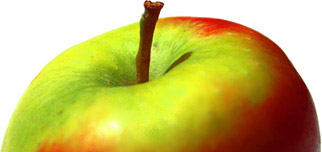

Fiesta is a modern (1970s) English variety from the East Malling Research Station in Kent, sometimes known as Red Pippin. Like many modern apples one of the parents is the classic English Cox's Orange Pippin. Fiesta is a very good substitute for Cox's Orange Pippin in many respects, and whilst it lacks some of the depth and subtlety it is a better choice for the gardener.
The key to the flavour of most modern varieties that have been developed from Cox's Orange Pippin is often found in the other parent. In the case of Fiesta that is Idared, a 1940s American variety which is itself quite similar to Cox. Perhaps it is this similarity which allows the basic Cox flavour to come through quite faithfully in Fiesta.
Fiesta is a medium-sized apple, with the characteristic flecked red and orange flush over yellow - a very attractive autumnal colouring. It is crisper than Cox, and in some ways a more accessible easier-eating apple than its parent. It is also quite juicy and is a very good variety for making your own apple juice from.
The flavour is essentially sweet, but with some of the rich complexity of Cox, and some good acidity too. In an average year Fiesta is merely a good sweet Cox-style apple, but in a year that suits it, Fiesta gets very close indeed to the heights of Cox's Orange Pippin. This can be a really good apple.
Cox is not a great apple for storing, but Idared stores extremely well and can easily last into the following spring in a basic cold store. The longevity of Idared is inherent in Fiesta as well, but although it remains firm, the appealing sweetness seems to disappear after a while - but it remains pleasant to eat fresh and this is definitely a point in its favour.
Fiesta is also an excellent variety for growing in the garden in most parts of the UK, as (unlike Cox) it is easy to grow and crops quite well
The only minor disadvantage is that Fiesta grows in a bizarre straggly fashion, rather more sideways than vertically. This is definitely not a variety to plant as a specimen tree - it has the growth habit of a clematis!
In summary Fiesta is a good choice for the gardener wanting a Cox-style apple without the hassle. It is easier to grow in every respect than Cox's Orange Pippin yet comes very close indeed in the quality of flavour.
Fiesta apple identification images
All images copyright Orange Pippin unless otherwise stated.


USDA identification images for Fiesta
The identification paintings in the USDA Pomological Watercolor Collection span the years 1886 to 1942.
Citation: U.S. Department of Agriculture Pomological Watercolor Collection. Rare and Special Collections, National Agricultural Library, Beltsville, MD 20705.
Parents and other ancestors of this variety
- Cox's Orange Pippin (parent)
- Idared (parent)
Offspring of this variety
- Smitten(distant descendant)
Visitor reviews
- 11 Apr 2025crops heavily good taste superior to cox orange pippin
- 04 Sep 2024I planted a Fiesta tree in my garden 26 years ago, and it has rarely let me down. In all that time I can only recall one fallow year and one year when the fruit was unifomly small. Otherwise it is utterly reliable in giving me a plantiful crop of reasonable sized fruit, much of which I share with grateful neighbours. The big bonus with Fiesta is its storability: each year I pack away sufficient fruit to see me through almost to the next year's harvest, keeping it individually wrapped in newspaper in an old metal filing cabinet in the garage.
- 10 Aug 2022I have a very small tree and it’s only four years old. I moved it from a pot to the ground last year resulting in a very small crop of apples. Despite the weather and very little rain I have well over 30 apples, of a good size. I see it is low growing resulting in heavy branches bending right over. My solution was an upside down obelisk which supports the branches well. A wonder tasting apple.
- 19 Jul 2022I bought and planted a fiesta tree this year and so far the apples 🍏 look very green- when can I expect it to turn red?? Or is it a golden delicious I was sold instead?? Newbie gardener!
- 25 Oct 2020 SHROPSHIRE, United KingdomVery good and Prolific apple, have 35 mature trees on 106. Crops every year of very nice apples.Got approximately 4 tonne this year...which is too many. Going to top work 10 to 15 with Charles Ross in March
- 29 Oct 2016 UNITED KINGDOM, United KingdomI love my Fiesta. I never feed it or water it. It crops heavily. The apples are often HUGE. And I love the sweet-sharp taste and juiciness. Prone to canker and straggly growth. But none the worse for it. I eat as much fresh as I can and microwave the rest without water in a casserole dish. I mash them up a bit with a potato masher, then freeze in half inch thick slabs. I can then either heat up a whole slab as needed, in the microwave, or snap off a bit and do the same. I'm still eating some of last year's! This year's is nearly read for picking.
- 18 Aug 2016 CORNWALL, United KingdomI really like the flavour of this apple and agree with the tasting notes. My tree has a ragged, willow like shape, but is a prolific fruit bearer. It is prone to scab.
- 13 Mar 2015 WASHINGTON, United StatesIt's mid-march and I'm into a box of these that were put into the fridge in October. It has little scab, consistent size, it is crisp, juicy, balanced sweet tart, mild in flavor and scrumptious to gobble up right now. I have no apples in storage that have compared with this delightful blend. I pull these out to share and of course the somewhat shrunken/wrinkley appearance causes folks to look sideways but the first bite and everyone wants there own tree.
- 18 Oct 2014 BC, CanadaBought at the UBC Apple Festival Oct 18, 2014. Very good flavour, crisp, sweet with some complexity of flavours. I don't mind the toughness of skin mentioned by others. In previous years, I've found it goes a bit mushy if kept in the fridge for a couple of months. Eating them fresh this year.
- 12 May 2014 NORFOLK, United KingdomI have one apple tree of this variety which we inherited when we moved and last year the crop was great and I was still eating them in March this year after storing them in our garage. I agree with everyone who say 's they are very tasty apples but agree that you have to peel them first. I don't know if the shape of the tree is the same as other people's tree as ours is like an umbrella shape?
- 19 Feb 2012 SURREY, United KingdomTesco sells these as 'Red Pippin' and I have to say I found them very disappointing. There is a vague coxyness to them but its very diluted and overall the flavour is poor. Its quite similar to Early Windsor, which are usually what Sainsburys sell as their basics apples and is similarly boring. I bought one bag and wont buy another. Many breeders have sought to attain the COP flavour without the COP's drawbacks by crossing COP with something else. I find it unsurprising that few of these are any good. We know that cox came from Ribston Pippin so its a mystery why this isnt used as a parent instead as its clearly the source of those lovely genetics.
- 20 Oct 2011 CAMBRIDGESHIRE, United KingdomThis year's Fiesta apples were ripe much earlier than usual due to the hot spring weather giving way to a very cool summer, with the result that many of my fruit trees panicked, shut down their growth and dropped about half of their leaves in early August! My Fiesta apples began to drop in early September (about two weeks early) and I had harvested them all by mid-September. Fruit quality and flavour was average (not too sharp, not too sweet, slight hint of Cox flavour) but fruit which has recently been coming out of cool storage is now only just about palatable; with very strong flavours of aniseed and/or brandy (rather sweet, spicy and alcoholic). In my climate, the tree and its fruit remain almost pest and disease-free without need for sprays (albeit with a little bitter pit on some fruits). Despite claims that it only has average resistance to powdery mildew, in my very-mildew-prone location it appears to be almost immune, while other trees have been killed or crippled due to being very prone to this fungal menace of spray-free growers. Remarkably, Fiesta also seems to not be particularly attractive to woolly aphids, with no colonies established so far despite some very heavy infestations on some of its neighbouring trees. However, in the last few years my Fiesta has been developing some burr-knotting on the undersides of lower branches which might cause a variety of problems in later years such as partial girdling, canker, or it may allow tunnelling/wood-eating pests to get into the heart of the tree, resulting in a shortened lifespan. On the other hand, the development of burrs as the tree ages could make this variety reasonably easy to proagate from any cuttings which bear these burrs (although the burrs didn't start to appear on my tree until the tree was several years old - and, having tried it; I can state for a fact that cuttings from this tree which don't have those burrs will not root themselves under normal conditions).
- 06 Oct 2010 United KingdomI was surprised to read the word 'tastless' associated with this deliciously tangy apple. Recently available at my local farm shop I think it was one of the nicest English apples I have tasted. Aspects of strawberry and the tartness of Cox apples combine into a very juicy and delicious apple.
- 13 Sep 2010 CAMBRIDGESHIRE, United KingdomWith the first of my Fiesta apples being picked at the moment, I revisited this page. I find that in my area, Fiesta is a good performer of a tree - good regular crops of blemish-free, quality fruit. As often stated: a good garden tree. Disease and frost resistance is plenty adequate in my area (eastern UK). It also doesn't suffer much from pest/insect/maggot damage. It is slightly prone to bitter pit in its younger years, when carrying only a light crop and growing strongly at the same time - no doubt the bitter pit problem is inherited from its very-prone Cox parent. As the tree starts to mature, the bitter pit problem ceases. As mentioned by another poster: Fiesta will often form a spreading, twiggy, untidy or one-sided tree, which can require a bit of pruning effort to shape it. Unfortunately, despite many claims of good flavour, I find the apples to be merely juicy, with no definite flavour. None of my Fiesta's apples have attained a Cox-like flavour. In summary: a good, reliable, relatively trouble-free tree, but the fruit is only fair flavour and the tree has a tendency for one-sided growth.
- 24 Oct 2009 MELBOURN, CAMBRIDGESHIRE, United KingdomMy experience with growing Fiesta is that it is prone to canker.
- 11 Oct 2009 NORFOLK, ENGLAND, United KingdomWe have been told that the willow type apple tree iin my garden is a Fiesta Red Pippin. This year I did prune and we have much larger apples which I think taste like the Cox apple and is very juicy. The skin however is very tough and they are better pealed. I have also cooked these apples and they stay very firm. Does this sound like a Fiesta Red Pippin apple?
- 03 Jun 2008 SOMERSET, United KingdomMy Fiesta is a biennial bearer, but with excellent flavour. The tree itself is very untidy and actually fell over in a storm last year, however it has set a reasonable amount of fruit this year propped up by 2 stakes.
- 26 Jan 2008 PERTHSHIRE, United KingdomWe agree with your tasting notes - keeps well, tastes good. Just now eating last years crop for first time. Also juices well - like several others. Also very fond of Katy for an early one. We have 12 varieties in a small new domestic orchard, in what is typically a soft-fruit area. - Fiesta was amongst the first planted in Jan 1999 as a maiden form Butterworths.
- 12 Nov 2007 SURREY, United KingdomI think Fiesta does not have much taste, and what it does have is unpleasant.
- 11 Oct 2007 IrelandI agree with the above description of this variety. A bit prone to scab, and needs to be well thinned to avoid lots of small apples, but an apple of the highest quality.
Tree register
United States
- Jon Shannon in Shaw Island, WA
- Kim Wratten in Shoreline, WA
- Peter in Johnson City, TN
- Steven Stanley in Johnson City, TN
- Terry Graham in Tumwater, WA
United Kingdom
- A. Madog in Denbigh, DENBIGHSHIRE, N.WALES
- Alan Elsbury in Chippenham, WILTSHIRE
- Alan Turner in Ross-On-Wye, HEREFORDSHIRE
- Alex in Scourie, SUTHERLAND
- Andrew Guille in St Saviour, GUERNSEY
- Andrew Guille in St Saviour, GUERNSEY
- Anthony Payne in Bath,
- Barbara Brown in Gt. Yarmouth, NORFOLK
- Barry Mitchell in Coleraine, LONDONDERRY
- Bill Taylor in Chorley, LANCASHIRE
- Billy Auger in Hopton Wafers, SHROPSHIRE
- Chris in Lancashire, UK
- Christine Bradley in LEICESTER, LEICESTERSHIRE
- Craig Bridge in Lincoln, LINCOLNSHIRE
- Craig Bridge in Lincoln, LINCOLNSHIRE
- Dan in Uxbridge, MIDDLESEX
- David Harmston in Sleaford, LINCS
- David Styles in Hove, EAST SUSSEX
- Deborah Kaufmann in Hyde,
- Deborah Kaufmann in Ashton Under Lyne,
- Elaine Anderson in COLCHESTER, ESSEX
- Eric Hill in Bristol, SOUTH GLOUCESTERSHIRE
- Esther Harding in Queensferry, FLINTSHIRE
- Euan Cameron in LARBERT,
- Gary Christie in Donaghcloney, NORTHERN IRELAND
- Graham Hinchliffe in Eastbourne, EAST SUSSEX
- Hans Butler in Loughborough, LEIESTERSHIRE
- Henryc in Andover, HAMPSHIRE
- Ian Crook in Edinburgh, LOTHIAN
- Ian Dimery in Ripon, NORTH YORKSHIRE
- Ian Scott in Tewkesbury, GLOUCESTERSHIRE
- James Doak in Kingsbridge, DEVON
- Janet Chetwood in Sedbergh, CUMBRIA
- Jason Saberton in Doddington, CAMBS
- John Baker in Llanfairynghornwy, ANGLESEY
- John Dench in Etchingham, EAST SUSSEX
- John Mullen in Kilmarnock, AYRSHIRE
- Julia Lindsey in Durham, DURHAM
- Kevin in Stevenage, HERTFORDSHIRE
- Kevinincornwall in Liskeard, UNITED KINGDOM
- Lexi in Nottingham, CHOOSE AN OPTION
- Malcolm Whitmore in Loughborough, LEICS
- Marian Fitch in Street, SOMERSET
- Martin Wren in Sutton, SURREY
- Mathew Thompson in Brechin, ANGUS
- Matt Brown in Chester, CHESHIRE
- Michael Adams in Halifax, WEST YORKSHIRE
- Mike Channon in Launceston, CORNWALL
- Mike Pearson in Liverpool, MERSEYSIDE
- N. Buck in Cambridge, CAMBRIDGESHIRE
- Nick Miller in London,
- Paul in Ballyclare, CO. ANTRIM
- Paul Knight in Eastleigh, HAMPSHIRE
- Pauline in Longham, NORFOLK
- Pauline Dolby in NORFOLK, ENGLAND
- Pete High in Cumbria
- Peter Kent in Casnewydd, GWENT
- Peters in Sheffield, SOUTH YORKSHIRE
- Rebecca Gilmour-Jones in PEEBLES,
- Richard Borrie in York, YORKSHIRE
- Robert Wagner in Nr Kilmarnock, AYRSHIRE
- Rocky Van De Benderskum in Margate, KENT
- Roy Stephenson in Shiremoor, Newcastle, TYNE AND WEAR
- Simon Pegg in Bellingdon, BUCKS
- Steve Sim in Grange Over Sands, CUMBRIA
- Steve Webster in Truro, CORNWALL
- Stuart Clark in Methil, FIFE
- Stuart Logan in Newbury, BERKSHIRE
- Sylvia Blower in Folkestone, KENT
- Tony in Glasgow, SCOTLAND
- Tv15 in Basingstoke,
France
- Michele Petey in Saint-Paulet-De-Caisson, GARS
Ireland
- Dan Kissane in CO KERRY
- James A Nolan in Glynn,, WEXFORD.
- Patsy Connolly in Galway, IRELAND
Italy
- Melora in Cervia, RAVENNA
Netherlands
- Cheuk A Lam in Amsterdam, NOORD-HOLLAND
- Liz Waters in Amsterdam,
Portugal
- Luis Godinho in Sao Mamede, BATALHA
Spring blossom records for this variety
2025 season
- 16th April 2025 - tree owned by Richard in York, United Kingdom
2024 season
- 18th April 2024 - tree owned by Richard in York, United Kingdom
2022 season
- 28th April 2022 - tree owned by Eric in Bristol, United Kingdom
2020 season
- 27th April 2020 - tree owned by Richard in York, United Kingdom
- 22nd April 2020 - tree owned by Eric in Bristol, United Kingdom
2018 season
- 27th April 2018 - tree owned by David in Hove, United Kingdom
2017 season
- 17th April 2017 - tree owned by Eric in Bristol, United Kingdom
2016 season
- 21st May 2016 - tree owned by Andrew in St Saviour, United Kingdom
- 19th May 2016 - tree owned by Andrew in St Saviour, United Kingdom
- 10th May 2016 - tree owned by Eric in Bristol, United Kingdom
- April 2016 - tree owned by Mike in Launceston, United Kingdom
2015 season
- 12th May 2015 - tree owned by Michael in Halifax, United Kingdom
- 7th May 2015 - tree owned by Richard in York, United Kingdom
- 4th May 2015 - tree owned by Andrew in St Saviour, United Kingdom
- 4th May 2015 - tree owned by Andrew in St Saviour, United Kingdom
- 26th April 2015 - tree owned by Eric in Bristol, United Kingdom
2014 season
- 13th May 2014 - tree owned by Michael in Halifax, United Kingdom
- 1st May 2014 - tree owned by Eric in Bristol, United Kingdom
- 1st May 2014 - tree owned by Ian in Tewkesbury, United Kingdom
- 30th April 2014 - tree owned by Andrew in St Saviour, United Kingdom
- 27th April 2014 - tree owned by Andrew in St Saviour, United Kingdom
- 19th April 2014 - tree owned by Pauline in Longham, United Kingdom
2013 season
- 24th May 2013 - tree owned by Andrew in St Saviour, United Kingdom
- 22nd May 2013 - tree owned by Andrew in St Saviour, United Kingdom
- 16th May 2013 - tree owned by David in Sleaford, United Kingdom
- 13th May 2013 - tree owned by Eric in Bristol, United Kingdom
2012 season
- 9th May 2012 - tree owned by Andrew in St Saviour, United Kingdom
- 9th May 2012 - tree owned by Andrew in St Saviour, United Kingdom
- May 2012 - tree owned by Pauline in Longham, United Kingdom
- 26th April 2012 - tree owned by Eric in Bristol, United Kingdom
- 26th April 2012 - tree owned by Dan in Uxbridge, United Kingdom
2011 season
- 26th April 2011 - tree owned by Malcolm in Loughborough, United Kingdom
- 22nd April 2011 - tree owned by Eric in Bristol, United Kingdom
- 22nd April 2011 - tree owned by Andrew in St Saviour, United Kingdom
- 18th April 2011 - tree owned by Dan in Uxbridge, United Kingdom
- 15th April 2011 - tree owned by David in Sleaford, United Kingdom
- 13th April 2011 - tree owned by Alan in Chippenham, United Kingdom
2010 season
- 7th May 2010 - tree owned by Matt in Chester, United Kingdom
- 5th May 2010 - tree owned by Stuart in Newbury, United Kingdom
- 4th May 2010 - tree owned by N. in Cambridge, United Kingdom
- 3rd May 2010 - tree owned by Marian in Street, United Kingdom
- 17th April 2010 - tree owned by David in Sleaford, United Kingdom
2009 season
- 25th April 2009 - tree owned by N. in Cambridge, United Kingdom
- April 2009 - tree owned by Malcolm in Loughborough, United Kingdom
Record your blossom dates in our Fruit Tree Register - more >>.
Harvest records for this variety
2024 season
- 2nd week October 2024 - tree owned by Richard in York, United Kingdom
2019 season
- 4th week September 2019 - tree owned by Jon in Shaw Island, United States
2018 season
- 4th week September 2018 - tree owned by Jon in Shaw Island, United States
2017 season
- 3rd week September 2017 - tree owned by Jon in Shaw Island, United States
- 1st week September 2017 - tree owned by Sylvia in Folkestone, United Kingdom
2016 season
- 3rd week September 2016 - tree owned by Jon in Shaw Island, United States
2015 season
- 1st week October 2015 - tree owned by Andrew in St Saviour, United Kingdom
- 1st week October 2015 - tree owned by Andrew in St Saviour, United Kingdom
- 4th week September 2015 - tree owned by Jon in Shaw Island, United States
2014 season
- 4th week September 2014 - tree owned by Jon in Shaw Island, United States
- 4th week September 2014 - tree owned by Andrew in St Saviour, United Kingdom
- 4th week September 2014 - tree owned by Andrew in St Saviour, United Kingdom
2013 season
- 3rd week September 2013 - tree owned by Jon in Shaw Island, United States
2012 season
- 2nd week October 2012 - tree owned by Pauline in Longham, United Kingdom
- 1st week October 2012 - tree owned by Andrew in St Saviour, United Kingdom
- 1st week October 2012 - tree owned by Andrew in St Saviour, United Kingdom
- 1st week October 2012 - tree owned by Kim in Shoreline, United States
- October 2012 - tree owned by Julia in Durham, United Kingdom
- 3rd week September 2012 - tree owned by Jon in Shaw Island, United States
2010 season
- 3rd week October 2010 - tree owned by Matt in Chester, United Kingdom
- October 2010 - tree owned by Pauline in , United Kingdom
2009 season
Origins
- Species: Malus domestica - Apple
- Parentage: Cox's Orange Pippin and Idared
- Originates from: United Kingdom
- Introduced: 1972
- Developed by: East Malling Research
- UK National Fruit Collection accession: 1983-038
Identification
- Awards: RHS AGM (current)
- Country of origin: United Kingdom
- Period of origin: 1950 - 1999
- Fruit colour: Orange flush
- Flower colour: Pink - light
- Leaf colour: Green
- Popularity: Best sellers
- Annual cycle: Deciduous
Using
- Picking season: Late
- Keeping (of fruit): 3 months or more
- Flavour quality: Good
- Flavour style (apples): Aromatic
- Discoloration of fruit: Oxidising
- Cropping: Heavy
- Fruit persistence: Normal ripening
- Food uses: Eating fresh
- Food uses: Juice
- Picking period: mid-October
- Wildlife: RHS Plants for Pollinators
Growing
- Gardening skill: Beginner
- Flowering group: 3
- Pollinating others: Average
- Ploidy: Diploid
- Vigour: Average vigour
- Bearing regularity: Regular
- Fruit bearing: Spur-bearer
- Organic culture: Suitable
- Self-fertility: Partially self-fertile
Climate
- Frost resistance of blossom: Good resistance
- Climate suitability: Temperate climates
- Summer average maximum temperatures: Cool ( 20-24C / 68-75F)
- Summer average maximum temperatures: Warm (25-30C / 76-85F)
- Cold hardiness (RHS): H6 (to -20C)
Other qualities
- Disease resistance: Average
- Powdery mildew: Some resistance
- Canker: Some susceptibility
- Bitter pit: Some susceptibility
Where to buy trees
The following tree nurseries offer Fiesta apple trees for sale:
- Orange Pippin Fruit Trees (UK) United Kingdom
Fiesta apple trees - Cummins Nursery
United States More >>
Where to buy fresh fruit
The following orchards grow Fiesta:
United States
Washington
- Skipley Farm, Snohomish *** Feature Orchard ***
United Kingdom
England - midlands
- Meynell Langley Trials Gardens, Derby
- The Vyne, Basingstoke
- Cotteridge Community Orchard, Birmingham
- Walsgrove Farm, Worcester
England - south-east
- Home Cottage Farm, Iver
- Kimpton Manor Apple Press, Andover
England - south-west
- Charlton Orchards, Taunton
Canada
British Columbia
- Dragonfly Farm, Salt Spring Island
- Riley Creek Farm, Lillooet
- Salt Spring Apple Company, Salt Spring Island
- Swallow Hill Farm and Orchard, Metchosin
References
- Fruit Expert
Author: Hessayon