
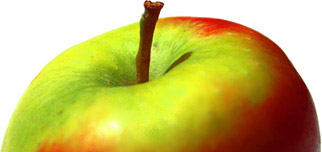

Laxton's Superb is a classic and popular English-style variety from the late Victorian period, one of the high-points in the development of English apples. Laxton Brothers were important breeders at this time and this is probably their most important variety.
Laxton's Superb is essentially a Cox-style apple, but with an interesting twist in flavour inherited from its other parent Wyken Pippin, which had been popular since the 18th century but is now little known. The shape is much more upright than the flattened signature of Cox, and is reminiscent of Adams Pearmain. The colour is dull red flush over green - attractive in a subdued way.
The white-green flesh is quite dense and sweet, and very "appley". The texture is firm rather than crisp, and there is not a lot of juice. Not perhaps characteristics that would endear it to a modern audience, but nevertheless it is actually quite appealing. Like several older varieties it somehow tastes better if you cut it with a knife and eat it in slices or wedges rather than biting into it.
Laxton's Superb represented the state of the art of in English apples at the start of the 20th century, and it is fascinating to compare it with the new varieties such as Meridian and Saturn which have come through at the end of the century. All these varieties use Cox's Orange Pippin as a starting point, but the appearance and combination of flavours in Laxton's Superb makes it very different from the up-front appeal of most modern varieties.
Laxton's Superb apple identification images
All images copyright Orange Pippin unless otherwise stated.

USDA identification images for Laxton's Superb
The identification paintings in the USDA Pomological Watercolor Collection span the years 1886 to 1942.
Citation: U.S. Department of Agriculture Pomological Watercolor Collection. Rare and Special Collections, National Agricultural Library, Beltsville, MD 20705.
Parents and other ancestors of this variety
- Cox's Orange Pippin (parent)
- Wyken Pippin (parent)
Offspring of this variety
Visitor reviews
- 13 Oct 2024Loved it, but on one point I would disagree... very juicy!
- 13 Oct 2022I encountered these growing in a Kent orchard in the late seventies. Tasted one straight from the tree. Best apple I ever tasted, never surpassed.
- 20 Sep 2021 WALES, UK, United KingdomFrom our tree about 25 years old. Best eater I've ever tasted. Crops hugely every year. For some reason, it tastes best when peeled and sliced rather than just bitten into.
- 24 Aug 2014 KENT, United KingdomMine is a very old tree, so old that I cut it to the ground about 20 years ago and it came up strong! Now crops every two years. Bumper crop this year 2014.
- 08 May 2014 ARGYLL, United KingdomEnjoyed reading all your comments, and picked up a few good tips. We live down in the Mull of Kintyre and have this year planted a Mini Orchard with the following: Laxton Superb/ James Grieves/ Malus Sylvestris{Wild Crab Apple/ Medlar Westerveldt/ Victoria Plum/ Pershore Plum. I am very excited at the prospect of growing, learning and hopefully harvesting our own fruit. But please wish us luck because we get a lot of wind down here. Are any of you in the same situation?
- 24 Oct 2013 DUBLIN, IrelandLive in a late Victorian terraced house and am the proud owner of a Laxton's Superb. Had major problems with Codling moth 15 years ago when I moved in. Greasebanded and started feeding birds. The balance has been restored with very few infected apples. Grew up with large orchard and wide variety but Laxton's is my favourite. Have 2 for my lunch today.
- 11 Apr 2013 NOTTINGHAMSHIRE, United KingdomI moved house in 2011 to one which has a Laxton Superb tree in the garden, at a guess maybe about 12-15 years old. 2011 season was exceptional - large quantity of delicious apples, wonderful flavour. 2012 season was a disaster - not a single apple, most probably the late frost saw to that. Here's hoping for a bumper 2013.
- 28 Aug 2011 SHEFFORD, United KingdomInterested to see Michael Strawson's comments above. When I lived in Bedford I lived in a house built on the ground where the Laxton Superb was developed. So when I moved house I planted one and have not got one single apple off it before it went rotten! Very disapppointed. I'm thinking of cutting it down - but reluctant.
- 07 Oct 2010 CAMBRIDGESHIRE, United KingdomLaxton's Superb is quite prone to scab. I live in one of the drier and milder parts of the UK (where scab attack is relatively mild), but my Laxton Superb loses most of the fruit to split skins as a result of scab infection. The splits then allow other rots or insects to attack the fruit. Definitely *NOT* recommended for spray-free growing due to scab susceptibility. My own Laxton's Superb is likely to be re-grafted with a more scab-resistant variety.
- 07 Oct 2010 SOMERSET, United KingdomLove this variety, superbe by name, superbe by taste. We planted the tree 10 years ago and got a large crop this year, but most of them are either full of insects rotting on the tree. What are we doing wrong?
- 27 Apr 2010 ESSEX, United Kingdomi have a laxton's superb apple, but it only bears apples every other year,is this normal ,or is there something i can do to encourage it to bear fruit yearly,i planted it october 1987
- 07 Aug 2009 LINCS, United KingdomI first tasted this wonderful apple when I bought a house in Bedford which had been owned by one of the Laxton brothers. There were two trees in the garden. I now have one at my home in lincolnshire and it is in it's second season, producing well. I hope I can restrain myself and not start picking too early!
- 21 May 2009 BRADFORD, United KingdomThe only time I have ever found these apples , was at a friutiers in Tyseley , Brum ......most delicious ! Always looking for more , but will plant a tree now .
- 12 May 2009 PRESTON, United KingdomYou should get a crop after the first season since planting.
- 24 Mar 2009 BRIGHTON, United KingdomI have just purchased a Laxton's Superb from B&Q for £14.95 if anyone is still looking for this variety. Does anyone know how long I can expect to wait for a crop?
- 18 Nov 2008 PRESTON LANCS PR44, United KingdomI have a 15 year old tree, yealded 400 apples last year. They keep until end of March. Just cut up & Microwave till soft. Only 100 thiis year Lovely flavour.Need lesson on Pruning. Which apple woud be good partner?
- 13 Oct 2008 GOSFORD, NSW.., AustraliaAs a child growing up in Holyhead, Anglesey dad had a Laxton Superb tree in the back garden and the fruit was the best. Recently re-acquainted myself with the taste of Cox's Orange Pippin on a visit to the UK, almost as good. Trying to find grower/dsitributor in OZ of either tree.
- 13 Jun 2008 BLACKPOOL, United Kingdomhi peggy mullally due to your comments i have bought a laxtons superb in blackpool at a local garding center its call baguleys garden center in blackpool
- 25 Nov 2007 BRIDGEND, S. WALES, United KingdomMy father had a laxtons Fortune (early eater) and a Laxtons Superb (late Keeper) both were wonderful. 10 years ago we bought aLaxtons Superb tree, this year due to weather was the best crop ever, full of juice and overladen. I agree it's the best apple ever. Can't we bring it back as a national British apple and beat the french. Help to stop imports, etc.
- 01 Nov 2007 United KingdomI found Laxton Superb apples in Sainsbury's on Monday, absolutely delicious, I prefer them to all of the other apple varieties I've bought recently. Check out your local store Peggy! They were supplied by Boxford Farms in Suffolk.
- 31 Oct 2007 CORNWALL, United KingdomI have an old apple tree at the bottom of the garden and a knowledgeable friend reckons it's a Laxton's Superb. Fruiting better than ever this year - I guess whatever the weather something benefits! And welcome lack of autumn gales means most of the apples have stayed on the tree for once. I have just eaten a couple of the apples - beautiful taste, the way they should be.
- 29 Oct 2007 NORFOLK, United KingdomJust bitten into an apple from the old tree growing against the back wall in my garden. Utterly delicious and It must be the summer we've had - it was dripping with juice.
- 19 Oct 2007 LETCHWORTH GARDEN CITY, HERTS, United KingdomWe have a Laxton tree in our garden and this year it is so overladened that we cannot use the apples! We are giving them away to anyone who likes them, and a lot do, because we do not want to waste them. The house is about 90 years old, the tree must have been there a long time. Mrs Mullally is welcome to some if she is every up our way.
- 15 Oct 2007 LEAMINGTON SPA, United KingdomWe had a Laxton's superb apple tree in our garden when I was a child in the 40's. It is to my mind, the most delicious apple that I have ever had the pleasure of eating. My big disappointment in life, is that I have never ever found anywhere that sells them since. Please tell me if you can, where I can purchase them. I will be forever grateful.
- 03 Aug 2007 United KingdomJust tasted our Laxton's Superb, first crop, totally agree with your description, superb
Tree register
United States
- Elisa Herbert in HICKORY, NC
- Jo Elsmore in BLOORS,
- Jon Shannon in Shaw Island, WA
United Kingdom
- Alison Underwood in Colwyn Bay, NORTH WALES
- Amphibian in Weavering, KENT
- Andy Chaplin in Sheffield, SOUTH YORKSHIRE
- Andy Davice in Oxford, OXFORDSHIRE
- Barrie in Barnehurst, KENT
- Barry Mitchell in Coleraine, LONDONDERRY
- Beccy Bishop in Bexhill-On-Sea, EAST SUSSEX
- Ben in Peterborough, LINCOLNSHIRE
- Bill Barker And Sharon Cherry in Leicester, CHERRYLEATHER@GOOGLEMAIL.COM
- Cath in Kirkcaldy, FIFE
- Chris Hutchinson in Bedford, BEDFORDSHIRE
- Claire in LANCASTER, LANCASHIRE
- Clive Seabury in Wellington, SHROPSHIRE
- Colin Bowen in
- Danny Apps in Lochore, FIFE
- David Coxon in Ipswich, SUFFOLK
- David Harmston in Ewerby Thorpe, Sleaford, LINCS
- David Porter in POOLE, DORSET
- David Sinclair-Jones in London,
- David Storer in Oldmeldrum, ABERDEENSHIRE
- David Wilkinson in HEYTESBURY, WILTSHIRE
- Deborah Kaufmann in Hyde,
- Delia Bethell in OXFORD,
- Denise in WEST SUSSEX
- Dougas Wilson in Perth,
- Ed Beadle in Cheser,
- Frank Mcconnell in Swanley, KENT
- Fred Bloggs in Whitstable, KENT
- Graeme Coates in Standlake, OXON
- Graham Jones in Beverley, EAST YORKSHIRE
- Helen Kershaw in Liverpool, MERSEYSIDE
- Helen Parker in Southampton, HANTS
- Henryc in Andover, HAMPSHIRE
- Ian Crook in Edinburgh, LOTHIAN
- Ian Robertson in Ipswich, SUFFOLK
- Ivor Kiverstein in Pulborough, WEST SUSSEX
- Jane in Shrewsbury, SHROPSHIRE
- Jean Lippett in Martock, SOMERSET
- Jessie Lei in Betchworth, UK
- John Adams in Alvechurch, WEST MIDLANDS
- John Baker in Llanfairynghornwy, ANGLESEY
- John Carr in Leatherhead, SURREY
- Jon Drakes in Keelby, LINCOLNSHIRE
- Jon Drakes in Keelby, LINCOLNSHIRE
- Karenjo Worthington in Lancaster, LANCASHIRE
- Keith Pickering in Helmsley, York, NORTH YORKSHIRE
- Kevinincornwall in Liskeard, UNITED KINGDOM
- Lydia Guy in DARTMOUTH, DEVON
- Lyn Eryl Jones in Cambridge, CAMBRIDGESHIRE
- Malcolm Goodwin in Eye, SUFFOLK
- Mandy Russell in Bedford, BEDS
- Mandy Russell in Bedford, BEDS
- Margaret Brooker in Ellerker, EAST YORKSHIRE
- Margaret Pollock in STIRLING, STIRLINGSHIRE
- Mark in Chippenham, WILTS
- Martin A Smith in Petersfield, HAMPSHIRE
- Martin Timms in Baldock, HERTFORDSHIRE
- Mary Frew in NORFOLK
- Matthew Pennington in Bristol, NORTH SOMERSET
- Mel in Luddendenfoot Halifax, WEST YORKSHIRE
- michaelviola@btinternet.com in Bracknell, BERKSHIRE
- Mike Galtrey in Godalming, SURREY
- Mike Pearson in Liverpool, MERSEYSIDE
- Mrs Veronica Edwards in Lyonshall, HEREFORDSHIRE
- N. Buck in Cambridge, CAMBRIDGESHIRE
- Norman Dickinson in Lewes, EAST SUSSEX
- Owen Roberts in Reepham, NORFOLK
- Paul F Darlington in Preston, LANCS
- Paul Smith in Chatteris, CAMBRIDGESHIRE
- Pete Lucas in Burbage, WILTSHIRE
- Peter Evans in Northwich, CHESHIRE
- Peter Revell in Hemel Hempstead, HERTS
- Ray Symons in London,
- Rebecca Gray in
- Richard in Needham Market, SUFFOLK
- Sally Heron in Kirriemuir, ANGUS
- Simon Lampitt in Malvern, WORCESTERSHIRE
- Simon Lampitt in Malvern, WORCESTERSHIRE
- Stephen Mann in Ripon, YORK
- Steve Dewsberry in Nottingham, NOTTINGHAMSHIRE
- Sue Kendall in ILFRACOMBE, DEVON
- Suzanne Mcnally in Banbury, OXON
- Terry in Blackpool, LANCASHIRE
- Tim Brown in Randalstown, CO ANTRIM
- Vin Heron in EAST TORRINGTON, LINCOLNSHIRE
- Wayne Seagate in Watlington, NORFOLK
Denmark
- Hanne Olsen in Kgs. Lyngby,
France
- Deborah (Debbi) Baron in Saint Julien Aux Bois, CORREZE
Ireland
- Lars Christoffersen in TRIM,
- Stephen Shanley in Dublin,
Netherlands
- Cheuk A Lam in Amsterdam, NOORD-HOLLAND
Australia
- Hayden in Winslow, VICTORIA, AUSTRALIA
- Nicola Griffiths in Teesdale, VICTORIA
Spring blossom records for this variety
2022 season
- 26th April 2022 - tree owned by Mike in Godalming, United Kingdom
2020 season
- 24th April 2020 - tree owned by Mike in Godalming, United Kingdom
2018 season
- 6th May 2018 - tree owned by Mike in Godalming, United Kingdom
- 6th May 2018 - tree owned by Bill in Leicester, United Kingdom
2017 season
- 1st May 2017 - tree owned by Bill in Leicester, United Kingdom
- 25th April 2017 - tree owned by Mike in Godalming, United Kingdom
2016 season
- 10th May 2016 - tree owned by Mike in Godalming, United Kingdom
- 9th May 2016 - tree owned by Bill in Leicester, United Kingdom
- May 2016 - tree owned by Jane in Shrewsbury, United Kingdom
2014 season
- 5th May 2014 - tree owned by Helen in Liverpool, United Kingdom
- 4th May 2014 - tree owned by Beccy in Bexhill-On-Sea, United Kingdom
- 30th April 2014 - tree owned by Ed in Cheser, United Kingdom
- 30th April 2014 - tree owned by Hanne in Kgs. Lyngby, Denmark
- 27th April 2014 - tree owned by Norman in Lewes, United Kingdom
- 25th April 2014 - tree owned by Mike in Godalming, United Kingdom
- 7th April 2014 - tree owned by David in London, United Kingdom
2013 season
- 22nd May 2013 - tree owned by David in Ewerby Thorpe, Sleaford, United Kingdom
- 19th May 2013 - tree owned by Jean in Martock, United Kingdom
- 13th May 2013 - tree owned by Mike in Godalming, United Kingdom
2012 season
- 11th May 2012 - tree owned by Mike in Godalming, United Kingdom
- 19th April 2012 - tree owned by John in Leatherhead, United Kingdom
2011 season
- 29th April 2011 - tree owned by Hanne in Kgs. Lyngby, Denmark
- 26th April 2011 - tree owned by John in Leatherhead, United Kingdom
- 24th April 2011 - tree owned by Mary in , United Kingdom
- 22nd April 2011 - tree owned by Ed in Cheser, United Kingdom
- 18th April 2011 - tree owned by Keith in Helmsley, York, United Kingdom
- 18th April 2011 - tree owned by Graeme in Standlake, United Kingdom
2010 season
- 5th May 2010 - tree owned by John in Leatherhead, United Kingdom
- 4th May 2010 - tree owned by Jon in Keelby, United Kingdom
- 4th May 2010 - tree owned by Jon in Keelby, United Kingdom
- 1st May 2010 - tree owned by N. in Cambridge, United Kingdom
- 29th April 2010 - tree owned by Simon in Malvern, United Kingdom
- 28th April 2010 - tree owned by Simon in Malvern, United Kingdom
- April 2010 - tree owned by Lyn in Cambridge, United Kingdom
2009 season
- 7th May 2009 - tree owned by John in Leatherhead, United Kingdom
- May 2009 - tree owned by Lyn in Cambridge, United Kingdom
- May 2009 - tree owned by Ed in Cheser, United Kingdom
- 20th April 2009 - tree owned by N. in Cambridge, United Kingdom
- March 2009 - tree owned by Norman in Lewes, United Kingdom
Record your blossom dates in our Fruit Tree Register - more >>.
Harvest records for this variety
2023 season
- 3rd week August 2023 - tree owned by Helen in Liverpool, United Kingdom
2020 season
- 3rd week October 2020 - tree owned by Mike in Godalming, United Kingdom
2018 season
- 1st week October 2018 - tree owned by Mike in Godalming, United Kingdom
2017 season
- 1st week October 2017 - tree owned by Bill in Leicester, United Kingdom
2016 season
- 3rd week October 2016 - tree owned by Mike in Godalming, United Kingdom
- 1st week October 2016 - tree owned by Bill in Leicester, United Kingdom
- September 2016 - tree owned by Jane in Shrewsbury, United Kingdom
2015 season
- 3rd week October 2015 - tree owned by Mike in Godalming, United Kingdom
- 2nd week October 2015 - tree owned by Helen in Southampton, United Kingdom
2014 season
- 1st week October 2014 - tree owned by Mike in Godalming, United Kingdom
- October 2014 - tree owned by Helen in Liverpool, United Kingdom
2013 season
- 1st week November 2013 - tree owned by Mrs Veron in Lyonshall, United Kingdom
- 2nd week October 2013 - tree owned by Graeme in Standlake, United Kingdom
- 1st week October 2013 - tree owned by Mike in Godalming, United Kingdom
2012 season
- 1st week October 2012 - tree owned by michaelviola@btinternet.com in Bracknell, United Kingdom
- 1st week October 2012 - tree owned by Mike in Godalming, United Kingdom
2011 season
- 2nd week October 2011 - tree owned by Mandy in Bedford, United Kingdom
- October 2011 - tree owned by Beccy in Bexhill-On-Sea, United Kingdom
- October 2011 - tree owned by Helen in Southampton, United Kingdom
- 1st week September 2011 - tree owned by Steve in Nottingham, United Kingdom
- 3rd week August 2011 - tree owned by John in Leatherhead, United Kingdom
- 1st week January 2011 - tree owned by Nicola in Teesdale, Australia
2010 season
- October 2010 - tree owned by Beccy in Bexhill-On-Sea, United Kingdom
- October 2010 - tree owned by Lyn in Cambridge, United Kingdom
- 3rd week September 2010 - tree owned by Keith in Helmsley, York, United Kingdom
- 2nd week September 2010 - tree owned by John in Leatherhead, United Kingdom
2009 season
- 2nd week October 2009 - tree owned by Peter in Northwich, United Kingdom
- October 2009 - tree owned by Lyn in Cambridge, United Kingdom
- October 2009 - tree owned by N. in Cambridge, United Kingdom
- 2nd week September 2009 - tree owned by Keith in Helmsley, York, United Kingdom
- 2nd week September 2009 - tree owned by John in Leatherhead, United Kingdom
- September 2009 - tree owned by Ed in Cheser, United Kingdom
- August 2009 - tree owned by Norman in Lewes, United Kingdom
Origins
- Species: Malus domestica - Apple
- Parentage: Cox x Wyken Pippin
- Originates from: Bedford, England, United Kingdom
- Introduced: 1897
- Developed by: Laxton Brothers Nursery
- UK National Fruit Collection accession: 1979-170
Identification
- Country of origin: United Kingdom
- Period of origin: 1850 - 1899
- Fruit colour: Orange / Red
- Leaf colour: Green
- Popularity: Best sellers
- Annual cycle: Deciduous
Using
- Picking season: Late
- Keeping (of fruit): 1-2 months
- Flavour quality: Good
- Flavour style (apples): Sweeter
- Discoloration of fruit: No discoloration (Good for drying)
- Vitamin C content: Low
- Cropping: Heavy
- Fruit persistence: Normal ripening
- Food uses: Eating fresh
- Picking period: early October
- Wildlife: RHS Plants for Pollinators
Growing
- Gardening skill: Average
- Flowering group: 4
- Pollinating others: Average
- Ploidy: Diploid
- Vigour: Slightly large
- Bearing regularity: Biennial tendency
- Fruit bearing: Spur-bearer
- Self-fertility: Partially self-fertile
Climate
- Cold hardiness (USDA): Zone 4 (-34C)
- Climate suitability: Temperate climates
- Summer average maximum temperatures: Cool ( 20-24C / 68-75F)
- Summer average maximum temperatures: Cold (< 20C / 67F)
Other qualities
- Disease resistance: Average
Where to buy trees
The following tree nurseries offer Laxton's Superb apple trees for sale:
- Orange Pippin Fruit Trees (USA) United States
Laxton's Superb apple trees - Orange Pippin Fruit Trees (UK) United Kingdom
Laxton's Superb apple trees - Cummins Nursery
United States More >>
Where to buy fresh fruit
The following orchards grow Laxton's Superb:
United States
Maine
- Tiny Orchards, Saco
United Kingdom
England - midlands
- Walsgrove Farm, Worcester
England - north
- Pickering Road Community Orchard, Hull
- Holly Mount Orchard, Bury
- Lockwood Hey Orchard, Saddleworth
England - south-east
- Home Cottage Farm, Iver
- Kimpton Manor Apple Press, Andover
- Holton Orchards, Halesworth
Netherlands
Noord-Holland
- Het Keetje, Westwoud
References
- Apples of England (1948)
Author: Taylor - Fruit Expert
Author: Hessayon