
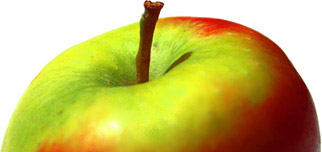
Small, firm early apple. Very good dessert quality. Often known as Laxton's Epicure.
USDA identification images for Epicure
The identification paintings in the USDA Pomological Watercolor Collection span the years 1886 to 1942.
Citation: U.S. Department of Agriculture Pomological Watercolor Collection. Rare and Special Collections, National Agricultural Library, Beltsville, MD 20705.
Parents and other ancestors of this variety
- Cox's Orange Pippin (parent)
- Wealthy (parent)
Offspring of this variety
Visitor reviews
- 30 Oct 2017 NY, United StatesI hope to have 5 scion coming the spring 0f 2018 of this cultivar. Grafting it onto G890 Root stock and hoping that they take off. Never done any grafting before but I've got to start sometime.
- 18 Aug 2017 United KingdomWe think our tree is probably an Epicure. Certainly looks like the picture and is ripe now, on a smallish tree. It has a boring insect (?) problem. Many of the fruit are so infected and, turning much redder, fall off early, leaving the non infected, yellowish green ones with slight mottled red linear patterns to ripen fully on the tree.
- 20 Oct 2011 CAMBRIDGESHIRE, United KingdomFruits on my tree have been ripening slightly later than many claim and, rather than being "early", it is more like "early-mid" - for example, in my climate Beauty of Bath is ready in late July, Discovery is ready in early August and Epicure is not ready until late August. Fruit quality is quite good for an early(ish) variety but Epicure fruits absolutely must to be left on the tree to ripen for as long as possible - even better if they drop, which signals that they are ready. They must be allowed to change colour to yellow background with some orage stripes. Unripe windfalls may be able to be ripened in the sun for several days. Fortunately, when it comes to ripening on the tree - unlike many other earlies which get eaten by wasps and other insects - Epicure apples seem much less prone to pest damage than other earlies, so can be left on the tree for longer, to ripen more fully, without as much worry of heavy losses to insects which are usually sustained by the likes of Discovery. The tree itself is about medium vigour but also very precocious (and apparently quite fertile) which could easily reduce final tree size if allowed to fruit early in life. Even before a spur system is built-up, a young Epicure (even on vigorous roots) will often fruit on the tips of unpruned one-year-old shoots. One notable feature of this tree is its unusually large leaves. The tree has slightly above average overall resistance to diseases and I do not spray. If it has a weakness, it might be canker, which is not so much of a problem in my relatively low-rainfall climate (although my low-fertility soil reduces plant health and reduces their disease resistance).
Tree register
United Kingdom
- Alison Underwood in Colwyn Bay, NORTH WALES
- David in Hereford,
- Douglas Silverstone in Chesham, BUCKS
- Fred Bloggs in Whitstable, KENT
- Graham Charles Schofield in Newmarket, SUFFLOK
- Henryc in Andover, HAMPSHIRE
- Margaret Brooker in Ellerker, EAST YORKSHIRE
- Martin A Smith in Petersfield, HAMPSHIRE
- Matthew Pennington in Bristol, NORTH SOMERSET
- N. Buck in Cambridge, CAMBRIDGESHIRE
- N. Buck in
- Nick Burrows in Stubbs Walden, NORTH YORKSHIRE
- Nigel in CAMBRIDGE, CAMBRIDGESHIRE
- Peter Revell in Hemel Hempstead, HERTS
- Sally in DERBYSHIRE
- Suzanne Mcnally in Banbury, OXON
- Tony Burch in Blandford Forum, DORSET
- Tony Hedge in Streatley, BERKSHIRE
Netherlands
- Cheuk A Lam in Amsterdam, NOORD-HOLLAND
Australia
- Hayden in Winslow, VICTORIA, AUSTRALIA
Spring blossom records for this variety
2022 season
- 4th May 2022 - tree owned by Cheuk in Amsterdam, Netherlands
2013 season
- April 2013 - tree owned by Tony in Streatley, United Kingdom
Record your blossom dates in our Fruit Tree Register - more >>.
Harvest records for this variety
Origins
- Species: Malus domestica - Apple
- Parentage: Wealthy x Cox's Orange Pippin
- Originates from: Bedford, United Kingdom
- Introduced: 1909
- Developed by: Laxton Brothers Nursery
- UK National Fruit Collection accession: 2006-013
Identification
- Country of origin: United Kingdom
- Period of origin: 1900 - 1949
- Awards: RHS AM
Using
- Picking season: Early
Growing
- Flowering group: 3
- Vigour: Slightly small
Where to buy fresh fruit
No orchards have registered as growing this variety. If you grow this and want to register please go to our Orchard Registration form.
References
- Apples of England (1948)
Author: Taylor - Fruit Expert
Author: Hessayon