
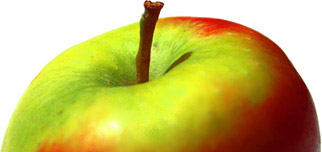

Pixie is a small apple which is big on flavour. The exact parentage is not known, but it is thought to be Cox's Orange Pippin or Sunset. Since Sunset is also an offspring of Cox it is not surprising that Pixie both looks and tastes very similar to Cox. The flavour is extremely good, tending to be slightly sharper than a Cox, especially just after picking - but it's a refreshing sharpness and certainly not acidic. Pixie is also juicier and crisper than a Cox.
As its name suggests, Pixie tends to be a rather small apple, and for this reason it is not grown commercially. However it makes an ideal apple tree for the garden, since it grows easily and crops well without much effort required on the part of the gardener! It is also resistant to the main diseases of apples, scab and mildew. The main problem is a tendency to over-crop and produce lots of very small apples, but this can be prevented by simply removing a lot of the fruitlets immediately after the tree has blossomed, and in this way some good-sized apples can be produced. Pixie also seems to grow well on dwarfing rootstocks such as M9 and M27, so it will fit in quite a small space.
Pixie is one of the later-ripening varieties, and is ready for picking around the middle of October. It tastes nice straight from the tree, but like many late varieties it also keeps well. In fact, in good conditions the flavour can improve, up to December or January - put the apples in plastic bag with a few holes in, and store in a refrigerator or a cold but frost-free outbuilding.
Anyone who likes a Cox-style apple will definitely appreciate Pixie, and it undoubtedly belongs to the small band of Cox-style apples which come close to the balance and depth of their illustrious parent.
Pixie apple identification images
All images copyright Orange Pippin unless otherwise stated.

USDA identification images for Pixie
The identification paintings in the USDA Pomological Watercolor Collection span the years 1886 to 1942.
Citation: U.S. Department of Agriculture Pomological Watercolor Collection. Rare and Special Collections, National Agricultural Library, Beltsville, MD 20705.
Parents and other ancestors of this variety
Visitor reviews
- 13 Nov 2020 DEVON, United KingdomWe inherited this in a mixed small orchard in N Devon 6 years ago, it was already mature. It is on a vigorous standard rootstock and unthinned it produces thousands of small apples but thinned they grow to a good [supermarket standard] size. Delicious for anyone who like a crisp cox type apple. Stored last year, lightly wrapped in a shaded wooden shed until March and definitely better after some storage in my opinion. We get some surface mould and pits but I think this is orchard neglect, not a variety problem as all our apples suffer with it at the moment.
- 04 Jan 2015 NOTTINGHAMSHIRE, United KingdomWe have had excellent crops for 3 years since planting and find the sharp/sweet taste, crispness and juicy texture all first rate. We had over 60 apples this year; last year I had to lash the two main branches together to allow the tree to hold the weight of the crop! The size of the fruit is also in no way small, I would say a good medium- our soil is fairly heavy - old mushroom field- but overlying well-drained sandstone. Also, so far, touch wood, no disease.
- 16 Aug 2014 United KingdomNice apple but VERY susceptible to disease in our warm wet climate.
- 11 Oct 2013 United StatesExcellent late season Cox, crops and stores very well
Tree register
United States
- Jo Elsmore in BLOORS,
United Kingdom
- Cathiegreig in Glenrothes, FIFE
- Christiane in SHUDY CAMPS, CAMBRIDGESHIRE
- David Harmston in Ewerby Thorpe, Sleaford, LINCS
- David Sinclair-Jones in London,
- Don Barton in Stourport-On-Severn, WORCESTERSHIRE
- Elizabeth Moriarty in Oxford, OXON
- Gary Christie in Donaghcloney, NORTHERN IRELAND
- Jean Lippett in Martock, SOMERSET
- John Adams in Alvechurch, WEST MIDLANDS
- John Ellis in Salisbury, WILTSHIRE
- Mark Beverley in Berwick Bassett, WILTSHIRE
- Pamela in Bressingham, NORFOLK
- Peter Revell in Hemel Hempstead, HERTS
- Phil in Stoke-On-Trent, STAFFS
- Richard Borrie in York, YORKSHIRE
- Steve Sim in Grange Over Sands, CUMBRIA
- Sue Kendall in ILFRACOMBE, DEVON
- Sue Morris in Maidstone, KENT
- Terry Smith in Huntingford, DORSET
Spring blossom records for this variety
2014 season
- 13th April 2014 - tree owned by David in London, United Kingdom
2013 season
- 23rd May 2013 - tree owned by Richard in York, United Kingdom
- 22nd May 2013 - tree owned by Jean in Martock, United Kingdom
- 10th May 2013 - tree owned by David in Ewerby Thorpe, Sleaford, United Kingdom
Record your blossom dates in our Fruit Tree Register - more >>.
Harvest records for this variety
Origins
- Species: Malus domestica - Apple
- Parentage: Cox seedling ?
- Originates from: England, United Kingdom
- Introduced: 1947
- UK National Fruit Collection accession: 1978-320
Identification
- Awards: RHS AGM (current)
- Country of origin: United Kingdom
- Period of origin: 1900 - 1949
- Fruit colour: Orange flush
- Flower colour: Pink - light
- Leaf colour: Green
- Popularity: Best sellers
- Annual cycle: Deciduous
Using
- Picking season: Late
- Keeping (of fruit): 3 months or more
- Flavour quality: Good
- Flavour style (apples): Aromatic
- Discoloration of fruit: No discoloration (Good for drying)
- Cropping: Good
- Fruit persistence: Normal ripening
- Food uses: Eating fresh
- Picking period: early October
- Wildlife: RHS Plants for Pollinators
Growing
- Gardening skill: Beginner
- Flowering group: 4
- Pollinating others: Average
- Ploidy: Diploid
- Vigour: Average vigour
- Bearing regularity: Regular
- Fruit bearing: Spur-bearer
- Self-fertility: Not self-fertile
Climate
- Climate suitability: Temperate climates
- Summer average maximum temperatures: Cool ( 20-24C / 68-75F)
- Cold hardiness (RHS): H6 (to -20C)
Other qualities
- Disease resistance: Good
Where to buy trees
The following tree nurseries offer Pixie apple trees for sale:
- Orange Pippin Fruit Trees (UK) United Kingdom
Pixie apple trees
Where to buy fresh fruit
The following orchards grow Pixie:
United Kingdom
England - midlands
- Walsgrove Farm, Worcester
References
- Fruit Expert
Author: Hessayon