
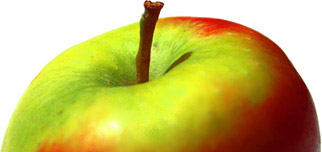

Jonagold is high quality American apple, developed in the 1940s. As its name suggests, this is a cross between a Jonathan and a Golden Delicious. It is quite widely grown, and unusually for a Golden Delicious cross, is not limited to the warm apple regions, although it is not often found in the UK.
Jonagold is a large apple, and makes a substantial snack. If you are struggling to eat your 5 portions of fruit and veg per day, this can help! The large size is a good clue that this is a triploid apple variety, with 3 sets of genes. As a result it is a poor pollinator of other apple varieties, and needs two different nearby compatible pollinating apple varieties. Golden Delicious is well-known as a good pollinator of other apple varieties, but cannot pollinate Jonagold.
The colouring is yellow of Golden Delicious, with large flushes of red. This is a crisp apple to bite into, with gleaming white flesh. The flavour is sweet but with a lot of balancing acidity - a very pleasant apple.
Jonagold's other parent, Jonathan, is an old American variety which was discovered in the 1820s.
In the UK Jonagold sometimes appears in supermarkets in the spring packaged as "value" apples, often from Holland, and at a very low price. We are trying to find out more about these apples, but it seems that they are mainly "second" quality apples which are nearing the end of their storage life and are surplus to other uses.
Jonagold is widely-grown by commercial growers, and there are a number of more highly-coloured sports. Jonagored is probably the most widely known of these. Others include: Decosta, Primo, Rubinstar, Red Jonaprince.
Jonagold apple identification images
All images copyright Orange Pippin unless otherwise stated.


USDA identification images for Jonagold
The identification paintings in the USDA Pomological Watercolor Collection span the years 1886 to 1942.
Citation: U.S. Department of Agriculture Pomological Watercolor Collection. Rare and Special Collections, National Agricultural Library, Beltsville, MD 20705.
Parents and other ancestors of this variety
- Golden Delicious (parent)
- Jonathan (parent)
Offspring of this variety
- Ambrosia - Possible parent
Sports of this variety
Sports are natural genetic mutations of the original variety.
Visitor reviews
- 03 Jan 2025They are the most popular type here in Iceland. Perfect sweetness and acidity balance
- 22 Sep 2024Ive just eaten my second ever UK-grown Jonagold. Until now I was a devoted fan of Cox’s OP which are increasingly hard to find in UK but these are a very acceptable second best 😋
- 13 Sep 2024I grow this Apple which don't grow too big but grow to a nice stackable size
- 28 Feb 2024 WA, United StatesA fantastic apple! I've had these both from the grocery store and picked from an orchard, and they are always great. Very crispy and sweet like honey.
- 17 Sep 2023Very crispy with good balance of sweet and acidity, very nice with cheese. Easy to eat good cropper
- 09 Oct 2022Bought plant in 2019, at discounted price of £5. This year 2022 it produced about 20 large apples. They are a firm crispy apple to bite into with good flavour.They are nothing like golden delicious (which I dislike too soft, with little flavour). Grown in Bedford, UK. During dry hot summer, didn’t water.
- 23 Sep 2022I have eaten a lot of jonagold apples. There has often been brown spots near the core of the apple. The new crop is out now and extremely delicious and reasonably priced!
- 30 Jan 2021 WA, United StatesI find what others say here to be true to my experience with Jonagold. excellent flavour. About 60% scab resistance in a wet scab prone area. A great all around apple. It can keep well if kept cold enough and ventilated. I might add that home growers might have more problems with corkspot and bitterpit than with other types if their soil is low in calcium.
- 04 Nov 2020 STOCKHOLM, SwedenI tasted this variant and it’s not the best but not the worst. To my surprise, it was very, VERY squishy and soft. I continued to eat and it got softer and sweeter. I took a peek at the flesh and there were big brown parts. I don’t know if I just got a bad one or if this is how they’re supposed to be. 4/10 will probably eat again.
- 24 Oct 2020 OHIO, United StatesBest apples I have had. Can’t find them in Dayton. I got these at the food bank I love them
- 07 Oct 2019 LOLLAND, DenmarkSmashing for juice, which given their size and the fact that supermarkets in the UK dont like to buy big apples, is what they usually end up getting picked for. A shame.
- 09 Oct 2018 CORNWALL, United KingdomBest flavoured apple I have grown so far. Yes it has scab here in Cornwall, but who cares, it tastes amazing. though prone to canker, only had one case on one branch in the last 9 years, so not that bad I thought. If i'd ever move, I would plant it again.
- 07 Nov 2015 CALIFORNIA ,, United StatesI just Reid these for the first time today got them at the local girders store Super King for 89 cents a pound. They were amazing crisp ,juicy, and full of flavor! The best apple I have ever tasted in all my years! The people who complained these apples were soggy and tasteless are nuts ! They must haves not had a Janigold because these are amazing!
- 05 Sep 2015 NC, United StatesI normally buy Gala apples at the grocery store and love them. Today I went to our local Farmer's Market to see if the apples were in yet. There were no Gala apples so I asked the vendor to recommend one of his eating apples that were sweet and soft and not so crisp. He pointed me toward the Jonagold. I had never even heard of these apples. I have to admit, these apples are very good! Everything he said they were. I will definitely be buying more of these delicious apples!!!!
- 21 Aug 2015 OR, United StatesThis is my favorite eating apple when it is fresh and my biggest disappointment when it has been offered after long storage in the grocery. I imagine that most of the negative comments are due to the cheap mistreated version of this great apple.
- 25 Jul 2015 NORTH CAROLINA, United StatesI first discovered this apple while on a tour/field trip in my Fruit crops course at Co. State Univ. The orchard was at a fairly high elevation near Cedaredge/Paonia area. Picked right off the tree in September, and it was the best apple I had ever tasted, crisp, juicy, sweet (not too sweet), with a little tartness. I asked the grower why they were not more of them in the stores, and his answer was that they are not good keepers, and best if eaten within a month after picking. So I bought my own tree and have had heavy crops of large delicious apples for the last 15 years. We do not spray, so we get a little spotting and such minor imperfections on the outside, but just bite into one and you have a little bit of heaven. Western states which have hot dry days and cool nights, do develop a little more flavor, but for Western NC, it is an awfully good apple.
- 18 May 2015 ONTARIO, CanadaJonagold, where have you been all my life? I recently bought a bunch of these apples at the supermarket as they were on sale and the cheapest. I took a chance and am hooked! Beautiful, large, and ever so tasty & crispy. My other favourite apples are Mutsu and Empires and this is comparable.
- 15 Nov 2014 United StatesMy favorite, favorite apple. crisp, juicy, firm, with some sweetness but not as much as honeycrips. Comparable to empires or mutsus in texture but sweeter. Cameo is very similar.
- 21 Oct 2014 NY, United StatesIt sounds from the comments like this is not worth it from a supermarket. But, if you can find a farm with them, I think they are fantastic. I picked some this weekend, and they are honey sweet, with a little bit of a bite. They are huge!! I can barely finish one. I highly recommend this apple if you like Honeycrisps, but wish they were sweeter. Mine were crisp, more sweet than tart, and just plain tasty. I wish they kept longer so I could have picked more!
- 21 Jun 2014 IA, United StatesI agree with nearly every comment here. I have bought the best and not so best tasting apple every at the SAME STORE. Different batches...all depends on when their picked so I'm buying my OWN tree. The triple chromosome pollination factor worries me a bit but I figure it's worth a try.
- 01 Apr 2014 IA, United StatesI've only tried the ones at the grocery store which were grown in Michagan. They were crisp and juicy, and a little on the tart side. I prefer those traits in an apple, but these really lacked in flavor, so I probably won't buy them again.
- 20 Mar 2014 MARYLAND, United StatesJonagold is one of those apples that can taste either extraordinary or no-so-special. It depends on where you get them. I've yet to taste a supermarket Jonagold that warranted the price. Sorry but they had little flavor. Now the ones I've bought from family owned orchards up in the Mount Airy/Frederick area were phenomenal: crisp, juicy, dense, and good strong apple flavor complemented by a subtle pear-drop sweetness inherited from Golden Delicious. The overall tasting experience is a mouthful of fruity goodness. Now is it as good as Jonathan? Hard question because it will depend on what you are looking for in an apple. Jonathan's have an intense apply flavor combined with a rich spiciness that is lacking in Jonagold. B-U-T Jonagold has more complex fruity flavors. Personally I prefer Jonathan, but I usually buy both when given a chance. Both do well as cooking applies but I prefer Jonathan for pies. For the home gardener Jonathan is also better because the size of the tree is more manageable and it is partially self-fertile. Jonagold will require a pollinator.
- 11 Mar 2014 CA, United StatesBlech! I got two of these from Lucky supermarket. They were terrible. Soggy and tasteless. And yes, they were really waxy. They weren't cheap either.
- 08 Dec 2013 CO, United StatesCottony and unremarkable. One bite and I'm done. They're on sale everywhere, ALL THE TIME - the mark of a variety ruined by volume apple growers who need red, easy to ship apples.
- 18 Nov 2013 BEIJING, United KingdomRecently I found that Jonagold (or ??? in Chinese) are grown here in the northeast of China. No cheaper though than other common varieties such as Fuji or Gala. They are fairly large, yellow with red stipes, quite attactive fruit. Flavour is bittersweet, but more sweet than bitter. The skin has a nice stong apple smell, but an unpleasant waxy coating. Is the waxiness common?
- 21 Oct 2013 OHIO, United StatesPurchased these at Richard Bros near Jackson Ohio. Extremely large and juicy this year. We usually prefer golden delicious, but as we were late visiting, this was a super replacement. They are thin skinned and quite juicy, and we agree with the tasting notes. Our were 50/50 blend of yellow and red.
- 18 Oct 2013 NJ, United StatesGot couple from an Asian grocery store who gets them from NY orchard. Very crisp and nicely flavored. I liked the balance of sweetness and tartness as I usually had it as dessert after meals. I am not sure if its due to their large size, but I felt that the apple was juicier and overall just better when served in slices rather than eaten whole. I hope to go back and get couple more if they're still there.
- 23 Sep 2013 NY, United StatesMy new addiction!! I just discovered these apples while apple picking, and OMG - the best ever! A wonderful infusion of sweet and tart. Perfectly crunchy! They filled the majority of my sack! I brought a few to work, now all my co-workers want IN!!
- 03 Jul 2013 DEVON, United KingdomGrown & eaten fresh off the tree this apple is super.Supermarket apples are nowhere near as nice,hence these mixed reviews.Being a triploid the large size puts off many potential buyers.Need regular spraying programme in wet climate here in SouthWest,otherwise blackspot infected
- 28 Jan 2013 WISCONSIN, United StatesWhen this apple is good, it's one of my favorites, as good as any apple I've tasted anywhere, but sometimes it's mediocre, mostly thanks to when they're picked and how they're stored and displayed by the wholesalers and grocers, I'm guessing. They also seem to come in different strains. One is larger with a more golden and a little rougher peel, not quite russeted, which goes mealy a little quicker than the other strain which has a smoother peel and is slightly smaller, crisper,redder, and has a better balanced flavor. In Frank Browning's book "Apples" written in 1999, Jonagold was the most planted apple variety in Europe at the time it was written, which probably explains the low prices some of you have seen over there.
- 22 Jan 2013 NEVADA, United StatesI was very proud to hear this delicious apple that so many people love was created at Cornell University.
- 09 Jan 2013 NY, United StatesBo - tastes like a direct cross between a Red Delicious and a Golden Delicious. I think it misses the mark as it lacks the honey flavor of a golden delicious delicious and the crispness of a red delicious. Brent- A big apple with a somewhat crisp finish. Not as sweet as some dessert apples.
- 05 Jan 2013 ONTARIO, CanadaActually the most delicious apple when picked fresh from the tree (Ontario, Canada). I am surprised by the lack of flavour reported by some reviewers, my guess is either the apples weren't fresh or the soil/climate is it ideal for flavour outside NE North America.
- 21 Nov 2012 WV, United StatesTotally love this apple! One of the bigger dessert apples.
- 15 Jun 2012 TEXAS, United StatesThe Jonagold is my current addiction. When they are in season, there is nothing I'd rather eat. They are sweet, have a hint of tart, are crispy and firm. I am in search of an opposite season apple because during the 6 months I cannot find Jonagold, my apple consumption drops off precipitously.
- 08 Mar 2012 DERBYSHIRE, United KingdomWell I agree its not the best tasting apple, but its fantastic value for money especially considering the large quality fruits. At my supermarket they are 5 times cheaper than Jazz or Fuji (my favourites). They are juicy and I like the texture - but poor flavour.
- 15 Feb 2012 GEORGIA, United StatesI must be honest, I didn't like this apple. The taste was wonderful, but the texture of the flesh threw me. I like my apples very VERY crisp, and it just didn't live up to my standards. A very good apple taste-wise though.
- 18 Oct 2011 IDAHO, United StatesI recently found Jonagolds at a regional grocery store and bought them because they were big, and they had a special. Little did I know that I was about to bite into the best apple I've ever had. Great to eat with peanut butter (chunky!) and great plain too. I love the taste where it's not too tart but not too sweet. The only problem is, most stores don't carry them!
- 03 Jul 2011 SURREY, United KingdomThe absolute worst apple variety available on the mass market. They always look beautiful, but taste of nothing. I'd rather go without apples than eat Jonagolds.
- 13 Jan 2011 NW VA, United StatesOur local Costco sells them from PA. Apples from the US northeast are the best d/t the climate and limestone soil imparting excellent flavor. Jonagolds are a perfect combo of tart/sweet and firm but juicy. There only weakness is they soften a little faster if not refigerated. I've a tree growing them -but I think someone took the first dozen or so. Not surprised.
- 12 Nov 2010 TX, United StatesOur botany class has an apple tasting each semester. For fall 2010, this was the clear winner--crisp, juicy, sweet and tart. Seldom disappoints!
- 06 Oct 2010 WASHINGTON, United StatesAn excellent apple. I grow several strains. For baking by far the best is Jonaprince. It's flavor is tops!
- 26 Apr 2010 ONTARIO, CanadaI am planning of planting a new apple tree to replace one that I have lost. I have heard a lot of good things about the Jonagold Apple. I am looking for an apple that is good eating as well as a good cooking apple. Am I on the right track? I would be interested in your comments.
- 16 Apr 2010 BEDS, United KingdomRegarding the cheapness in supermarkets, I offer two possible explanations: 1. They are often irregular in shape and size. This devalues them in the eyes of the big retailers. 2. I've noticed that the supermarkets where I shop only put out one small box at a time. This makes me wonder if retailers are using it as a loss leader to reduce their average per/kilo price of apples.
- 15 Nov 2009 IRELAND, IrelandVery commanly found grown in Ireland, often organically. Therefore it must be a fairly hardy apple. Some Irish-centric info can be found here.... http://www.theapplefarm.com/celtic/jonagored.htm
- 30 Oct 2009 SUTTON SURREY, United KingdomAt a farmers' market they selling a multitude of different apples and as I eat an apple every day I was drawn to the one I'd never heard of. I bought a bag of Jonagold. A taste bomb, it is crisp, juicy a big. The best ever.
- 23 Sep 2009 ENGLAND, United KingdomBy far the best tasting apple I have ever tried, very similar to the apples I used to eat off my nans tree about 45 years ago I never knew what sort they were and have never found any as nice since until now these taste exactly the same, gorgeous.
- 01 Sep 2009 SALE, MANCHESTER, United KingdomThis is an important improvement to apple growing quality
- 08 Jul 2009 WINSFORD, CHESHIRE, United KingdomWhat does Rob Barlow use to pollenate his Jonagold?
- 17 Jun 2009 DAVENHAM CHESHIRE ENGLAND, United KingdomI note the comment " Not grown in UK -- often 2 I have been growing these apples for quite a few years now -- quite succesfully A realy good apple but did not know it was a USA developed
- 11 Mar 2009 TATURA.VICTORIA.AUSTRALIA, AustraliaI have bought these apples down at Geeveston,a cold area in southern Tasmania.I love anything and everything apple and thes are without doubt the best apples I have ever eaten.
- 23 Dec 2008 ST IVES, CORNWALL, United KingdomI'm passionate about apples, and on holiday this October in Macedonia I saw huge crops of Jonagold, Golden Delicious and (a few) Jonathans and Galas being gathered in. I had no idea that Macedonia was a major producer, as the only Jonagold I've seen in the UK have been Dutch, but apparently Macedonia exports mainly to the Gulf States ! I bought Jonagold for the first time as I'll always try a variety I've not seen before - and they were (still are) amazingly cheap. I like them a lot, I enjoy their crisp, slightly orangey sharp/sweetness, their juiciness and the fact that they are good "keepers". Other favourites Egremont russet, crisp cox (there are always some disappointingly soft ones), new season Discovery, James Grieve, Kidd's Orange.
- 14 Dec 2008 SAN JOSE, CALIFORNIA, United StatesI have never liked apples or even apple pie because I didn't like the taste or the peeling of an apple, then I tried a Gala Apple because of thin skin it was a winner with me. One day while shopping for some apples, I saw a JonaGold and decided to try it. The color was striking and the taste was out of this world, it is by far the best tasting apple ever. I eat one everyday and will be sad when the season is gone I have become addicted to them. The price is a dollar or two cheaper than the rest, but I like that. An apple that is the best tasting ever at an affordable price is a WINNER.
- 12 Nov 2008 BULGARIA, BulgariaThe best tasting apples. Very crisp and aromatic. You can notice the fragrance right away when you cut them! There are a sport of Jonagold - "Decoster", with a litle more acidic taste - superior!
- 11 Jul 2008 DURHAM UK, United KingdomHalf the price of other varieties. Firm, slightly acidic flesh. Best peeled and sliced into segments with a touch of sugar, rather than eaten whole (and I'm not a sweet-tooth). Big enough to make a good baked apple by the looks of it.
- 24 Jun 2008 BOSTON, United StatesFear not, folks: this variety has been sold Stateside for decades with very few problems and has origins in one of the oldest apple growing regions in the nation. My guess is the ones you are eating are direct from the farm, so you should be fine.
- 29 May 2008 TILLATOBA, MS, United StatesUndoubtedly the best tasting apple I have ever tried! My only problem is they are difficult to find in my area. If you like a crisp firm apple the is slightly sweet and tangy at the same time, try these!!
- 13 May 2008 MELBOURNE, AustraliaIt is cheap also in Australia. about $1-2 difference with other varieties. Makes me worry
- 19 Apr 2008 KENT, United KingdomI've had similar concerns to those of Cliff, does anyone know why they are so cheap?
- 20 Jan 2008 DORSET, ENGLAND, United KingdomI agree with your tasting notes but what worries me is why they are so extremely cheap in s/markets, viz. 27p per kg against 63p per kg + for most other varities. Are they stock-piled somewhere in the EU? Are they as safe to eat? Are they subject more to pests & subsequently sprayed heavily? I would be grateful for your comments. Thanks.
- 17 Sep 2007 CORNELL UNIVERSITY, United StatesThis apple variety was created at Cornell University.
Tree register
- United States64
- United Kingdom38
- Germany 3
- Hungary 1
- Ireland4
- Netherlands 3
- Canada5
- Australia6
- New Zealand3
- Japan1
- Poland1
United States
- Alison Loy in Burtchville, MICHIGAN / ST. CLAIR
- Amanda Gajdzik in SHELBYVILLE, KY
- Axel Kratel in Santa Cruz, CALIFORNIA
- baker3@wildblue.net in Thawville, ILLINOIS
- Ben in Helenwood, TN
- Brian Phillips in Saint Johns, MI
- Carolyn Drought in Franksville, WI
- Charlie in Grinnell, IA
- Dan Vorhis in FREELAND, WA
- Daryl King in Denver, CO
- Dave Dangelo in Augusta, MAINE
- David Black in Bentonville, ARKANSAS
- David Young in RIVES JUNCTION, MICHIGAN
- Dennis in Bradford, DARKE, OH
- Dennis in Great Meadows, NJ
- Don Mcivor in Twisp, WA
- Donald Smith in Harwinton, CT
- Dr. Sloan in Portland, OR
- Eric in Seabeck, WA
- Florian Deisenhofer in Brush Prairie, CLARK COUNTY WA
- Gary in Pleasant Hill, CA
- George Cochran in Maple City, MI
- Glenn Tremble in Trail, OREGON
- James Nichols in La Luz, NEW MEXICO
- James Roden in Estacada, OR
- James Wargo in SOUTHBURY, CT
- Jessica Klein in Maple Valley, WASHINGTON
- Jo Elsmore in BLOORS,
- Joe & Rachel Bender in ALBION, INDIANA / NOBLE
- Jonathan Bastedo in YUCAIPA, CA
- Kacie Winn-Skelley in Plain City, OH
- Karen in New Johnsonville, TN
- Keaton Foster in BEAR LAKE, MI
- Kevin Maphis in Big Pool, MARYLAND
- Kim Lapacek in Poynette, WI
- Lindy Metz in Stow, OHIO
- Lloyd Bell in Beaverton, OR
- Mark Beeson in Wichita, KS/SEDGWICK
- Mark Campbell in Centerville, INDIANA
- Mark Ward in DIAMOND POINT, NY
- Maryann in Kewanee, IL
- Matt in Emmett, MI
- Melody Renee Delury in Anderson, IN
- Michael Foote in GREENPORT, NY
- Mrs. G in Newport, RI
- Myrna Curzon in Salem, OR
- Nickschweitzer@Comcast.Net in Sparta, MICHIGAN (MI)
- Paula Reinbold in Rush, COLORADO
- Phillip Hatcher in Sand Springs, OKLAHOMA
- Phillip Hatcher in Sand Springs, OKLAHOMA
- Randy in Baxley, GA
- Randy Anderson in MONTICELLO, KY
- Rex Callis in Pittsboro, IN
- Rick Simoniello in Storrs / Mansfield, CT
- Ricky Bruckner in RAVENNA, OHIO (OH)
- Robert Crandall in Capac, MICHIGAN
- Ryan Grover in Vineyard, UTAH
- Selmi's Orchard and Farm in Rock Falls, IL
- Steve Larson in Battle Ground, WA
- Steve Pabody in Ferndale, WASHINGTON
- Steven Stanley in Johnson City, TENNESSEE
- Terry Smith in Prescott Valley, AZ
- Thomas Griffith in Cottage Grove, WI
- Tom Parks in Holladay, UT
United Kingdom
- Alice Jones in
- Alison Quinsey in Beccles, SUFFOLK
- Anja Britton in NOTTINGHAMSHIRE
- Barbara Brown in Gt. Yarmouth, NORFOLK
- Brian Addy in WEST YORKS
- Cath in Kirkcaldy, FIFE
- Dale Reynolds in Wisbech, CAMBS
- Danny Apps in Lochore, FIFE
- Elaine Evans in Mold, FLINTSHIRE
- Erika Keschner in Mytholmroyd, WEST YORKSHIRE
- Graeme Stockdale in Pilsley, Chesterfield, DERBYSHIRE
- Ivor Kiverstein in Pulborough, WEST SUSSEX
- Jacqueline Lawrence in Milford Haven, PEMBROKESHIRE
- James Empett in Ashford, KENT
- Jamie Jones in Runcorn, CHESHIRE
- John Dench in Etchingham, EAST SUSSEX
- K. Woodward in Warsash, SOUTHAMPTON
- Marian Fitch in Street, SOMERSET
- Mark in Chippenham, WILTS
- Mark in Chippenham, WILTS
- Mark Baldwin in Wigan, LANCASHIRE
- Mark Beverley in Berwick Bassett, WILTSHIRE
- Meadowcopse in Chester, CHESHIRE
- Mike Snelgrove in Abergavenny, MONMOUTHSHIRE
- Mrs Tricia Pursey in Redditch, WORCESTERSHIRE
- Nicola Kirkpatrick in Howden, EAST YORKSHIRE
- Nicola Kirkpatrick in Howden, EAST YORKSHIRE
- Peter Bowles in Swaffham, NORFOLK
- Peter Hsu in Poole, DORSET
- Peter Hsu in Poole, DORSET
- Philip Baldock in Eastbourne, EAST SUSSEX
- Robert Waterhouse in Crediton, DEVON
- Steve Sim in Grange Over Sands, CUMBRIA
- Thomas Bennell in BRISTOL,
- Tony in Glasgow, SCOTLAND
- Tracy Richard in Harlow, ESSEX
- Victoria Birkett in Aberdeen, SCOTLAND
- Wayne Seagate in Watlington, NORFOLK
Germany
- Justus Burmann in SCHMALLENBERG-WESTFELD,
- Justus Burmann in SCHMALLENBERG-WESTFELD,
- Justus Burmann in SCHMALLENBERG-WESTFELD,
Hungary
- Mark Searle in
Ireland
- James A Nolan in Glynn, WEXFORD
- James A Nolan in Glynn,, WEXFORD.
- Simon Clarke in Duleek, COUNTY MEATH
- Ute Bohnsack in Kilfenora, CLARE
Netherlands
- Cheuk A Lam in Amsterdam, NOORD-HOLLAND
- Karel in Alem,
- Nynke Zijlstra in Eastermar, FRIESLAND
Canada
- Bill Cuell in Kaslo, BC
- Bill O'Keefe in Dobbinton, ONTARIO
- v k Howald in Lucknow, ONTARIO
- Will in Severn, ONTARIO
- Will Langlands in Powell River, BC
Australia
Japan
- Caleb Fuller in Yoshitomi-Machi, FUKUOKA
Poland
- Richard in Krakow,
Spring blossom records for this variety
2022 season
- 2nd May 2022 - tree owned by James in Glynn, Ireland
- 2nd May 2022 - tree owned by James in Glynn,, Ireland
2019 season
- 29th April 2019 - tree owned by Ryan in Vineyard, United States
2018 season
- 4th May 2018 - tree owned by Cheuk in Amsterdam, Netherlands
2017 season
- 25th April 2017 - tree owned by Cheuk in Amsterdam, Netherlands
2016 season
- 2nd May 2016 - tree owned by Erika in Mytholmroyd, United Kingdom
2015 season
- April 2015 - tree owned by Jamie in Runcorn, United Kingdom
2014 season
- 12th May 2014 - tree owned by Dennis in Great Meadows, United States
- 6th May 2014 - tree owned by Danny in Lochore, United Kingdom
- April 2014 - tree owned by Nicola in Howden, United Kingdom
2013 season
- 14th May 2013 - tree owned by K. in Warsash, United Kingdom
- 30th April 2013 - tree owned by Florian in Brush Prairie, United States
2012 season
- 9th May 2012 - tree owned by James in Estacada, United States
- 4th May 2012 - tree owned by Florian in Brush Prairie, United States
- 2nd May 2012 - tree owned by Steve in Ferndale, United States
- 2nd May 2012 - tree owned by Karel in Alem, Netherlands
- 29th April 2012 - tree owned by Mrs Tri in Redditch, United Kingdom
- 27th April 2012 - tree owned by Simon in Duleek, Ireland
- 11th April 2012 - tree owned by Gary in Pleasant Hill, United States
- 21st March 2012 - tree owned by Randy in Baxley, United States
2011 season
- May 2011 - tree owned by v in Lucknow, Canada
- 25th April 2011 - tree owned by Barbara in Gt. Yarmouth, United Kingdom
- 21st April 2011 - tree owned by Karel in Alem, Netherlands
2009 season
- 4th April 2009 - tree owned by Mrs Tri in Redditch, United Kingdom
Record your blossom dates in our Fruit Tree Register - more >>.
Harvest records for this variety
2023 season
- 1st week October 2023 - tree owned by Will in Severn, Canada
2019 season
- 1st week September 2019 - tree owned by Dennis in Bradford, United States
2016 season
- November 2016 - tree owned by Elaine in Mold, United Kingdom
- October 2016 - tree owned by Erika in Mytholmroyd, United Kingdom
2015 season
- September 2015 - tree owned by Jamie in Runcorn, United Kingdom
- 3rd week August 2015 - tree owned by Phillip in Sand Springs, United States
2013 season
- 3rd week September 2013 - tree owned by Mrs. in Newport, United States
- 1st week September 2013 - tree owned by baker3@wildblue.net in Thawville, United States
2012 season
- 1st week November 2012 - tree owned by James in Estacada, United States
- 1st week October 2012 - tree owned by Steve in Ferndale, United States
- 1st week October 2012 - tree owned by Lloyd in Beaverton, United States
2011 season
- 1st week October 2011 - tree owned by v in Lucknow, Canada
2010 season
- 2nd week November 2010 - tree owned by Brian in , United Kingdom
- 3rd week September 2010 - tree owned by Ute in Kilfenora, Ireland
2009 season
- 2nd week September 2009 - tree owned by Mrs Tri in Redditch, United Kingdom
Origins
- Species: Malus domestica - Apple
- Parentage: Golden Delicious x Jonathan
- Originates from: Geneva, New York, United States
- Introduced: 1943
- Developed by: New York State Agricultural Experiment Station
- UK National Fruit Collection accession: 1982-291
Identification
- Awards: RHS AGM (current)
- Country of origin: United States
- Period of origin: 1900 - 1949
- Fruit colour: Orange flush
- Flower colour: White
- Leaf colour: Green
- Annual cycle: Deciduous
Using
- Picking season: Late
- Keeping (of fruit): 1-2 months
- Flavour quality: Very good
- Flavour style (apples): Sweet/Sharp
- Discoloration of fruit: No discoloration (Good for drying)
- Cropping: Heavy
- Fruit persistence: Normal ripening
- Food uses: Eating fresh
- Food uses: Culinary
- Food uses: Juice
- Food uses: Hard cider
- Picking period: mid-October
- Wildlife: RHS Plants for Pollinators
Growing
- Gardening skill: Average
- Flowering group: 4
- Pollinating others: Poor
- Ploidy: Triploid
- Vigour: Vigorous
- Bearing regularity: Regular
- Fruit bearing: Spur-bearer
- Self-fertility: Not self-fertile
Climate
- Cold hardiness (USDA): Zone 4 (-34C)
- Chill requirement: Low-chill
- Climate suitability: Temperate climates
- Climate suitability: Warm climates
- Summer average maximum temperatures: Cool ( 20-24C / 68-75F)
- Summer average maximum temperatures: Warm (25-30C / 76-85F)
- Cold hardiness (RHS): H6 (to -20C)
Other qualities
- Disease resistance: Poor
- Canker: Some susceptibility
- Scab (Apple and Pear): Some susceptibility
- Fire blight: Some susceptibility
- Cedar apple rust: Some susceptibility
Where to buy trees
The following tree nurseries offer Jonagold apple trees for sale:
- Orange Pippin Fruit Trees (USA) United States
Jonagold apple trees - Orange Pippin Fruit Trees (UK) United Kingdom
Jonagold apple trees - Thomas Fruit Trees (EU) France
Jonagold apple trees - Cummins Nursery
United States More >> - Keepers Nursery
United Kingdom More >>
Where to buy fresh fruit
The following orchards grow Jonagold:
United States
Alabama
- Crow Mountain Orchard, Fackler
- Isom Orchards, Athens
- Scott's Orchard, Hazel Green
California
- Apple Lane Orchard, Julian
- Bellevue's See Canyon Farms, San Luis Obispo
- Jon A. Yori Ranches, Modesto
- Moms Country Orchards, Yucaipa
- Noble Orchards, Paradise
- Peacefield Orchard, Julian
- Prevedelli Farms, Watsonville
- Seven C's Family Orchard, Tehachapi
Colorado
- Apple Valley Orchard, Penrose
- Bolton's Orchards, Grand Junction
- Gott Bro's Orchard & Produce, L.L.C., Ignacio
- Happy Apple Farm, Penrose
- Peachfork Orchards & Vineyard, Palisade
- Red Mountain Ranches, Cedaredge
Connecticut
- Averill Farm, Washington Depot
- Bishop's Orchard, Guilford
- Emerald Green Farm & Gardens, Wallingford
- Hindinger Farm, Hamden
- Lyman Orchards, Middlefield
- Norton Brothers Fruit Farms, Cheshire
Delaware
- Fifer Orchards, Camden Wyoming
- T.S. Smith & Sons, Bridgeville
Georgia
- B.J. Reece Apple House, Ellijay
- Freedom Farms - Apple & Peach Orchard, Chatsworth
- Hillside Orchard Country Store, Lakemont
- Mercier Orchards, Blue Ridge
- R & A Orchards, Ellijay
- Red Apple Barn (Little Bend Orchard), Ellijay
Idaho
- BYU-Idaho Apple Orchard Museum, Rexburg
- Kelley Orchards (Weiser), Weiser
- Williamson Orchards & Vineyards, Caldwell
Illinois
- All Seasons Apple Orchard, Woodstock *** Feature Orchard ***
- Braeutigam Orchards, Belleville
- Camp's Orchard, Roseville
- Christ Orchard, Elmwood
- Curtis Orchard & Pumpkin Patch, Champaign
- Eckert Orchards, Inc., Belleville
- Edgewood Orchards, Quincy
- Homestead Orchard, Woodstock
- Jonamac Orchards, Malta
- Mileur Orchard, Murphysboro
- Pleasant Row Orchard, Cuba
- Prairie Sky Orchard, Union
- R.E. Arends Orchard, Laura
- Royal Oak Farm and Fruit Orchard, Harvard *** Feature Orchard ***
- Stone's Apple Barn, East Moline
- Tanner's Orchard, Speer
- Valley Orchard, Cherry Valley
- Woodstock Country Orchard, Woodstock
Indiana
- Anderson Orchard, Mooresville
- Apple of His Eye, Anderson
- Bender's Nursery and Orchard, Albion
- Blue River Orchard, Fredericksburg
- Chandler's Farm, Fillmore
- Cook's Orchard, Fort Wayne
- County Line Orchard, Hobart
- Deer Creek Orchard, Galveston
- Ditzler Orchard, Rosedale
- Doud's Countyline Orchard, Wabash
- Dougherty Orchards, Cambridge City
- G. W. Stroh Orchards, Angola
- Garwood Orchards, LaPorte
- Goley's Orchard, Madison
- HighPoint Orchard & Farm Market, Greensburg
- Kercher's Sunrise Orchards Farm Market, Goshen
- McClure's Orchard, Peru
- Melton's Orchard and Country Market, Bloomington
- Orchard Hill Farms, Kendallville
- Pleasant View Orchard, Fairland
- Radke's Orchards, Michigan City
- Schafer Orchards, Princeton
- Tuttle Orchards, Greenfield
- Wea Creek Orchard, Lafayette
- Harker Family Farms & Orchard, Waldron
Iowa
- 3 Bee Farms, Griswold
- Allen's Orchard, Marion
- Appleberry Farm, Marshalltown
- Appleberry Orchard, Donnellson
- Belaire Winery, St Ansgar
- Berry Patch Farm, Nevada
- Blueridge Orchard, Denver
- Center Grove Orchard, Cambridge
- Deal's Orchard, Jefferson
- Ditmars Orchard, Council Bluffs
- East View Orchard, Fredericksburg
- Gravert's Apple Basket Orchard, Sabula
- Hillside Orchard, Hamburg
- Iowa Orchard, Urbandale
- Mincer Orchard & Farms, Hamburg
- Smalls Fruit Farm, Mondamin
- Storybook Orchard, Story City
- The Big Apple Orchard, Mount Vernon
- Timeless Prairie Orchard, Winthrop
- Wilson's Orchard, Iowa City
Kansas
- Fieldstone Enterprise, Overbrook
- Meadowlark Farm, Rose Hill
- Stephen's Orchard, Bonner Springs
Kentucky
- Apple Tree (Home of the Scarlett Gala), Cumberland
- Eckert | Boyd Orchard, Versailles
- Evans Orchard & Cider Mill, Georgetown
- Hidden Hollow Orchard and Wildlife Sanctuary, Louisville
- Hinton's Orchard & Farm Market, Hodgenville
- Reed Valley Orchard, Paris
Maine
- McDougal Orchards, Springvale
- Megquier Hill Orchard (formerly Goss), Otisfield
Maryland
- Baugher Apple Orchard and Farm, Westminster
- Bragunier Orchard, Big Pool
- Lewis Orchards and Farm Market, Cavetown
Massachusetts
- Berlin Orchards, Berlin
- Green River Farms, Williamstown
- Mann Orchards, Methuen
- Marino Lookout Farm, South Natick
- Parlee Farms, Tyngsboro
- Ragged Hill Orchard, West Brookfield
- Russell Orchards, Ipswich
- Tougas Family Farm, Northborough
Michigan
- (A.W.) Overhiser Orchards, South Haven
- Alber's Orchard & Cider Mill, Manchester
- Apple Valley Orchard, Saginaw
- Bayne's Apple Valley Farm, Freeland
- Crane's U-Pick, Fennville
- Erie Orchards and Cider Mill, Erie
- Erwin Orchards U-Pick & Cider Mill, South Lyon
- Evans Brothers Fruit Company, Frankfort
- Forraht Farms, Berrien Springs
- Grand View Orchard, Hudsonville
- Gull Meadow Farms, Richland
- Hildebrand Fruit Farms, Berrien Springs
- Husted Farm Market and Cider Mill, Kalamazoo
- Keeney Orchards, Tipton
- Klackle Orchards, Greenville
- Knaebe's "Mmmunchy Krunchy" Apple Farm Cider Mill, Rogers City
- Koan's Orchard, Flushing
- Lange Farms, Niles
- Lehman's Orchard, Niles
- Lewis Farm Market & Petting Farm, New Era
- Markillie Orchard and Cider Mill, Howell
- Miller Family Orchard, Vassar
- Moelker Orchards & Farm Market, Grand Rapids
- Morrison Farms, Williamsburg
- Nye's Apple Barn and Farms, St. Joseph
- Orchard Hill Farm, Caledonia
- Orchard on the Lake,
- Phillips Orchards & Cider Mill, Saint Johns
- Rennhack Orchards, Hart
- Ridgeway Farm Market, Bangor
- Robinette's Apple Haus and Winery, Grand Rapids
- Schultz Fruitridge Farms, Mattawan
- Springhope Farm, Galien
- Steffens Orchard Market, Sparta
- Tompkins' Orchard and Country Store, Vassar
- Uncle John's Cider Mill & Fruit House Winery, St. Johns
- Hanulcik Farm Market, Ionia
Minnesota
- Southwind Orchards, Dakota
- Sunrise River Apple Farm, Wyoming
Missouri
- Centennial Farms, Augusta
- Kithcart's Orchard, Rich Hill
- Lehman Family Orchard, LLC, Spickard
- Mother Earth Market LLC, Waverly
- Peters Orchards & Market, Waverly
- Purple Gate Farm, Highlandville
- Schweitzer Orchards, St. Joseph
- Sunshine Valley Farm, Rogersville
- Theirbach Orchards & Berry Farm, Marthasville
- West Orchards, Macon
Montana
- O'Farrell Orchards, Bigfork
- Wise Owl Orchards, Florence
Nebraska
- Apple Acres Orchard, Kearney
- Degroot Orchards, Madison
- Martin's Hillside Orchard, Ceresco
Nevada
- Sweet Farm, Fallon
New Hampshire
- Alyson's Apple Orchard, Walpole
- Apple Annie, Brentwood
- Butternut Farm LLC, Farmington
- Demeritt Hill Farm, Lee
- Lull Farm, Hollis
- McLeod Brothers Orchard, Milford
- Old Ciderpress Farm, Westmoreland
- Smith Orchard, Belmont
New Jersey
- Alstede Farms, Chester
- Battleview Orchards, Freehold
- Delicious Orchards, Colts Neck
- Heritage Station, Richwood
- Longmeadow Farm, Hope
- Neale's Orchards Farm Market, Glassboro
- Parks Farms, Chester
- Peaceful Valley Orchards, Pittstown
- Riamede Farm, Chester
- Stoneyfield Orchards, Belvidere
- Terhune Orchards, Princeton
- Tree-Licious Orchards, Port Murray
New Mexico
- Alary Farm, Corrales
- Cadwallader Mountain Farms, Mountain Park
- Manzanar Los Silvestres, Abiquiu
New York
- Apple Barrel Orchards, Penn Yan
- Bellinger's Apple Orchard, Fultonville
- Black Diamond Farm, Trumansburg
- Borden's Orchard, Schaghticoke
- Bowman Orchards, Rexford
- Exelsior Farms, Kent
- Fishkill Farms, Hopewell Junction
- G and S Orchards, Macedon
- Goold Orchards, Castleton on Hudson
- Hopedale Farm, Hudson
- Indian Ladder Farms Inc., Altamont
- LoveApple Farms, Ghent
- Masker Fruit Farms Inc., Warwick
- Mead Orchards LLC, Tivoli
- Miller's Apples, Dunkirk
- Morgan Farms LLC, Marion
- Northern Orchard Co Inc., Peru
- Ontario Orchards Farm, Market & Cider Mill, Sterling
- Prospect Hill Orchards, Milton
- Rose Hill Farm, Red Hook
- Samascott Orchard, Kinderhook
- Seven Ponds Orchard, Water Mill
- Soons Orchards Inc., New Hampton
- Trapani Farm LLC, Milton
- Weed Orchards, Marlboro
- Whittier Fruit Farm, Rochester
- Wickham's Fruit Farm, Cutchogue
North Carolina
- AH & W Farm, Boomer
- Billy Laughter Orchards, Hendersonville
- Brushy Mountain Farm&Orchard, Moravian Falls
- Creasman Farms, Hendersonville
- DH Orchards, Moravian Falls
- Haight Orchards, Reidsville
- JH Stepp Farm's Hillcrest Orchard, Hendersonville
- Justus Orchards, Hendersonville
- Lyda Farms, Hendersonville
- Old Cider Mill, Bat Cave
- Piney Mountain Orchards, Hendersonville
- Skytop Orchards, Flat Rock
- Tall Pine Apple Orchards, Hendersonville
Ohio
- Arrowhead Orchard, Paris
- Bauman Orchards, Rittman
- Beckwith Orchards, Cider Mill and Gift Shop, Kent
- Burnham Orchards, Berlin Heights
- Eshleman Fruit Farm, Clyde
- Fuhrmann Orchards, Wheelersburg
- Hidden Hills Orchard, Marietta
- Hoen's Orchard and Market, Delta
- Hugus Fruit Farm, Rushville
- Johnston Fruit Farms, Swanton
- Legend Hills Orchard, Utica
- Lynd Fruit Farm, Pataskala
- MacQueen Orchards, Holland
- Monroe's Orchard & Farm Market, LLC, Hiram
- Moreland Fruit Farm, Wooster
- Ochs Fruit Farm, Lancaster
- Rittman Orchards, Doylestown
- The Orchard & Company, Plain City
- Wesler Orchards, New Paris
- West Orchards, Perry
Oklahoma
- High-Fence Farm LLC, Sand Springs
Oregon
- Bays Farm, Banks
- Beilke Family Farm, Brooks
- Bells Orchard, Beaverton
- First Fruits, Independence
- Haury Farms, Salem
- Kiyokawa Family Orchards, Mount Hood Parkdale
- Marquam Meadows Fruit Company, Molalla
- Mason Hill Orchard, North Plains
- River Bend Farm/Pleasant Hill Orchard, Eugene
- Smith Berry Barn, Hillsboro
- Stephens Farm, Dayton
- Thomas Orchards, Kimberly
- B&P Hitz Fruit Farm, Woodburn
Pennsylvania
- Andrews Farm Market, Saint Thomas
- Apple Castle, New Wilmington
- Brown's Orchards & Farm Market, Loganville
- County Line Orchard, Kempton
- Dries Orchards, Sunbury
- Flinchbaugh's Orchard and Farm Market, Hellam
- Grim's Greenhouse & Farm Market, Breinigsville
- Half Crown Hill Orchard, McDonald
- Hollabaugh Brothers, Biglerville
- Kauffman's Fruit Farm, Bird-in-Hand
- Kistaco Farm, Apollo
- Klim Orchard, Lake Ariel
- Masonic Village Farm Market, Elizabethtown
- McConnells' Farm, Aliquippa
- Northrop's Apple Acres, Lake City
- Orton's Fruit Farm, North East
- Paulus Orchards, Dillsburg
- Rice Fruit Company, Gardners
- Rocky Ridge Orchards, Kane
- Ross Run Ranch, Tionesta
- Shady Brook Farm, Yardley
- Shanesville Fruit Farm, Boyertown
- Shaw Orchards, Stewartstown
- Shenot Farm, Wexford
- Simmons Farm, McMurray
- Soergel's Orchards, Wexford
- Solebury Orchards, New Hope
- Strites' Orchard, Harrisburg
- Sycamore Spring Orchard & Farm Market, Jonestown
- Taggart's Orchard, Washington
- Townsend Brother's Fruit Farm, Spring Church
- Weaver's Orchard, Morgantown
Rhode Island
- Barden Family Orchard, North Scituate
- Young Family Farm, Little Compton
Tennessee
- Melody Orchard, Rogersville
Texas
- Love Creek Orchards, Medina
- The Apple Conservatory, Austin
Utah
- Burgess Orchards, Alpine
- Fowers Fruit Ranch LLC, Genola
- McMullin Orchards, Payson
- Zollinger Fruit & Tree Farm, Inc, Logan
Virginia
- Berrier Farms, Inc., Cana
- Carter Mountain Orchard, Charlottesville
- Dickie Brothers Orchard, Roseland
- Graves Mountain Farm, Syria
- Hollin Farms, Delaplane
- Jenkins Orchard, Woodville
- Marker-Miller Orchards Farm Market, Winchester
- Morris Orchard, Monroe
- Showalter's Orchard & Greenhouse, LLC, Timberville
- Silver Creek and Seamans' Orchards, Inc., Tyro
Washington
- Borton Fruit, Yakima
- Muscle and Arm Farm, Freeland
- Rosabella's Garden, Bow
- Skipley Farm, Snohomish *** Feature Orchard ***
- Tonnemaker Hill Farm, Royal City
Wisconsin
- Door Creek Orchard, Cottage Grove
- Hillside Apples, Casco
- Maple Ridge Orchard, Cashton
- Orchard Store at Old Homestead, Franksville
- Pleasant View Orchard, Niagara
- Rim's Edge Orchard, Germantown
- Sutter's Ridge Orchard, Mt Horeb
United Kingdom
England - midlands
- Walsgrove Farm, Worcester
England - north
England - south-east
- Holton Orchards, Halesworth
England - south-west
- West Bradley Orchards, Glastonbury
France
Poitou-Charente
- Les Vergers de Vendée, Maureuil sur Lay
Netherlands
Noord-Holland
- Het Keetje, Westwoud
Canada
British Columbia
- Apple Barn Pumpkin Farm, Abbotsford
- Apple Luscious Organic Orchards, Salt Spring Island
- Applebarn -- Taves Family Farms, Abbotsford
- Blue Haze Farm, Victoria
- Dragonfly Farm, Salt Spring Island
- Fruit Forest Certified Organic Farm, Cobble Hill
- Garside's Fruit Farm, Abbotsford
- Michell Brothers Farm, Victoria
- Orchard Corners Organics, Kelowna
- Riley Creek Farm, Lillooet
- Roseridge Orchards, Kelowna
- Salt Spring Apple Company, Salt Spring Island
- Spencer Hill Orchard, Grand Forks
- Starry Night Meadows Farm, Mayne Island
- Swallow Hill Farm and Orchard, Metchosin
New Brunswick
- Verger Belliveau Orchard, Memramcook
Nova Scotia
- Elderkin's Farm Market, Greenwich
- Sarsfield Farms Inc., Canning
- Vista Bella Farm Orchard and Apiary, Malagash
Ontario
- DeVries Fruit Farm, Fenwick
- Dixie Orchards, Caledon
- Juicy-Fruit Orchards, Thedford
- Kennette Apple Orchard, Lakeshore
- Meleg's Lakeview Orchard & Cider Mill, Kingsville
Australia
Victoria
- Heritage Fruits Society, Fairfield
- Petty's Orchard, Templestowe
Switzerland
Geneva
- Verger de Saint-Loup, Versoix
References
- Cedar-Apple Rust
Author: Stephen Vann, University of Arkansas, Division of Agriculture (FSA7538)
Rated as susceptible - control usually needed where CAR is prevalent. - Apples for the 21st Century
Author: Manhart - Fruit Expert
Author: Hessayon