
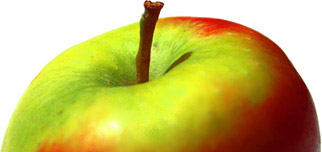

Spartan is a small sweet apple, and a great favourite with children. It is very much a "McIntosh" style apple, bright crimson skin and whiter-than-white flesh. We leave ours on the tree as long as possible, until they are crimson all over, as this allows the flavour to develop. Straight from the tree the flesh is very crisp and juicy, but it softens a bit within a week or so of picking - although remaining juicy. This is also a good variety for juicing - the juice colour is not especially remarkable but the flavour is sweet and pleasant. Spartan is an excellent garden apple, being easy to grow, resistant to scab, fairly resistant to mildew, and it crops very reliably - and by growing your own you can enjoy Spartan at its best, straight from the tree. However it can be prone to canker in wetter regions.
Spartan is a historically interesting apple, being an early example of a variety developed in a formal scientific breeding programme in Canada. It was raised at the Canadian Apple Research Station in Summerland, British Columbia, in the 1920s, and the mother variety is McIntosh (of course). There is some uncertainty over the pollen parent, it is usually thought to be Newtown Pippin.
Spartan is also one of the few North American apple varieties that can be grown successfully throughout the UK, where it has long been a popular garden apple variety.
If you only have space for one of the McIntosh-style apple varieties in your garden orchard, Spartan is a good choice - straight from the tree on a cold autumn morning, the vinous sugar-rush is hard to beat!
Spartan apple identification images
All images copyright Orange Pippin unless otherwise stated.

USDA identification images for Spartan
The identification paintings in the USDA Pomological Watercolor Collection span the years 1886 to 1942.
Citation: U.S. Department of Agriculture Pomological Watercolor Collection. Rare and Special Collections, National Agricultural Library, Beltsville, MD 20705.
Parents and other ancestors of this variety
- McIntosh (parent)
Offspring of this variety
Siblings of this variety (same parentage)
- Empire - Spartan and Empire are half-brothers
Visitor reviews
- 20 Oct 2024We have this apple tree in our garden and it is the BEST apple I've ever eaten, so crispy, juicy and delicious! 🍎 Incredible.
- 19 Oct 2023Just discovered the Suess-Looking tree in my daughter's yard is a Spartan apple tree. Been eatijg apples all my Life and this one is truly the best in flavor, crunch and size to eat. Love love them. They are adjacent to the Ice Age Trail in tye Monches WI area.
- 10 Sep 2023This apple is glorious. Great for a small garden and prolific in crop. However, it can be prone to wasp damage and can rot on the tree quickly. 2022 was the best year yet, but 2023 has been very disappointing. The cold and wet spring/early summer may be the cause.
- 03 Nov 2019 SLOVAKIA, SlovakiaThis apple is my personal No1 (along with Gravenstein apple, too). Two years ago I was lucky to buy a house with a nice garden. The previous owner planted three Spartan apple trees some 30 years ago. Last year I harvested around 700kg (cca 1500 lbs) of these apples. Every single day during the harvest season, I was looking forward to come back from my work to go immediately to my garden, to pick up one or two to eat them fresh directly from the tree. these apples are beautifully candy sweet with a hint of tropical fruit and ticklish yet balanced tart. They are exceptionally juicy with pleasant smell and beautiful look. What else do you require from the PERFECT APPLE??? I also made great must and cider from them. I do not know how in the USA, but in Slovakia we are allowed to bring your own fermented shreded fruits, or juice to a local destillery (you just have to pay alcohol tax and some fees to destillery depending from the volume you produce). So I shreded my Spartan apples with Golden Delicious apples (cca 3/1 ratio) to ferment them to make apple brandy. I have to say It was worth the effort, since I got 70 litres (cca 18,5 gallons) of finest delicious 52% volume brandy. During the winter time it is great to add some to improve my hot tea, lovely on rocks, or even straight . Also a nice gift for my family and friends. :-)
- 07 Jul 2019 ANGUS, United KingdomCrops well every year with me in eastern Scotland. blossom resists our late frosts and I have yet to see any problems of scab or canker, my trees get plenty of wind and I am on a sandy free draining soil which is probably why. I have seen other Spartans elsewhere with awful canker so maybe it prefers lighter soils? They are a good breakfast apple with a light perfume flavour
- 27 Jan 2019 SASKATCHEWAN, CanadaI mistakenly ( how does one do that) bought a bag of the Spartan variety apples from.local Costco store. Ok...I am a diehard McIntosh fan; love the hard white flesh and the absolute tartness. The apples are a reasonable medium size ,good red color overall, flesh clear white, juicy,sweet, the taste,for me in the circumstances, I found too much hint of pear ( which is what told me it wasnt the mac I thought). As other eaters/ posters have commented an excellent apple in it's own right and one I am sure children would love.
- 31 Oct 2016 WILTSHIRE, United KingdomThis is probably my favourite eating apple, which surprises me as I normally don't like McIntosh-style apples at all. In fact this is the apple the McIntosh probably wishes it could be - sweet and acid in really good balance with a hint of burnt caramel, almost toffee-apple flavour. Grows well and always gives a good crop.
- 02 Nov 2015 HERTS, United KingdomYuk too sweet and not enough acidity for my taste.
- 24 Jul 2014 ALBERTA, CanadaThe Spartan is by far my favorite apple. I found our stores are carrying so many different varieties of apples but the Spartan is hard to find. WHY? Nothing compares to it!
- 30 Aug 2013 OR, United StatesI love this apple! I grow about 8 or 10 different kinds of apples, and this one is ALWAYS the best producer AND the one tree that is the least affected by scab or insects (I only spray minimally). Plus it has the most beautiful fruit while on the tree. An all around winner!
- 15 Jan 2013 NY, United StatesBrent - a sweet apple with a crisp bright white flesh. also has a very small core which means more appley goodness for you to enjoy.
- 19 Mar 2012 TX, United StatesJust tried my first Spartan. This is March and it was a bit mealy from storage, but the flavor was excellent. Very reminiscent of a Mac--sweet and tart together. Bet it's fantastic right off the tree!
- 01 Dec 2011 FIFE, United KingdomI have just eaten one of the tastiest apples out of a Sainsbury family pack, I never thought that I would be so interested to find out what type of apple it was . The Spartan now has my vote for a snack or an addition to a ploughman's lunch.
- 22 Oct 2011 OREGON, United StatesWe just bought our tree last week and planted it. Hopefully next year it will bear fruit.
- 20 Oct 2011 CAMBRIDGESHIRE, United KingdomMy Spartan remain very healthy and completely pest and disease-free (Eastern UK) despite the claims that they are supposed to be prone to canker or other diseases - but perhaps that will come as the trees age. The tree itself is about medium vigour or perhaps slightly less than medium if allowed to crop heavily at a young age - which can happen because it is quite precocious and fertile. The fruit is remarkably free from pest or fungal damage, although if the skin (which is quite thick and has a yeasty "bloom") is broken, the fruits succumb surprisingly quickly to brown rot. With us having an unusually warm spring followed by an unusually cool summer, the fruits have been of inferior quality this year; developing the notorious "metallic" and "woody" taste (woody as in the taste when you lick your ice-lolly stick) which can happen occasionally. In most years, the Spartan fruit produced here is good, and palatable to most people; fairly sweet and juicy, with hints of melon and strawberry. Fruit tends to lose its quality after a few months of storage - tasting fermented and losing its texture, although, like Red Delicious, can still look excellent on the outside.
- 05 Oct 2009 United KingdomI purchased some of these the other day from a farmers market, who come to our local town once a month. This is the first time that I have tried them and they were recommended and I must admit they were absolutely gorgeous.
- 23 Aug 2009 United KingdomI have a family apple tree where Spartan is the dominant apple. It is usually a prolific flowerer/fruiter with the odd year off for recuperation. Although the apple is good, every year I lose most of the crop due to a worm parasite which seems to burrow into virtually evey apple on the tree. For this reason, most of the apples end up in pies or discarded.
- 16 Mar 2009 VANCOUVER, CanadaMy neighbour has one in his garden and it fruits well and is resistent to the typical Pacific Northwest crop of diseases. Tastey too.
- 24 Oct 2008spartan its very good apple variety.
- 06 Oct 2008 CREWE, United KingdomHave 4 spartan in my garden. Oldest one is now 5 years,fruiting well,cover with netting to prevent attacks by birds,(they are not having MY spartan)!!!!! What a great apple,picked one or two this morning for eating latter in day.Question, Do they store?
- 30 May 2008 HONOLULU, United StatesALOHA ~~ EXCELLENT APPLE. RAISED IN RHODE ISLAND, OLDEST OF SIX, ONE OF MANY FAMILY TRADITIONS WAS THE HAPPY WEEKEND TREK TO THE RI COUNTRYSIDE FOR A BUSHEL OF McINTOSH APPLES. LIVING IN HONOLULU NOW FOR 20 YRS, SPARTANS ARE REALLY THE CLOSEST I'VE EVER GOTTEN TO THE TASTE OF MY BELOVED McINTOSH.
- 17 Jan 2008 TROON AYRSHIRE, SCOTLAND, United KingdomInherited this apple tree and over the years it has yielded a lot of fruit - never tasted an apple so good - bumper crop this year so brought apples into work - everyone raved about the taste,colour,texture etc yummee OP: Yes, this is an easy apple to grow, and great straight from the tree.
- 27 Nov 2007 SEQUIM, WA. USA, United StatesThis apple has the best taste for cooking or eating and I would like to grow my own tree's, but cannot find where to buy them in Clallam County?
- 02 Nov 2007 CO. DURHAM, United StatesWe like spartans very much but it seems to be a very short season. We've found them in Waitrose and Sainsbury's. Is it possible to buy a box from an English grower? OP: Yes, Spartans are great straight from the tree, but don't really keep.
- 27 Oct 2007 CAMBRIDGE, United KingdomEvery year we pick apples at a friend's orchard, but we never knew what they were until we had them identified at the apple day at the botanical gardens last week end. The ones we love, aka "the purple ones", as my children call them, were identified as Spartan, but they are almost plum colour, with white flesh tinted pink in places, and not as squashed in shape as the one in your photo. Nothing like it really...anyway we absolutely adore them, eat them every day and have made quite a lot of juice. The others, which we also like but not as much, are Queen cox and Crispin Mutsu - these were probably ready a bit earlier and have gone a bit soft, but the taste is quite nice. We also picked some Howgate Wonder for baking, and they are nice and sharp, but I quite like to eat them raw too! Orangeippin: yes, Spartan can go very deep crimson/purple if left on the tree as late as possible.
- 22 Oct 2007 ENGLAND, United KingdomMy first experience of a Spartan apple, and its certianly a good one. Seems to be available in Waitrose at the moment - at least until I buy them all!
- 21 Oct 2007 ENGLAND, United KingdomI have just had the apples growing in our garden identified as Spartans. I love the way they have a whitish bloom on the skin until you polish them, then they glow deep red, much darker than the picture above. They make a wonderful sunset coloured apple juice, keep well when stored - altogether, a great apple!
- 15 Oct 2007 BETHEL CT, United StatesI recently went apple picking in Washington CT Averill Farm. I picked all Spartan apples, they are the BEST so far!!
- 15 Oct 2007 OXFORD, ENGLAND, United KingdomI grow Spartan apples in my back garden. This year was an exceptional crop. One medium tree yielded nearly 200 kg of the little gems, which I shall shortly be pressing to make some Spartan Cider!
- 14 Oct 2007 PA, United StatesI love the spartan apple, but I haven't been able to find them in a long time, I finally got some at an Amish roadside stand I frequent near my home. I ate one on the way home and couldn't get over how good it was, I'm going back to get some more.
- 11 Oct 2007 ENGLAND, United KingdomBought 3 of these. My children hated them! I however adored them as they brought back memories of my childhood. No idea why. Will buy them again.
- 07 Oct 2007 PENNSYLVANIA, United StatesI absolutely love this apple, but it is extremely hard to find where I live. Every year I ask various growers from around my area, but it seems noone has them. I would appreciate knowing where I can find these delicious apples. Thanks, Pat Robbins
Tree register
United States
- Albany Appleguy in Castleton, NY
- Axel Kratel in Santa Cruz, CALIFORNIA
- Brendan in EVERETT, WA
- Dan Vorhis in FREELAND, WA
- David Swann in Mesa, CO
- Don Mcivor in Twisp, WA
- Florian Deisenhofer in Brush Prairie, CLARK COUNTY WA
- Fruittaart in Lynnwood, WASHINGTON
- j Nelson in Yelm, WASHINGTON
- Jim Gana in Hallstead, PA
- Jo Elsmore in BLOORS,
- John R. Szakacs in Ben Lomond, CA
- John R. Szakacs in Ben Lomond, CA
- KC in Littleton, COLORADO
- Kekozlow in WHITING, IN
- Kim Lapacek in Poynette, WI
- Leslie Orlando in San Jose, CA
- Paula Reinbold in Rush, COLORADO
- Randy Jensen in Ceresco, NE
- Sam Murphy in WOODLAND, WA
- Shirley Morelli in Northport, WA
- Steve Larson in Battle Ground, WA
- Susan Forrester in Middleton, WI
- Tara Chambless in Bremerton, WA
- Thomas Griffith in Cottage Grove, WI
- Tim Cheney in Walpole, ME/LINCOLN
United Kingdom
- Alice Jones in
- Alison Underwood in Colwyn Bay, NORTH WALES
- Billy Auger in Hopton Wafers, SHROPSHIRE
- Christopher Tudor in Lydd, KENT
- Colin Bowen in
- Dave Brett in Derby,
- David Cook in Broadstone, DORSET
- Davidjohndawkins in Ely, CAMBS
- Diana Gibbs in LOWER RAYDON,
- Elizabeth in Brooke, NORFOLK
- Geoff King in Leeds, WEST YORKSHIRE
- Graham Hinchliffe in Eastbourne, EAST SUSSEX
- Hans Butler in Loughborough, LEIESTERSHIRE
- Ian in PAVENHAM, BEDFORDSHIRE
- Ian Robertson in Ipswich, SUFFOLK
- Ivor Kiverstein in Pulborough, WEST SUSSEX
- James in Melbourne, DERBYSHIRE
- James C. Porteous in York, NORTH YORKSHIRE
- Janet Humphries in Southampton, HAMPSHIRE
- John in Malmesbury, WILTSHIRE
- John Dench in Etchingham, EAST SUSSEX
- John Meager in Reading, BERKSHIRE
- Jon Drakes in Keelby, LINCOLNSHIRE
- Jon Drakes in Keelby, LINCOLNSHIRE
- Jon Drakes in Keelby, LINCOLNSHIRE
- Jon Drakes in Keelby, LINCOLNSHIRE
- Kevin in Stevenage, HERTFORDSHIRE
- Kevinincornwall in Liskeard, UNITED KINGDOM
- l Griffiths in Littleport, CAMRIDGESHIRE
- Malcolm Whitmore in Loughborough, LEICS
- Mark in Chippenham, WILTS
- Mark in Chippenham, WILTS
- Michael And Judith Baker in Whitstable, KENT
- Mike in Rottingdean,
- Mike Galtrey in Godalming, SURREY
- N. Buck in Cambridge, CAMBRIDGESHIRE
- N. Buck in Cambridge, CAMBRIDGESHIRE
- N. Buck in
- P Venner in WORTHING, WEST SUSSEX
- Paul Magnall in Leeds, WEST YORKSHIRE
- Pete High in Cumbria
- Peter Tyler in Eye, SUFFOLK
- Philip Babey in SOUTHAMPTON, HAMPSHIRE
- Richard Borrie in York, YORKSHIRE
- Ron Bell in MELROSE, SCOTLAND
- Rupert in Sherborne, DORSET
- Rupert in Sherborne, DORSET
- Rupert in Holnest, DORSET
- Steve Sim in Grange Over Sands, CUMBRIA
- Steve Stoodley in Glastonbury, SOMERSET
- Steve Wilde in Colchester, ESSEX
- Tamar Irvine in East Harling, NORFOLK
- Tammy Jackson in Lavenham, Sudbury, SUFFOLK
- Terry Smith in Huntingford, DORSET
- Tony in Glasgow, SCOTLAND
- Tv15 in Basingstoke,
- Zhenya in Cambridge, CAMBRIDGESHIRE
Finland
- Alexis in Lemland, ÅLAND ISLANDS
Ireland
- James A Nolan in Glynn,, WEXFORD.
Canada
- David G Anderson in Williamstown, ON
- Erik Nordenson in Cobourg, ONTARIO
- Mat Vaughan in Clear Creek, ONTARIO
- Nancy Wilson in Peterborough, ONTARIO ,
- Roger Macpherson in Delta, B.C.
- Stella Hiemstra in INVERARY, ONTARIO
Australia
- Hayden in Winslow, VICTORIA, AUSTRALIA
- Jenny in Melbourne, VICTORIA,
- Stephen Quah in MELBOURNE, VICTORIA
New Zealand
- Giles in HAMILTON, WAIKATO
- Robert Mcbride in TAPANUI, OTAGO
Switzerland
- Helmut Mueller in Neukirch, THURGAU
Poland
- Richard in Krakow,
Spring blossom records for this variety
2022 season
- 11th May 2022 - tree owned by Jim in Hallstead, United States
- 11th May 2022 - tree owned by Jim in Hallstead, United States
- 11th May 2022 - tree owned by Jim in Hallstead, United States
- 1st May 2022 - tree owned by James in Glynn,, Ireland
- 20th April 2022 - tree owned by Mike in Godalming, United Kingdom
2021 season
- 14th May 2021 - tree owned by Mike in Godalming, United Kingdom
- 5th May 2021 - tree owned by Jim in Hallstead, United States
2020 season
- 17th May 2020 - tree owned by Jim in Hallstead, United States
- 23rd April 2020 - tree owned by Mike in Godalming, United Kingdom
2019 season
- 11th May 2019 - tree owned by Jim in Hallstead, United States
- 29th April 2019 - tree owned by Mike in Godalming, United Kingdom
2018 season
- 15th May 2018 - tree owned by Jim in Hallstead, United States
- 4th May 2018 - tree owned by Mike in Godalming, United Kingdom
2017 season
- 5th May 2017 - tree owned by Jim in Hallstead, United States
- 17th April 2017 - tree owned by Mike in Godalming, United Kingdom
2016 season
- 9th May 2016 - tree owned by Mike in Godalming, United Kingdom
- 8th May 2016 - tree owned by Jim in Hallstead, United States
- 31st April 2016 - tree owned by James in York, United Kingdom
2015 season
- 12th May 2015 - tree owned by Jim in Hallstead, United States
- 11th May 2015 - tree owned by Albany in Castleton, United States
- 29th April 2015 - tree owned by Mike in Godalming, United Kingdom
- 19th April 2015 - tree owned by James in York, United Kingdom
2014 season
- 15th May 2014 - tree owned by Jim in Hallstead, United States
- 9th May 2014 - tree owned by James in York, United Kingdom
- 6th May 2014 - tree owned by Don in Twisp, United States
- May 2014 - tree owned by Dave in Derby, United Kingdom
- 24th April 2014 - tree owned by Mike in Godalming, United Kingdom
- 19th April 2014 - tree owned by Fruittaart in Lynnwood, United States
2013 season
- 10th May 2013 - tree owned by Fruittaart in Lynnwood, United States
- 30th April 2013 - tree owned by Florian in Brush Prairie, United States
- 9th April 2013 - tree owned by James in York, United Kingdom
2012 season
- 12th May 2012 - tree owned by Fruittaart in Lynnwood, United States
- 6th May 2012 - tree owned by Florian in Brush Prairie, United States
- 26th April 2012 - tree owned by Peter in Eye, United Kingdom
- 15th April 2012 - tree owned by James in York, United Kingdom
2011 season
- 26th April 2011 - tree owned by Malcolm in Loughborough, United Kingdom
- 20th April 2011 - tree owned by James in Melbourne, United Kingdom
- 18th April 2011 - tree owned by David in Broadstone, United Kingdom
- 15th April 2011 - tree owned by James in York, United Kingdom
2010 season
- 9th May 2010 - tree owned by N. in Cambridge, United Kingdom
- 8th May 2010 - tree owned by John in Reading, United Kingdom
- 5th May 2010 - tree owned by N. in Cambridge, United Kingdom
- 23rd April 2010 - tree owned by Christopher in Lydd, United Kingdom
- 28th March 2010 - tree owned by Leslie in San Jose, United States
2009 season
- 28th April 2009 - tree owned by N. in Cambridge, United Kingdom
- 23rd April 2009 - tree owned by Christopher in Lydd, United Kingdom
- 22nd April 2009 - tree owned by N. in Cambridge, United Kingdom
- April 2009 - tree owned by Malcolm in Loughborough, United Kingdom
Record your blossom dates in our Fruit Tree Register - more >>.
Harvest records for this variety
2022 season
- 2nd week September 2022 - tree owned by Jim in Hallstead, United States
2021 season
- 2nd week September 2021 - tree owned by Jim in Hallstead, United States
2020 season
- 1st week October 2020 - tree owned by Mike in Godalming, United Kingdom
2019 season
- 3rd week September 2019 - tree owned by Jim in Hallstead, United States
2018 season
- 1st week October 2018 - tree owned by Mike in Godalming, United Kingdom
2017 season
- 4th week September 2017 - tree owned by Jim in Hallstead, United States
2016 season
- 3rd week October 2016 - tree owned by James in York, United Kingdom
- 2nd week October 2016 - tree owned by Mike in Godalming, United Kingdom
- 2nd week October 2016 - tree owned by John in Malmesbury, United Kingdom
2015 season
- 4th week October 2015 - tree owned by James in York, United Kingdom
- 3rd week October 2015 - tree owned by Mike in Godalming, United Kingdom
- 3rd week October 2015 - tree owned by John in Malmesbury, United Kingdom
2014 season
- 2nd week October 2014 - tree owned by John in Malmesbury, United Kingdom
- 1st week October 2014 - tree owned by James in York, United Kingdom
2013 season
- 3rd week October 2013 - tree owned by James in York, United Kingdom
- 4th week September 2013 - tree owned by Florian in Brush Prairie, United States
2012 season
- 1st week October 2012 - tree owned by James in York, United Kingdom
2011 season
- 3rd week October 2011 - tree owned by Tara in Bremerton, United States
- 4th week September 2011 - tree owned by Colin in , United Kingdom
2010 season
- 2nd week October 2010 - tree owned by Colin in , United Kingdom
- 3rd week September 2010 - tree owned by James in York, United Kingdom
- 2nd week September 2010 - tree owned by Christopher in Lydd, United Kingdom
2009 season
- 2nd week October 2009 - tree owned by Richard in York, United Kingdom
- 2nd week September 2009 - tree owned by Christopher in Lydd, United Kingdom
- September 2009 - tree owned by N. in Cambridge, United Kingdom
- September 2009 - tree owned by Malcolm in Loughborough, United Kingdom
Origins
- Species: Malus domestica - Apple
- Parentage: McIntosh x Newtown Pippin (?)
- Originates from: Canada
- Introduced: 1926
- Developed by: R. C. Palmer, Summerland Research Station, BC
- UK National Fruit Collection accession: 1974-351
Identification
- Country of origin: Canada
- Period of origin: 1900 - 1949
- Fruit colour: Crimson
- Flower colour: White
- Leaf colour: Green
- Popularity: Best sellers
- Annual cycle: Deciduous
Using
- Picking season: Late
- Keeping (of fruit): 1 week
- Flavour quality: Good
- Flavour style (apples): Vinous
- Discoloration of fruit: Very oxidising (browns quickly)
- Vitamin C content: Low
- Cropping: Heavy
- Fruit persistence: Normal ripening
- Food uses: Eating fresh
- Food uses: Juice
- Picking period: mid-October
- Wildlife: RHS Plants for Pollinators
Growing
- Gardening skill: Beginner
- Flowering group: 3
- Pollinating others: Good
- Ploidy: Diploid
- Vigour: Average vigour
- Precocity: Precocious
- Bearing regularity: Regular
- Fruit bearing: Spur-bearer
- Organic culture: Suitable
- Self-fertility: Partially self-fertile
Climate
- Frost resistance of blossom: Good resistance
- Cold hardiness (USDA): Zone 3 (-40C)
- Climate suitability: Temperate climates
- Climate suitability: Warm climates
- Summer average maximum temperatures: Cool ( 20-24C / 68-75F)
- Summer average maximum temperatures: Warm (25-30C / 76-85F)
Other qualities
- Disease resistance: Average
- Bitter pit: Very resistant
- Powdery mildew: Some resistance
- Fire blight: Some resistance
- Cedar apple rust: Some resistance
- Canker: Some susceptibility
- Scab (Apple and Pear): Some susceptibility
Where to buy trees
The following tree nurseries offer Spartan apple trees for sale:
- Orange Pippin Fruit Trees (USA) United States
Spartan apple trees - Orange Pippin Fruit Trees (UK) United Kingdom
Spartan apple trees - Thomas Fruit Trees (EU) France
Spartan apple trees - Burnt Ridge Nursery and Orchards
United States More >> - Cummins Nursery
United States More >>
Where to buy fresh fruit
The following orchards grow Spartan:
United States
Arizona
- Beatty's Orchard, Hereford
California
- Parrish Pioneer Ranch, Yucaipa
- Riley's Apple Farm #1, Oak Glen
- Riley's at Los Rios Rancho, Yucaipa
Colorado
- Gott Bro's Orchard & Produce, L.L.C., Ignacio
Connecticut
- Allyn's Red Barn, Ledyard
- Averill Farm, Washington Depot
Idaho
- BYU-Idaho Apple Orchard Museum, Rexburg
Illinois
- Jonamac Orchards, Malta
- Kuipers Family Farm, Maple Park
Indiana
- Cook's Orchard, Fort Wayne
- G. W. Stroh Orchards, Angola
- McClure's Orchard, Peru
- Harker Family Farms & Orchard, Waldron
Iowa
- Apples on the Avenue, Nashua
- Wills Family Orchard, Adel
- Wilson's Orchard, Iowa City
Kentucky
- Eckert | Boyd Orchard, Versailles
Maine
- Hope Orchards, Hope
- Sweetser's Apple Barrel and Orchards, Cumberland Center
Massachusetts
- Bolton Spring Farm, Bolton
- Red Apple Farm, Phillipston
- Westward Orchards, Harvard
Michigan
- Johanson's Apple World, Baroda
- Kapnick Orchards, Britton
- Knaebe's "Mmmunchy Krunchy" Apple Farm Cider Mill, Rogers City
- Red Apple Orchard, Britton
Minnesota
- Aamodt's Apple Farm and Bakery, Stillwater
- Afton Apple Orchard, Hastings
- Eve's Orchard, Cleveland
- Minnesota Harvest, Jordan
- Nelson's Apple Farm, Webster
- Sogn Valley Orchard, Dennison
- Sweetland Orchard, Webster
Montana
- Ross Orchards, Fromberg
Nebraska
- Martin's Hillside Orchard, Ceresco
New Mexico
New York
- Bellinger's Apple Orchard, Fultonville
- Borden's Orchard, Schaghticoke
- Dr. Davies Farm, Congers
- Fishkill Farms, Hopewell Junction
- Goold Orchards, Castleton on Hudson
- Hopedale Farm, Hudson
- LoveApple Farms, Ghent
- Minards Family Farm, Clintondale
- Northern Orchard Co Inc., Peru
- Rose Hill Farm, Red Hook
- Rulfs Orchard, Peru
- Samascott Orchard, Kinderhook
Ohio
Pennsylvania
- Brown's Orchard and Cider Company, McDonald
- Shenot Farm, Wexford
- Taggart's Orchard, Washington
Rhode Island
- Barden Family Orchard, North Scituate
South Dakota
- Krause Family Orchard & Nursery Inc., Glenham
Washington
- Skipley Farm, Snohomish *** Feature Orchard ***
Wisconsin
- Bauer's Apple Shed, Hortonville
- Cattleana Ranch, Poygan Township/Omro
- Door Creek Orchard, Cottage Grove
- Roo's Apple Orchard, Omro
- Rush River Orchard and Bakery, Ellsworth
- Sacia Orchards, Galesville *** Feature Orchard ***
United Kingdom
England - midlands
- Meynell Langley Trials Gardens, Derby
- The Vyne, Basingstoke
- Walsgrove Farm, Worcester
England - south-east
- Home Cottage Farm, Iver
- Holton Orchards, Halesworth
England - south-west
- Trevalon Organic Cooperative, Liskeard
- Charlton Orchards, Taunton
- A'Beckett's, Devizes
Canada
British Columbia
- Apple Luscious Organic Orchards, Salt Spring Island
- Blue Haze Farm, Victoria
- Blush Lane Organic Orchard, Keremeos
- Garside's Fruit Farm, Abbotsford
- Orchard Corners Organics, Kelowna
- Ravenskill Orchards, Gabriola Island
- Roseridge Orchards, Kelowna
- Salt Spring Apple Company, Salt Spring Island
- Spencer Hill Orchard, Grand Forks
- Starry Night Meadows Farm, Mayne Island
New Brunswick
- Verger Belliveau Orchard, Memramcook
Nova Scotia
- Vista Bella Farm Orchard and Apiary, Malagash
Ontario
- Blue Dog Orchards, Clear Creek
- DeVries Fruit Farm, Fenwick
- Dixie Orchards, Caledon
- Juicy-Fruit Orchards, Thedford
- Moore Orchards, Cobourg
- Mountain Orchards, Mountain
- Organics Farm, Markham
- Waddell Apples, Kingston
Quebec
- Les Vergers de la Colline, Ste-Cécile de Milton
References
- Cedar-Apple Rust
Author: Stephen Vann, University of Arkansas, Division of Agriculture (FSA7538)
Rated as resistant - control only needed under high disease pressure. - Fruit Expert
Author: Hessayon