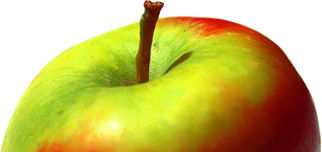
Redfree apple
/ 5 see reviews

A disease resistant summer apple developed by PRI. The scab resistance comes from the incorporation of Malus floribunda, a crab apple.
Redfree apple identification images
All images copyright Orange Pippin unless otherwise stated.
USDA identification images for Redfree
The identification paintings in the USDA Pomological Watercolor Collection span the years 1886 to 1942.
Citation: U.S. Department of Agriculture Pomological Watercolor Collection. Rare and Special Collections, National Agricultural Library, Beltsville, MD 20705.
Parents and other ancestors of this variety
- Jonathan
- Malus floribunda
- Melba
- Raritan (parent)
Offspring of this variety
Visitor reviews
- 11 Jun 2025 Paul MilenkovicThey are not the best keepers, but their unique fresh, sweet taste is unmistakenable and unique among apples. You can kind of taste the crabapple parentage in them. Every year I anticipate biting into one, crisp and juicy straight off the tree in the time from late August to mid September. Yes, they get soft-fleshed in storage, where you keep eating them until how they were right off the tree is a memory to anticipate for next year. The other crazy thing about them is that in storage, where skin waxes up--all apples do this to some extent, but the Red Free produces a lot of this wax in trying its best to let it keep a bit longer. Can never pick them as red as in the photo--there is a kind of woodpecker that pecks up the largest, reddest, sweetest of them. I am told that this bird doesn't eat the apple, rather, it wants to attract insects that are its protein serving.
- 05 Sep 2018 AdamME, United StatesOne of the worst apples I've tried, and I eat at least one apple a day. Soft and flavorless. Maybe I got a bad batch, but will avoid in the future.
- 24 Oct 2017 DonMICHIGAN, United StatesPicked mid August, ate some and made apple sauce . Enjoyed, good flavor and texture. Would recommend Redfree to others. Extremely low maintenance tree
- 21 Jul 2017 JimPA, United StatesJuly 21 and our Redfree apples are ready--crisp and juicy and just the right size for a snack. Many more than we'll be able to eat. My wife is going to dry some, and I'm thinking about getting out the cider press. I don't know what kind of cider they will produce, but I won't know unless I try.
- 23 Jun 2016 Gil SchieberWASHINGTON, United StatesI agree with the above. W.P is a better apple, but if you like the snaping texture of crisp (which it holds for a week or so) then this is fresh eating mild apple. Most importantly for me is the Scab resistance.
- 20 Sep 2011 MattWISCONSIN, United StatesRedfree are nice early season eating apples. The flavor is balanced sweet with a bit of zing but very mild over all. The best feature of these apples are their outstanding texture when eaten out of hand. Redfree apples are a simple refreshing treat that has built disease resistance. I prefer William's Pride to Redfree. W.P. is also an early dessert-quality apple with disease resistance but seems to have something more to the flavor than just sweet. I say try both!
Register your trees
Tree register
United States
- Aaron Curtis Graham in Champaign, IL
- Chris in Milford, IA
- Cory Lusk in Loveland, HAMILTON/OHIO
- Craig Sheehan in Winchester, KY
- Darren Peters in Rock Spring, GEORGIA
- Doug Drmolka in Marseilles, ILLINOIS
- Frank Omar in Hallowell, MAINE
- Jim in Turbotville, PA
- Kretschmann Family Organic Farm in ROCHESTER, PA
- Paul Gerrish in Newbury, MA
- Phillip Hatcher in Sand Springs, OKLAHOMA
- Roger Miller in Madison Heights, VA
- Ron Fischer in Orion, IL.
- Steve Pabody in Ferndale, WASHINGTON
- Surik Mehrabyan in ITHACA, NEW YORK
Canada
- Patsy Huntington in Mont-Tremblant, QUEBEC
Spring blossom records for this variety
2012 season
- June 2012 - tree owned by Patsy in Mont-Tremblant, Canada
- April 2012 - tree owned by Steve in Ferndale, United States
Record your blossom dates in our Fruit Tree Register - more >>.
Harvest records for this variety
Origins
- Species: Malus domestica - Apple
- Parentage: Raritan x PRI 1018-101
- Originates from: United States
- Introduced: 1981
- Developed by: PRI (Purdue, Rutgers, Illinois Co Op)
- UK National Fruit Collection accession: 1983-052
Identification
- Country of origin: United States
- Period of origin: 1950 - 1999
- Fruit colour: Red
- Leaf colour: Green
- Annual cycle: Deciduous
Using
- Picking season: Early
- Keeping (of fruit): 2-3 weeks
- Flavour quality: Good
- Flavour style (apples): Sweet/Sharp
- Discoloration of fruit: No discoloration (Good for drying)
- Cropping: Good
- Fruit persistence: Normal ripening
- Food uses: Eating fresh
- Picking period: early September
- Wildlife: RHS Plants for Pollinators
Growing
- Gardening skill: Beginner
- Flowering group: 3
- Pollinating others: Good
- Ploidy: Diploid
- Vigour: Average vigour
- Bearing regularity: Regular
- Fruit bearing: Spur-bearer
- Organic culture: Suitable
- Self-fertility: Not self-fertile
Climate
- Cold hardiness (USDA): Zone 4 (-34C)
- Climate suitability: Temperate climates
- Climate suitability: Warm climates
- Summer average maximum temperatures: Cool ( 20-24C / 68-75F)
- Summer average maximum temperatures: Warm (25-30C / 76-85F)
Other qualities
- Disease resistance: Good
- Scab (Apple and Pear): Very resistant
- Cedar apple rust: Very resistant
- Powdery mildew: Some resistance
- Fire blight: Some resistance
Where to buy trees
The following tree nurseries offer Redfree apple trees for sale:
- Orange Pippin Fruit Trees (USA) United States
Redfree apple trees
References
- Cedar-Apple Rust
Author: Stephen Vann, University of Arkansas, Division of Agriculture (FSA7538)
Rated as very resistant - no control needed against CAR.