
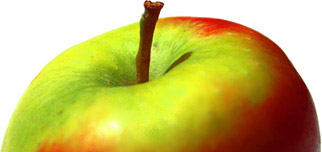

Possibly raised by a settler called John Crawford in Arkansas, USA in the 1840s, and certainly widely grown in Arkansas and Missouri later that century. It is thought to be a seedling of Winesap. This apple is notable for the extremely dark coloration, which becomes almost black after storage. The photo shows an Arkansas Black apple taken in March, having been harvested in October.
We are indebted to Monique Reed of Texas for the photo and following descriptive information.
"Now, this is supposed to be a very tart, crisp apple and a good keeper. I'd have to say it must mellow enormously in storage, as the one I had was firm and sound, but not especially crisp and not at all tart. (I'm guessing it's near the end of its storage life, since harvest is in fall.) The skin at this stage is extremely waxy. As advertised, the flesh is medium-pale yellow. It was pleasantly sweet and tasted almost as if it were an apple already prepared to go in a dessert--as if it were a tart apple with sugar (and something else? honey?) added, and perhaps a bit of vanilla near the outside and faint but definite almond undertones nearer the core. There was more going on, taste-wise than in a Red Delicious or your average Fuji--more depth, as in many of the older cultivars. Good apple. Not my favorite, but more interesting than many others."
Further information - see the Encylopedia of Arkansas History and Culture.
Arkansas Black apple identification images
All images copyright Orange Pippin unless otherwise stated.


USDA identification images for Arkansas Black
The identification paintings in the USDA Pomological Watercolor Collection span the years 1886 to 1942.
Citation: U.S. Department of Agriculture Pomological Watercolor Collection. Rare and Special Collections, National Agricultural Library, Beltsville, MD 20705.
Visitor reviews
- 30 Dec 2023Really awesome 👍💕💯
- 13 Oct 2023Photo is NOT outdoors during March!!!!!!!!!!!!!! RE: Arkansas Black Just ate 3/4 of 1, saving 1/4 for owner.
- 14 May 2022will this apple hang on the tree for storage
- 14 Apr 2022If you want to grow suckers this is your tree. More branching in general than any of the other ten or so varieties planted around the same time. Super vigorous, healthy, fruit keeps really well but bland until it has kept for a while. Crisp and juicy in February, probably beyond.
- 15 Mar 2020 ILLINOIS, United StatesWe had an Arkansas Black apple tree when I was a kid. The taste was so unique and wonderful, I have never forgotten it. Looking to get my own tree. Crunchy, crisp, tart/sweet. I remember the flesh being almost white compared to the dark exterior.
- 30 Oct 2017 OHIO, United StatesJust incredible pies - high pectin, self thickening, cooks rapidly. Beautiful, large, plentiful. Seems rarely disturbed by raccoons and squirrels. Tree's are healthy and grow strongly and rapidly. Took a solid decade to achieve high production. Love this historical American apple!
- 09 Sep 2017 MI, United StatesI found an Arkansas Black tree on the edge of a field along a ditchbank and was intrigued by the dark color of the apples. I picked a few and my family ate them. We jumped back in the car and went back to pick more. They are such delectable tart-sweet crisp apples for eating fresh we can't stay out of them. And the pies! The flavor is out of this world fantastic. Looked these up to identify on line. I will definitely look for saplings to purchase.
- 08 Dec 2016 NC, United StatesMy favorite apple of all time. Used to be available from a local orchard but must travel to western NC mountains now. Worth every gallon of gas and time spent.
- 03 Sep 2016 STILLWATER, United StatesBought some at ourfarmer's market, but they're green and red. Will they darken after picking? If so, I will wait .j
- 10 May 2016 AL-ALABAMA, United StatesA customer gave me a dz of these the first of Nov. last yr. She talked about how good they were as how I had never heard of them.She said to let them age several weeks. Well, I made my iron skillet apple pie with them for Thanksgiving. Best pie EVER!!!! Thinking of planting the trees.
- 10 Nov 2014 PENNSYLVANIA, United StatesI drive 2 hours each November to a Pennsylvania orchard just to get a bushel or two of Arkansas Blacks. They are the hardest, and most flavorful apple I've ever tasted! Since I discovered them I've introduced many other people this fragrant variety. The result of this good deed is that I have pick up their bushels as well :)
- 09 Nov 2014 GEORGIA, United StatesKathy- you can find Arkansas Blacks at Mercier Orchards in Blue Ridge, Georgia- we got a bushel there two weeks ago. When you say you got them in the foothills in California are you taking about Oak Glen or somewhere else. I grew up in Ontario and we got them there growing up.
- 02 Nov 2014 BADEN-WüRTTEMBERG, GermanyOne of the best tasting and wonderful looking varieties I know. I am searching for a nursery selling Arkansas Black in Europe, now that I have my own orchard I must have this apple. It wouldn't be complete without it.
- 25 Sep 2014 GEORGIA, United StatesThis is my favorite apple. I bought every year in the foothills of Ca. I wish I could find them in Georgia.
- 21 Sep 2014 MA, United StatesWhen aged until the skin is just shy of black (usually about a month) this is the Platonic ideal of apple-ness. Tart, crunchy, sweet but not too sweet. What more could you want?
- 11 Jan 2014 CA/ LOS ANGELES, United StatesI was shopping at Von's and noticed this dark fruit that looked like nectarines in the organic produce section. As I walked over, I was very surprised to see the fruit was an apple. I had never seen this type of Apple nor tasted it. It's great smell and color intrigued me. Therefore, I decided to buy two. When I ate the first one, I couldn't have enough. And, even though I'm really picky about the way an apple tastes, this apple convinced me to go back for more. I have bough more, and can say this is definitely my favorite apple. I hope Vons doesn't stop carrying it. Extremely delicious!!
- 26 Nov 2013 ARKANSAS, United StatesI had never heard of the Arkansas Black apple until we moved to Benton County Arkansas (place of its origin) 7 years ago. Now we're growing two of these trees. They are incredibly hardy (survived two consecutive summers of extreme drought and daily temps over 100 degrees). The apples are like none other I've ever eaten: hard as a rock, sweet/sour juicy, and a skin like polished ebony with a crimson glow. Outta this world!!!
- 18 Nov 2013 GA, United StatesI only brought 2 of the apples from the Dekalb Farmers Market in Decatur, Georgia. I started eating one of them on the way home and turned around to get more. They are so firm, crisp and flavorful. Plus they are aromatic and beautiful on my table. I could go on and on about this new food find and I am SO glad I discovered this apple. I plan on making my Thanksgiving Pie from them!
- 06 Oct 2013 MISSOURI, United StatesI have 2 of these in my little farm orchard and my husband and girls LOVE that the apples can sit for months in the fridge and still be good. This year we let them sit on the tree until they turned blackish red and the flavor was FANTASTIC!!! My little trees were so overloaded, I was afraid branches were going to snap in a fall thunderstorm or we would have left them on till the end of the month.
- 19 Sep 2013 United StatesFor years our tree only gave us a few tasteless apples. Then last year it delivered a boat load and because there were so many many we're left on the tree longer. This longer time, (I let them fall off the tree) made the most delicious apples I have ever tasted. It is September and it is going to give us another huge crop. Can't wait.
- 17 Jan 2013 Pennsylvania (south-central), United StatesI bought this apple from an apple orchard near Gettysburg. I have to agree with Monique Reed of Texas (see comment on Tasting Notes tab). The only additionI noticed: the apple is bland tasting, not tart, and I would prefer a Fuji over this apple any day.
- 14 Feb 2012 WV, United StatesThis apple is very popular here in WV. If grown like apples are grown in commercial orchards, the flavor is weak and not at all appealing. If grown organically or even if almost neglected other than pruning this apple is outstanding. One of my uncles remembers as a child digging through the leaves for these apples in February and March and eating them. He said they were perfectly crisp, sweet yet tart and very flavorful.
- 30 Oct 2011 TN, United StatesI bought these at the orchard today. It's bitter and not flavorful. My dog likes it, though.
- 11 Jul 2011 AR-ARKANSAS, United StatesMy Arkansas black apple tree just got brown leaves. Is the tree died?
- 11 Jun 2011 CALIFORNIA, United StatesI planted an Arkansas Black in my back yard near a self polinating tree. The area where I live is 5900 ft. elevation and it is a ski resort area in the San Gabriel Mountains of California. I planted the two and a half ft tall tree (then) in May of 2010. This year, ( now June of 2011) I am going to have 12 apples from a now three and a half ft tree. I certainly didn't expect any apples for the next two years. I'll get back to this site after late October to tell you how they are.
- 11 May 2011 ID, United StatesI first ate an Arkansas Black in Oak Glen, California-a low mountain area east of Los Angeles. I kept a basket of these apples for 4 months on my back porch. GREAT KEEPERS! I have never forgotten the FLAVOR. Have purchased a StarkSpur Arkansas Black tree. My county agric. extension agent said they would grow VERY well in southwest Idaho (where I now live).
- 28 Apr 2011 MISSISSIPPI, United StatesBought 8 trees 2 years ago from the local co-op, and was intrigued by the name Arkansas Black. So far I haven't had any eatable results, but this year looks more promising. Apr '11
- 30 Jan 2011 TURKEY, TurkeyI would like to learn If I can grow Arkansas black apple trees, in regions where the teperature is beween -10/+7 degrees in winter and +20/+35 degrees in summer. mumin
- 27 Jan 2011 CA, United StatesThis apple variety alongside the Pink Lady are my two favorite this year. My local Whole Foods Market carries organic apples. The first time I took a bite of an Arkansas Black I was reminded of a good red wine.
- 21 Nov 2010 SC, United StatesBought these tioday at the Apple Barn in Pigeon Forge Tn after hearing people rave about them. Very disappointed. Found them to be. Almost tastless although they are crisp. I don't understand what the hype is about
- 18 Nov 2010 UT, United StatesToday (Nov. 16th) I picked the most beautiful Arkansas Black apples. I have a young espaliered tree and this is the second year for these apples. I picked to early last year and the flavor was not developed yet. I live in the desert and we reach 115 degrees during the summer for weeks at a time. This apple is wonderful for my area in Hot Southern Utah and is definitively under loved .
- 17 Nov 2010 United StatesThe Black Arkansas is indeed back at the Dekalb Farmer's Market. Just got a couple and they are delish! Rock hard, crisp, and sweet/tart. Wish they were more widely available.
- 10 Nov 2010 GA, United StatesI have bought them at The DeKlab Farmers Market in Atlanta, for the last 4 years but none have arrived so far this year! Are they ready? Has anyone had one recently?
- 07 Oct 2010 TN, United StatesLast year I bought a mountain home that had 2 very old apple trees in the yard. They were overgrown and producing only a few apples on each tree. They were pruned last winter and both are full now. I had no idea what kind they were so I took an apple from each tree to a local apple grower and found out that one of the trees is an Arkansas Black and the other is Golden Delicious. It was interesting to read the comment from the writer in UT that Arkansas Black pollinates well with Golden Delicious. Probably why they were planted together.
- 15 Aug 2010 SC, United States15 August 2010 First tried one of these apples at a farmers market fall 09. Very good! Would they grow well in the midlands of SC? I have a small orchard growing with other kinds of apples but this became a favorite after using it in apple pie-both american and swedish. Until trying this one we used cortland for our baking back in MA but we couldnt find them here. Am so glad we were introduced to them at the Farmers market. Oh, great eating apple too!
- 08 Apr 2010 CALIFORNIA, United StatesWe have an AB tree in our yard--old tree, over fifty years old my guess. Prune it in the late winter, and it can be an extremely heavy producer the following summer (ours produces a lot and it is old). These are my favourite apple--makes GREAT apple sauce--not a juicing apple at all. Eating is fantastic--get them in season--tart, crisp, satisfying sense of dense flesh. They are good eating when they are not at maximum ripeness, and are spectacular when they go a deep red/almost black. They make a tasty apple pie. The claim that they go black in storage is a load of cockamamie. They go black (on the tree) when they are at maximum ripeness--use them at this point. This is a tree that enjoys a Mediterranean climate--we don't water it; it gets rain in the winter and early spring, and that is it. We are not particularly hot or cold--mild climate, north of San Francisco, on the coast.
- 04 Dec 2009 DEVILLE, RAPIDES/ LA, United StatesI need help! We are buying a place in north Ar. and are looking into planting several Black Apple trees on the property to raise for $. How many bushels does a mature tree produce? How long before a tree is mature enough to produce several bushels of apples? What is the average price for a bushel of apples? I myself have never tasted one but have heard rave reviews from others and have seen several roadside stands in NW Ar selling them but we didn't stop. Where can I get trees to plant? and When is the best time to plant the trees?
- 13 Nov 2009 SOUTH WEBER, UT, United StatesI got one of these trees as a semi-dwarf from Starks 3 years ago. It is a very beautiful tree and had a few apples by the 2nd year - a real surprise! I expected a tart cooking apple but was intrigued by the color and long-keeping characteristics and planned on making applesauce with a variety of apples. It is a really delightful tasting apple, however - the flavor is similar to what has been described and the aroma is subtle and wonderful. We do not harvest the apples until the very last of Oct. or 1st of Nov. - rare for the temp to go below 29-30 before that time, but if it did we would simply throw something over the tree - one major reason for getting a semi-dwarf. a So far we eat all the apples in a month or 2, but as the tree grows and production increases we will be able to evaluate the flavor after long storage. If you want one I heartily recommend Starks because this variety is a Starks Spur which has many more growing spurs than usual. Also, polinates just fine with a Golden Delicious.
- 05 Nov 2009 DECATUR, AL, United StatesHad my first taste of one of these a few years ago at an apple orchard, and was delighted to find them at my local farmers market recently. Tough skin but a deep, wine-honey flavor and sharp tartness. Macintosh wwere always my favorite until these...
- 27 Oct 2009 COOKEVILLE, TN, United StatesI am holding my first Arkansas Black apple in my hands...thought I'd post my thoughts as I tried it for the first time. I looks lovely & is exactly as pictured above. Here goes... WOW! It's super hard! After that shock, it's sweet, the smallest bit tart and crispy. The skin is a bit tough, not bad, though. I'd have to say my favorite is still the Pacific Rose. Think I'll purchase more of these and store for a month or so...
- 18 Oct 2009 GREENE CO., TN, United StatesWe purchased one of these trees from Lowe's in 2008 with a 'Golden Delicious Apple' tag on it. I love those. Well, in 2009 after blooming we had 10 apples appear. The skin was light at first but we knew right away it was not a Golden Delicious as they kept turnng darker. They are almost black now. Picked one too early but could tell they are going to be delicious apples. I found out from a man that sells apples along the highway what type of apples they are. Obviously the tree was tagged wrong but that is okay. Very fast grower and fruit the first year!
- 16 Oct 2009 LEAVENWORTH KANSAS, United StatesI've had one of these trees in my yard for several years, and never knew what kind it was until now!!! It is one of THEE best apple varieties in my book! I used to ONLY eat Granny Smith Apples, as I like them firm and tart. These knock Granny out, better flavor and DEFINETELY firm!!! We have VERY hot/humid summers, and winters below zero, but it doesn't seem to faze this tree. And you can eat it right off of our tree, don't need to 'age' it. Count me in as a #1 fan!
- 15 Oct 2009 OREM, UTAH COUNTY, UTAH, United StatesI discovered an older tree with these apples on in Orem, UTAH a week ago. This apple has no historical records of being propagated in our area. What a wonderful find. Great people that let me investigate their apples and other fruits to preserve and list.
- 13 Oct 2009 HEFLIN, AL, United StatesI had my first taste of an Arkansas Black apple last week. It was crisp, sweet, yet slightly tart and juicy. Wonderful. The tree it came from is located in Northeast AL close to the Tallapoosa River.
- 30 Sep 2009 CALIFORNIA, United StatesLisa: You can buy Arkansas Black apples at Riley's Farm in Oak Glen around the end of October.
- 24 Sep 2009 ORANGE COUNTY CA, United StatesWhere can I buy Arkansas Black apples?
- 29 Nov 2008 CALIFORNIA, United StatesThose grown in the mountains are hard as a rock when first picked and need to mellow in storage a month before you can sink your teeth into it, and thus make great keepers, storing fine in the crisper bin for months. They develop a very "greasy" skin in storage. However, those grown down in the hot inland valleys are wonderful to eat right off the tree, with a wonderfully crisp texture and a flavor that matches the skin; a deep, dark, winey, mohogany flavor with wonderful sugar and spice. The lowland ones do not keep anything like the mountain-grown ones however. They ripen here around Thanksgiving. Impervious to heat, they are excellent to grow in Southern California, even the low deserts.
Tree register
United States
- Aaron in Jenks, OK/TULSA
- Adam Dupps in Lawrenceburg, IN
- Adrian Astur Alvarez in Woodinville, WA
- Albany Appleguy in Castleton, NY
- Alex in Freeland, WA
- Alicia Collins in Montclair, NJ
- Amanda Emily in Colville, STEVENS, WA
- Arthur Patterson in Klamath Falls, OREGON
- Arthur Pitt in Finlayson, MN/PINE
- Axel Kratel in Santa Cruz, CALIFORNIA
- Ben in Helenwood, TN
- Bill Martin in Bristol, TN
- Bobby in Roanoke, VIRGINIA
- Brian Lance in Marion, ILLINOIS
- Brooke Schreier Ganz in Mill Valley, CA
- Bryan Houser in Elkton, MI
- Bryan m in TRENTON, NJ
- Chris Thomas in Federal Way, WASHINGTON
- Christoph in RENO, NV
- Craig Sheehan in Winchester, KY
- Csberch in TOLEDO, WA
- Dale Paulson in Chaseburg, WI
- Dale Paulson in Chaseburg, WI
- Dale Paulson in Chaseburg, WI
- Dan Spratlen in Camano Island, WASHINGTON
- Dan Spratlen in Camano Island, WASHINGTON
- Dan Wombles in New Canton, IL
- Dana Larkin in Virginia Beach, VA
- Dana Larkin in Virginia Beach, VA
- Daniel C in Sabetha, KANSAS
- Danny Chesser in Phoenix, ARIZONA/MARICOPA
- Danny Chesser in Phoenix, AZ
- Darren Peters in Rock Spring, GEORGIA
- Dave Beamer in Santa Barbara, CALIFORNIA
- David in Wilson, KS
- David A Dawson in Solsberry, INDIANA
- David Black in Bentonville, ARKANSAS
- Dennis in Bradford, DARKE, OH
- Dennis in Great Meadows, NJ
- Devan a Nicely in Lexington, VA
- Diana Mcbeth in Lincoln, NE
- Diana Shepard in Overland Park, KS
- Dianne Giles in Henderson, IOWA
- Dona Grant in Winchester, OHIO
- Duane Brown in West Jefferson, NC
- Ephrem Shelby in Opelika, AL
- Eric in Winslow, ARKANSAS
- Eric Powell in MD
- g Joseph Jordan in WEST CHESTER, PA
- Gary Hegler in Chesaning, MICHIGAN
- Gil Schieber in Snohomish, WASHINGTON
- Gina Colver in EPHRATA, WASHINGTON
- Glen in COUPEVILLE, WA
- Grouchybroad in Kirksville, MISSOURI
- J.P.Curry in Sturgeon, MO
- James Nichols in La Luz, NEW MEXICO
- Jason Long in Papillion, NEBRASKA
- Jeannie Berg in Scio, OR
- Jeff Fournier in Alger, MI
- Jerry Hudgins in Point Reyes Station, CALIFORNIA
- Jesse in Kernersville, NC
- Jim Riley in Oak Glen, CALIFORNIA
- Joe & Rachel Bender in Albion, INDIANA / NOBLE
- John R. Szakacs in Ben Lomond, CA
- Jon Shannon in Shaw Island, WA
- Jonathan Bastedo in YUCAIPA, CA
- Juan Casero in PALM BAY, FLORIDA
- Justin Piper in Oakland, OREGON
- Karen Spencer in Salado, TX
- Karl Collawn in Bumpass, VIRGINIA
- Kathy Kempson in Cazenovia, NY
- Katie Kranich in Elkton, MARYLAND
- Kellogg Hill Farms in SOUTH DAYTON, NY
- Ken Walden in Hodges, SOUTH CAROLINA
- Kenneth in Newberry, FLORIDA
- Kim Lapacek in Poynette, WI
- Kurt in Ladysmith, WI - WISCONSIN
- Liam Sauer-Wooden in Seattler, WA - WASHINGTON
- Lori - Jim McKeaige in Otter Creek, IOWA/JACKSON
- Mark A. Rock in Columbia Station, OHIO
- Mark A. Rock in Columbia Station, OHIO
- Mark Bartel in Hagerstown, MARYLAND
- Matthew in Pinon Hills, CA
- Michael Bell in Morgantown, KY
- Michael Dryfoos in EDGEWOOD, WA
- Michael Miller in Kennett Square, PA
- Mike Betts in Grattan Township, MICHIGAN/KENT
- Milovan Popovic in Ellington, CONNECTICUT
- Nathan Kunze in Utica, KY
- Nathan Parker in Mount Shasta, CA
- Nathan Sanders in Middleburg, PENNSYLVANIA
- Neil Clark in Yucaipa, CA / USA
- Owen Witesman in SPRINGVILLE, UT
- Paige in PILOT HILL, CALIFORNIA
- Paula Reinbold in Rush, COLORADO
- Peter in Johnson City, TN
- Phillip Hatcher in Sand Springs, OKLAHOMA
- Randy in Baxley, GA
- Randy Anderson in MONTICELLO, KY
- Randy Carbo in Hopedale, MASSACHUSETTS
- Ray And Jan Wickline in Middletown, MD
- Ray Wickline in Middletown, MARYLAND (MD)
- Red in Arcata, CA
- Regina White in FAIRMONT, WV
- Ricky d Hamblin in CLOVER, SC
- Roger Miller in Madison Heights, VA
- Ron Davis in CHUCKEY, TN
- Ron Fischer in Orion, IL.
- Ronald Wolfe in Monticello, ILLINOIS
- Ronny Blackstock in Fitzgerald, GA
- Roy Nichols in LA LUZ, NEW MEXICO
- Ryan in Cumming, GA
- Ryan in Poway, CALIFORNIA
- Ryan in Sterling, NY
- Scott McElhaney in Camas, WASHINGTON
- Scott McElhaney in Camas, WASHINGTON
- Shirley Morelli in Northport, WA
- Stephan Orchard in Westfield, INDIANA
- Stephen Daniels in Smithville, TENNESSEE
- Stephen Sain in Los Lunas, NEW MEXICO
- Steve Kollodge in BROOK PARK, MN
- Steven Stanley in Johnson City, TENNESSEE
- Steven Sypkens in Turney, MO
- Surik Mehrabyan in Ithaca, NY
- Tash in Centerburg, OHIO
- Tim in Leavenworth, LEAVENWORTH KANSAS
- Tom & Diane Davidson in Salt Lake City, UTAH
- Tony Enloe in Bat Cave, NORTH CAROLINA, HENDERSON
- Tyler Stewart in KLAMATH FALLS, OREGON
- Velvie Mckenzie in Jackson, OH
- Velvie Mckenzie in Jackson, OH
- Victoria Else in Middletown, NY
- Whitney Peters in Sixes, OREGON
- William & Deborah Seale in Washington, IA
United Kingdom
- Des Kelly in INVERNESS,
Netherlands
- Aron Jore-Van Houten in Arnhem, GELDERLAND
Portugal
- Luis Godinho in SAO MAMEDE, BATALHA
Spring blossom records for this variety
2025 season
- 1st May 2025 - tree owned by Milovan in Ellington, United States
2021 season
- 4th May 2021 - tree owned by Milovan in Ellington, United States
2020 season
- 27th April 2020 - tree owned by Jerry in Point Reyes Station, United States
- 24th April 2020 - tree owned by Steven in Turney, United States
2019 season
- 26th April 2019 - tree owned by Jerry in Point Reyes Station, United States
2018 season
- 30th April 2018 - tree owned by Jerry in Point Reyes Station, United States
2016 season
- May 2016 - tree owned by Lori in Otter Creek, United States
2015 season
- 9th April 2015 - tree owned by Karen in Salado, United States
- March 2015 - tree owned by Phillip in Sand Springs, United States
2014 season
- June 2014 - tree owned by Dave in Santa Barbara, United States
- 23rd April 2014 - tree owned by J.P.Curry in Sturgeon, United States
- 19th April 2014 - tree owned by Bobby in Roanoke, United States
2013 season
- April 2013 - tree owned by Bobby in Roanoke, United States
- April 2013 - tree owned by Phillip in Sand Springs, United States
2012 season
- April 2012 - tree owned by Ray in Middletown, United States
- 27th March 2012 - tree owned by Tim in Leavenworth, United States
- 23rd March 2012 - tree owned by J.P.Curry in Sturgeon, United States
- March 2012 - tree owned by Dona in Winchester, United States
2011 season
- 14th April 2011 - tree owned by J.P.Curry in Sturgeon, United States
Record your blossom dates in our Fruit Tree Register - more >>.
Harvest records for this variety
2020 season
- 3rd week November 2020 - tree owned by Jerry in Point Reyes Station, United States
- 4th week October 2020 - tree owned by Milovan in Ellington, United States
2018 season
- 3rd week October 2018 - tree owned by Dennis in Bradford, United States
2017 season
- 3rd week October 2017 - tree owned by Dennis in Bradford, United States
2016 season
- 4th week October 2016 - tree owned by Eric in , United States
- October 2016 - tree owned by Lori in Otter Creek, United States
2015 season
- October 2015 - tree owned by Roger in Madison Heights, United States
- October 2015 - tree owned by Phillip in Sand Springs, United States
2013 season
- 3rd week October 2013 - tree owned by J.P.Curry in Sturgeon, United States
- 2nd week October 2013 - tree owned by Phillip in Sand Springs, United States
- 1st week October 2013 - tree owned by Grouchybroad in Kirksville, United States
- October 2013 - tree owned by Bobby in Roanoke, United States
2011 season
- 3rd week November 2011 - tree owned by Arthur in Klamath Falls, United States
- 1st week October 2011 - tree owned by J.P.Curry in Sturgeon, United States
2010 season
- 1st week November 2010 - tree owned by Mark in Columbia Station, United States
2009 season
- 2nd week September 2009 - tree owned by Tim in Leavenworth, United States
Origins
- Species: Malus domestica - Apple
- Parentage: Winesap seedling?
- Originates from: United States
- Introduced: 1840s
- UK National Fruit Collection accession: 1955-093
- Some historical details taken with kind permission from 'The New Book of Apples' by Joan Morgan and Alison Richards , illustrated by Elisabeth Dowle, published by Ebury Press, 2002.
Identification
- Country of origin: United States
- Period of origin: 1800 - 1849
- Fruit colour: Crimson
- Flower colour: Pink - light
- Leaf colour: Green
- Popularity: Best sellers
- Annual cycle: Deciduous
Using
- Picking season: Late
- Keeping (of fruit): 3 months or more
- Flavour quality: Very good
- Flavour style (apples): Aromatic
- Cooking result: Textured puree
- Discoloration of fruit: No discoloration (Good for drying)
- Cropping: Good
- Fruit persistence: Normal ripening
- Food uses: Eating fresh
- Food uses: Culinary
- Food uses: Juice
- Food uses: Hard cider
- Picking period: early November
- Wildlife: RHS Plants for Pollinators
Growing
- Gardening skill: Average
- Flowering group: 3
- Pollinating others: Poor
- Ploidy: Triploid
- Vigour: Vigorous
- Bearing regularity: Regular
- Fruit bearing: Partial tip-bearer
- Attractive features: Attractive flowers
- Attractive features: Attractive fruit
- Self-fertility: Not self-fertile
Climate
- Cold hardiness (USDA): Zone 5 (-29C)
- Cold hardiness (USDA): Zone 6 (-23C)
- Cold hardiness (USDA): Zone 7 (-18C)
- Cold hardiness (USDA): Zone 8 (-12C)
- Cold hardiness (USDA): Zone 9 (-7C)
- Cold hardiness (USDA): Zone 10 (-1C)
- Climate suitability: Warm climates
- Summer average maximum temperatures: Warm (25-30C / 76-85F)
- Summer average maximum temperatures: Hot (>30C / 86F)
Other qualities
- Disease resistance: Good
- Cedar apple rust: Very resistant
- Scab (Apple and Pear): Some resistance
- Fire blight: Some resistance
Where to buy trees
The following tree nurseries offer Arkansas Black apple trees for sale:
- Orange Pippin Fruit Trees (USA) United States
Arkansas Black apple trees - Burnt Ridge Nursery and Orchards
United States More >> - Cummins Nursery
United States More >> - Trees of Antiquity, LLC
United States More >>
Where to buy fresh fruit
The following orchards grow Arkansas Black:
United States
Alabama
- Crow Mountain Orchard, Fackler
- Isom Orchards, Athens
- Mountain View Orchards, Jemison
- Scott's Orchard, Hazel Green
Arizona
- Beatty's Orchard, Hereford
Arkansas
- Caubble Orchards, Wynne
- Roberson Orchards, Omaha
California
- Denver Dan's, Camino
- Moms Country Orchards, Yucaipa
- Parrish Pioneer Ranch, Yucaipa
- Riley's at Los Rios Rancho, Yucaipa
- Riley's Farm Fort Cross Orchard, Yucaipa
- Sky Meadow Farms, Leona Valley
- The Apple Farm -- Bates & Schmitt, Philo
Colorado
- Third Street Apples, Penrose
Delaware
- Fifer Orchards, Camden Wyoming
Georgia
- Aaron's Apple House, Ellijay
- B.J. Reece Apple House, Ellijay
- Freedom Farms - Apple & Peach Orchard, Chatsworth
- Hillcrest Orchards, Ellijay
- Hillside Orchard Country Store, Lakemont
- Mercier Orchards, Blue Ridge
- R & A Orchards, Ellijay
- Red Apple Barn (Little Bend Orchard), Ellijay
Illinois
- Apples On Oak, Lockport
- Camp's Orchard, Roseville
- Curtis Orchard & Pumpkin Patch, Champaign
- R.E. Arends Orchard, Laura
Indiana
- Apple Works, Trafalgar
- Bender's Nursery and Orchard, Albion
- Bright Meadows Orchard, Lawrenceburg
- Cook's Orchard, Fort Wayne
- Deer Creek Orchard, Galveston
- Ditzler Orchard, Rosedale
- Doud's Countyline Orchard, Wabash
- Lee's Orchard, Columbus
- McClure's Orchard, Peru
- Harker Family Farms & Orchard, Waldron
Iowa
- 3 Bee Farms, Griswold
- Allen's Orchard, Marion
- Applecart Orchard, Vinton
- Burr Oak Farms, Winterset
- Deal's Orchard, Jefferson
- Smalls Fruit Farm, Mondamin
- Wilson's Orchard, Iowa City
Kansas
- Fieldstone Enterprise, Overbrook
- Meadowlark Farm, Rose Hill
- Stephen's Orchard, Bonner Springs
Kentucky
- Eckert | Boyd Orchard, Versailles
- Evans Orchard & Cider Mill, Georgetown
- Hinton's Orchard & Farm Market, Hodgenville
- Reed Valley Orchard, Paris
- Sandusky's Orchard, Liberty
Maine
- Eden Acres Family Farm, East Waterboro
Massachusetts
- Cider Hill Farm, Amesbury
- Red Apple Farm, Phillipston
Michigan
Minnesota
- Maple Run Orchard, Finlayson
Missouri
- Centennial Farms, Augusta
- Hickory Ridge Orchard, Mexico
- Purple Gate Farm, Highlandville
- Red Bird Hill Apple Orchard, Fulton
- Sunshine Valley Farm, Rogersville
- West Orchards, Macon
Nebraska
- Union Orchard, Union
New Hampshire
- Lull Farm, Hollis
- Old Ciderpress Farm, Westmoreland
New Jersey
- Strawberry Hill Farm, Chesterfield
New Mexico
- Costanza Apple Orchard, Belen
- Costanzas' Orchards and A-Bee Honey, Edgewood
- Fred & Ruby Martinez Orchards, Dixon
- Manzano Mountain Retreat and Apple Ranch, Torreon
New York
- Black Diamond Farm, Trumansburg
North Carolina
- Big Horse Creek Farm, Lansing
- Billy Laughter Orchards, Hendersonville
- Bohlen Farms, Chapel Hill
- Creasman Farms, Hendersonville
- Devil Dog Orchard, Reidsville
- JH Stepp Farm's Hillcrest Orchard, Hendersonville
- Justus Orchards, Hendersonville
- Lyda Farms, Hendersonville
- Mountain Fresh Apples, Hendersonville
- Piney Mountain Orchards, Hendersonville
- Skytop Orchards, Flat Rock
Ohio
- Hoen's Orchard and Market, Delta
- Ochs Fruit Farm, Lancaster
Oklahoma
- High-Fence Farm LLC, Sand Springs
Oregon
- Kiyokawa Family Orchards, Mount Hood Parkdale
- Marquam Meadows Fruit Company, Molalla
- Old Stage Farm, Central Point
- Thompson Creek Organics, Applegate
Pennsylvania
- Northrop's Apple Acres, Lake City
South Carolina
- Blue Haven Orchards, Long Creek
- Bryson's Apple Orchard, Mountain Rest
- Chattooga Belle Farm, Long Creek
Tennessee
- Breeden's Orchard & Country Store, Mount Juliet
- Fairmount Orchard Inc., Signal Mountain
- Hurricane Hollow Apple Orchards, Buffalo Valley
Virginia
- Ayers Orchards, Cana
- Jim’s Apples, Duffield
- Johnson's Orchards & Peaks of Otter Winery, Bedford
- Morris Orchard, Monroe
- Sweet Rose Farm, Blue Grass
- Thornton River Orchard, Sperryville
Washington
- Skipley Farm, Snohomish *** Feature Orchard ***
West Virginia
- Ruggles Orchard, Levels
Canada
British Columbia
- Salt Spring Apple Company, Salt Spring Island
Ontario
- O'Keefe Grange, Dobbinton
References
- Cedar-Apple Rust
Author: Stephen Vann, University of Arkansas, Division of Agriculture (FSA7538)
Rated as resistant - control only needed under high disease pressure