
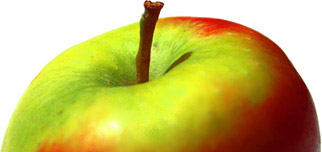

Bramley's Seedling is without doubt the definitive English cooking apple, and in terms of flavor ranks as one of the world's great culinary apples. Although England has produced a large number of excellent "cookers", Bramley is so dominant that the others are largely forgotten. Most cooks reach automatically for the trusty Bramley, and it is equally prevalent in commercial apple bakery products in the UK. Its key feature is the very high level of acidity, and the excellent strong apple flavour it lends to any apple dish.
In England a clear distinction is made between "eaters" and "cookers". English apple cookery usually calls for apples which cook to a puree - and the intense acidity of Bramley's Seedling guarantees the lightest and fluffiest of purees. This contrasts with the traditions of other countries, notably France and the USA, where cooks often prefer apples which keep their shape in cooking. For this reason Bramley's Seedling is not as well-known outside England as some of the other popular English apple varieties. It is quite widely planted in gardens in Denmark (where by 1938 it was considered to be the 4th most popular variety grown) and is now becoming popular in the USA as a result of increasing interest in English apple varieties.
Bramley's Seedling trees are extremely vigorous - at least a size larger than most other apple varieties on any given rootstock. They are quite easy to grow, and have attractive crimson blossom. The only complication for gardeners is that Bramley's Seedling is a triploid variety, with three sets of genes instead of the more usual two. As a result it needs two different pollinating apple trees nearby to ensure successful pollination.
They are also notably long-lived. 2009 was the 200th anniversary of the discovery of Bramley's Seedling, and - remarkably - the original tree was still alive in the same garden in Nottinghhamshire, England, where it was planted as a pip by a young girl, Mary Ann Brailsford, 200 years before. It takes its name from a subsequent owner of the house, a Mr Bramley who allowed a local nurseryman to propagate it in the 1850s on condition that it was given his name.
Also known as
- Uncle Hardin
Bramley's Seedling apple identification images
All images copyright Orange Pippin unless otherwise stated.


USDA identification images for Bramley's Seedling
The identification paintings in the USDA Pomological Watercolor Collection span the years 1886 to 1942.
Citation: U.S. Department of Agriculture Pomological Watercolor Collection. Rare and Special Collections, National Agricultural Library, Beltsville, MD 20705.
Offspring of this variety
Visitor reviews
- 13 Mar 2015 WASHINGTON, United States5 trees on Bud-9 one on m26. Vigorous! spury yet fat-wooded. Flat wide antler-like growing branches like Belle deBoskoop on bud-9. Regular, heavy bearing, even good in the shade-as it's thin acid is like a lemon-perfect complement to a pie (with another apple to add flavor). Yes, not much flavor, just acid. The "Northwest lemon".
- 02 Sep 2013 NONE, DenmarkWe have two BS trees in my birth-home. They were old and big when i was born 61 years ago. The still carry several hundred Kg's of apples every year. My old mom collects them, and give them away to the whole neighborhood. I moved 200Km's away, and have put some branches on one of my new appletrees here, and after two years, they already carry 18 BIG ones, heureka. All the best, Ebbe
- 19 Jul 2011 BEDFORDSHIRE, United KingdomHi, I have just bought a Bramley seedling and it has several apples on, some of which fell off when planting. Its a bit early in the season to be harvesting them but will the fallen ones continue to ripen?, can I use them now? what is best??
- 16 Feb 2011 IrelandI have over the last few months planted the beginning of my home orchard. I started with a couple of gifted Katy's, 3 Red Devils purchased from this site (thanks!) and most recently a Bramley Seedling from my local garden centre. Since I'd grown up with a small orchard at home I couldn't consider not having one of my own at our new house. I've gone for all large root stock to give the summer shaded orchard feel. I'm currently researching pollination due to just having picked up a Golden Delicious tree for a fiver and just determining that it 'fits' with the rest before I plant it. Looking forward to my first starter crops this year! To the Aussies and Americans looking for Bramleys, I'd offer to send you some but I'm not sure they'd go the distance and wold cost a fortunte to ship. Has anyone actually made any homemade cider from them?
- 01 Feb 2011 IRELAND, IrelandWe have one Bramley tree in our garden here in Dublin. It gives enough apples for the whole Winter most years. It's the only cooker I ever remember eating but this is probaby because others can't compete.
- 13 Dec 2010 FL, United StatesI grew up in Pennsylvania and we had an old apple tree outside our back door that had the best apples for making absolutely out of this world pies and apple sauce. The tree is still there, but unfortunately I'm not. I've spent years trying to find out what kind of apples they were. This past summer when I was in Ireland I saw apples in the store that looked amazingly like my apples except they were bigger. I looked to see what they were called and saw that they were Bramley apples. A few days later I stopped at a restaurant and had an apple tart that tasted exactly like the pies my mother used to make and when I asked what kind of apples they were made with was told that they were Bramley apples. Now, if I could just find Bramley apples in Florida ...
- 10 Nov 2010 CAMBRIDGESHIRE, United KingdomKimmy...... It is my understanding that "Bramley Original" should only be used to describe trees that are propagated from scion wood taken directly from the original tree, which still grows in Nottingham - England. There are claims that what is sold as Bramley by most nurseries is somewhat mutated, due to so many propagations in the last two centuries. It is claimed that grafts of Bramley Original produce slightly superior fruit and a slightly better-structured tree than what is usually sold as Bramley.
- 07 Nov 2010 CALIFORNIA, United StatesI'm trying to find out the difference between a "Bramley's Original" and a "Bramley's Seedling". Some mail-order Web sites sell both varieties. There must be some physical or flavor differences or they wouldn't sell both varieties. Also, does anyone know of a source for both of these varieties in California? I'm not interested in dwarf or semi-dwarf rootstock. I want the tree to grow to full size - 30 ft tall or higher. M-111 rootstock might be okay, but nothing smaller than that. Nurseries outside of California usually will not ship to California, unfortunately, and most nurseries only have the smaller growing rootstock.
- 11 Oct 2010 LANCASHIRE, United KingdomI planted a bramley apple tree about 7-8yrs ago, can't remember exactly, and it has grown well and gives us the most delicious apples, much, much redder than ordinary bramleys. It is so sweet it needs no sugar when cooked and has a lovely fluffy tecture. Does anyone else have a red bramley?
- 12 Sep 2010 AustraliaI've been trying in vain to find someone or somewhere selling BRAMLEY apples, Granny Smith's are a poor substitute for cooking apples. Is there anyone in NSW growing Bramleys?
- 14 Aug 2010 TYNE AND WEAR, United KingdomA good and useful website. My Bramley (about five years old) this year has produced a large quanitity of smallish apples. Should they have been thinned earlier in the season or will they still swell? David Stuart, Gateshead, UK, foxtrot_delta_sierra@yahoo.co.uk
- 14 Jun 2010 NY, United Statessaw delia's recipe for mincemeat and it called for bramley apples....what is a good substitute for this here in the states...thanks!!!
- 20 May 2010 QUEENSLAND, AustraliaHave to disagree that the Bramley is unsuitable outside a large commercial orchard. My family home in the UK has a small orchard consisting of four small Bramleys that have been going strong since my grandparents planted them back in the fifties. Every year we get so many apples we have to give away vast quantities. But the rest store very well throughout winter in an apple rack. In my view, no English apple orchard, private or commercial, is complete without a Bramley, the best cooking apple, and a Cox Orange Pippin, the best desert apple, both symbolising the very quintessence of an English cottage garden.
- 16 May 2010 SOMERSET, United KingdomIt may be different here in the UK, but my Bramley flowers at the beginning of the season, usually the second variety out of forty to come into blossom. Mine are huge vigorous trees, at least eighty years old, the branches are about twelve inches in diameter - when they go above thirty feet high we cut a couple of the highest branches out and they keep us in firewood for weeks. As the trunks are hollow it seems a good idea to take some of the weight off them. Ours are Crimson Bramleys, pretty red flushed fruit, many of them are very large, the size of two clenched fists. We get, at a guess, about ten wheelbarrows full of fruit from each tree, they've certainly repaid us well for the price my grandfather paid for them.
- 18 Apr 2010 WASHINGTON, United StatesBramley's being a triploid variety, it is sterile and requires another apple tree for pollination. Also, since Bramley's blooms very late, someone with room for only one other tree would do well to choose a self-fertile or partially self-fertile cultivar that blooms no earlier than mid-season in order to set Bramley fruit. A few possibilites that come to mind (no doubt there are more): John Grieve, Greensleeves, Kingston Black, Wolf River, Fiesta, Ellison's Orange, Northern Spy. Looking up the relatives of these cultivars may yield an option to suit your taste.
- 20 Mar 2010 LEICS., United KingdomLike Cox's, Bramley's is a poor variety for growing outside of large commercial orchards because of its awkward pollination requirements. It is supposedly far better on a large root-stock. Agreed on the comment about modern supermarket Bramley's - very unripe, though good flavour - fruit picked riper is a lot less tart.
- 14 Mar 2010 WASHINGTON, United StatesBruno, If you are located in the States, look up Raintree Nursery via a search engine. They offer Bramley on semi-dwarf rootstock (EMLA 7) which their catalog indicates should grow to about eleven feet tall, and semi-standard (MM111) which I would guess may reach 17 feet. I have ordered five different fruit trees from this company (four apples: Liberty, Queen Cox, Kingston Black and Ashmead's Kernel; and one sour cherry: English Morello) and my trees are doing well. I hope for a first crop this season.
- 11 Dec 2009 NORWICH, NORFOLK, United KingdomI don't really feel Bramley is "extremely tart". Very unripe ones (usually quite dark green) often found in supermarkets can be sharp. If allowed to ripen they can be eaten raw (I always steal a slice or two when cooking them) and need only a little sugar when cooked. Try adding sultanas or raisins to get the sweetness. This is a lovely apple.
- 23 Oct 2009 NEWCASTLE, NSW,, AustraliaUnfortunately I have never seen them anywhere except Ireland and the UK.
- 07 Aug 2009 ADELAIDE, AustraliaDo you know where I may be able to buy Bramley apples??
- 13 May 2009 NEWCASTLE, NSW,, AustraliaThe Bramley is the definitive cooking apple. Vastly superior to all others when used in tarts and pies. Because of the extreme tartness it requires large quantities of sugar giving a moist well flavoured result.
- 25 Sep 2008 SOUTHWELL, United KingdomThe original bramley apple tree can be found in the garden of the Bramley Apple Public House in the main street in Southwell opposite Southwell Minster
Tree register
- United States59
- United Kingdom230
- France 10
- Germany 1
- Ireland11
- Italy 4
- Netherlands 1
- Spain 3
- Sweden 1
- Canada5
- Australia8
- New Zealand8
- Switzerland1
- Japan2
- Norway1
United States
- Aaron Sprague in Woodstock, GA
- Albany Appleguy in Castleton, NY
- Alex in Freeland, WA
- Alistair Reece in GORDONSVILLE, VA
- Beth Matney in Bauxite, ARKANSAS
- Brian Pruiett in CARLSBORG, WA
- Bruce Griffin in Warrensburg, MO
- Chris in Kennewick, WA
- Chris Thomas in Federal Way, WASHINGTON
- Craig Engel in Viroqua, WI
- Dan Spratlen in Camano Island, WASHINGTON
- Dan Vorhis in FREELAND, WA
- Danielle Engelhardt in Garfield, WA
- Darren Peters in Rock Spring, GEORGIA
- Dave Beamer in Santa Barbara, CALIFORNIA
- Dave Dangelo in Augusta, MAINE
- David Gilmore in Mt Shasta, CA
- David Horn in Purcellville, VIRGINIA/LOUDOUN
- Eric in Winslow, ARKANSAS
- Eric Powell in MD
- Florian Deisenhofer in Brush Prairie, CLARK COUNTY WA
- Gale in Biloxi, MS
- Gayla Dionne in Pensacola, FL
- George Cochran in Maple City, MI
- Gina Colver in EPHRATA, WASHINGTON
- Herdie Baisden in STOCKHOLM, WI
- Jeremy Brown in Saint George, KANSAS
- John in Indianapolis, IN
- John in Indianapolis, IN
- Joy Elvin in PORTSMOUTH, RI
- Larry Landis in Corvallis, OREGON
- Lawrence Bradley in Tacoma, WA
- Leabelcher in Clinton, MISSOURI
- Lisa Hall in Dahlonega, GEORGIA
- Mark A. Rock in Columbia Station, OHIO
- Mark Bartel in Hagerstown, MARYLAND
- Mark Bunch in Palos Park, ILLINOIS
- Martin in Anaheim, CA
- Martin Howe in Buckingham, BUCKS
- Maureen Faulkner in Cudahy, WI
- Michael Cook in Rockville, MD
- Michael Cook in Rockville, MD
- Michael Dryfoos in EDGEWOOD, WA
- Michael Miller in Kennett Square, PA
- Mustafa in Salt Lake City, UT
- Nathan Parker in Mount Shasta, CA
- Owen Witesman in SPRINGVILLE, UT
- Paul Hammen in BONDUEL, WISCONSIN
- Ricky Bruckner in RAVENNA, OHIO (OH)
- Roger Miller in Madison Heights, VA
- Ryan Grover in Vineyard, UTAH
- Ryan Parsell in Langley, WA
- Scott McElhaney in Camas, WASHINGTON
- Scott McElhaney in Camas, WASHINGTON
- South Hill Cider in Ithaca, NY
- Thomas Griffith in COTTAGE GROVE, WI
- Veronica in Alexandria, VA
- William Sommerville in Boston, MA
- William Sommerville in South Dartmouth, MA
United Kingdom
- Reach Community Orchard in Cambridge,
- Reach Community Orchard in Cambridge,
- Reach Community Orchard in Cambridge,
- Reach Community Orchard in Cambridge,
- Adrian Hodge in Dereham, NORFOLK
- Alan Mountney in Stafford, STAFFORDSHIRE
- Alastair Robinson in Maidstone, KENT
- Alex in Scourie, SUTHERLAND
- Alison Underwood in Colwyn Bay, NORTH WALES
- Andrea Weston in Maldon, ESSEX
- Andrew & Jean Calverley in York, YORKSHIRE
- Andrew Colchester in Bures, SUFFOLK, UK
- Andrew Collins in NEWMACHAR, ABERDEENSHIRE
- Andrew Guille in St Saviour, GUERNSEY
- Andrew Guille in St Saviour, GUERNSEY
- Angela Bogle in Bakewell, DERBYSHIRE
- Anja Britton in NOTTINGHAMSHIRE
- Anthony Payne in Bath,
- Barbara Woodbine in Huntingdon, CAMBS
- Basil Longy in Ryde, ISLE OF WIGHT
- Bill Potter in Crosby, Maryport, CUMBRIA
- Bill Taylor in Chorley, LANCASHIRE
- Brian Sharp in Burrelton, PERTHSHIRE
- Brookside Farm in St. Austell, CORNWALL
- Bruce Nottrodt in Taunton, SOMERSET
- Cath in Kirkcaldy, FIFE
- Cathy in Wrexham, CLWYD
- Cathy in Wrexham, CLWYD
- Charles Wills in GUNNISLAKE, CORNWALL
- Chris Brown in Kidderminster, SHROPSHIRE
- Chris Wiseman in Looe, CORNWALL
- Christopher Regnart in Salisbury, WILTSHIRE
- Claire in LANCASTER, LANCASHIRE
- Claire in CARDIFF, WALES.
- Clifford Darby in Griffydam, LEICS
- Clive Rowlands in Northampton, NORTHANTS
- Colin Taylor in OXFORD,
- Connor in Southampton,
- D. A. L. Watt in Oban, ARGYLL
- D. A. L. Watt in Oban, ARGYLL
- Dave Woolcock in Preston, LANCASHIRE
- David Hill in Braintree, ESSEX
- David Lonsdale in Shipdham, NORFOLK
- David Porter in POOLE, DORSET
- David Rowe in KIRKWALL, ORKNEY
- David Scholes in Saddleworth,
- David Scholes in Saddleworth,
- David Scholes in Saddleworth,
- David Scholes in Saddleworth,
- David Scholes in Saddleworth,
- David Stuart in Gateshead, TYNE AND WEAR
- David Watts in GASTARD, WILTSHIRE
- Davidjohndawkins in Ely, CAMBS
- Deborah Gwilliam in Milnthorpe, CUMBRIA
- Deborah Kaufmann in Mossley,
- Des Kelly in Inverness,
- Diana Barnes in Heywood, LANCASHIRE
- Dianne Trembath in Newport, SHROPSHIRE
- Dominic in WEDNESBURY,
- Donald Bett in Cambridge, CAMBS
- Doreen Witts in Birchington On Sea, KENT
- Dougas Wilson in Perth,
- Dr Mairi Rennie in Petersfield, WEST SUSSEX
- Elizabeth Hodge in Evesham, WORCESTERSHIRE
- Emma in Dunstable, BEDFORDSHIRE
- Eric Hill in Bristol, SOUTH GLOUCESTERSHIRE
- Frances in Ivybridge, DEVON
- Frank Dobbs in Aghadowey, NORTHERN IRELAND
- Freyja Burrill in Kings Meaburn/ Penrith, CUMBRIA
- Geoff Jones in TRURO, CORNWALL
- Geoffrey Brown in Grundisburgh, SUFFOLK
- George-Anne Brooks in Richmond, NORTH YORKSHIRE
- Gillian Rose in
- Graeme Stockdale in Pilsley, Chesterfield, DERBYSHIRE
- Graham Charles Schofield in Newmarket, SUFFLOK
- Graham Silcocks in Hatherop, GLOUCESTERSHIRE
- Graham Silcocks in Hatherop, GLOUCESTERSHIRE
- Graham Silcocks in Hatherop, GLOUCESTERSHIRE
- Hans Butler in Loughborough, LEIESTERSHIRE
- Henryc in Andover, HAMPSHIRE
- Ian Crook in Edinburgh, LOTHIAN
- Ian Hindley in WARMINGTON, NORTHAMPTONSHIRE
- Ian Robertson in Ipswich, SUFFOLK
- Jacques Bowman in Haverhill, SUFFOLK
- Jan Church in Winchester, HANTS
- Jane Eve in Martley, WORCS
- Jane f in Boxford, SUFFOLK
- Janet in St Austell, CORNWALL
- Janet Brown in Carnoustie, ANGUS
- Jason Gunter in Bridgend,
- Jean Lippett in Martock, SOMERSET
- John in Malmesbury, WILTSHIRE
- John Back in Shanklin, ISLE OF WIGHT
- John Baker in Llanfairynghornwy, ANGLESEY
- John Dalton in Coulsdon, SURREY
- John Dench in Etchingham, EAST SUSSEX
- John Ellis in Salisbury, WILTSHIRE
- John Kenney in Sheffield, SOUTH YORKSHIRE
- John Meager in Reading, BERKSHIRE
- John Wimbleton in Benfleet, ESSEX
- johncole4321@yahoo.co.uk in Ramsgate, KENT
- Jon in Brigg, LINCOLNSHIRE
- Jon Yates in Aston, - NONE -
- Jonathan Morgan in Cambridge,
- Joyce M Brown in Abingdon, OXON
- Julia Lindsey in Durham, DURHAM
- Juliet in MARKET HARBOROUGH, LEICESTERSHIRE
- K Hufton in Stranraer, WIGTOWNSHIRE
- K Hufton in Stranraer, WIGTOWNSHIRE
- Kate Walbyoff in Hurstbourne Tarrant, HANTS
- Kevin Barry in Kilwinning, AYRSHIRE
- Kevin Chadwick in Birmingham, WEST MIDLANDS
- Kevin Chadwick in Birmingham, WEST MIDLANDS
- Kirsty Hutchison in Larbert, STIRLINGSHIRE
- l Griffiths in Littleport, CAMRIDGESHIRE
- Laurence Streatfield in Hayle, CORNWALL
- Lee Smeaton in Holbeach, LINCOLNSHIRE
- Linda Twidle in Nuneaton, WARWICKSHIRE
- Louise in Coventry, WEST MIDLANDS
- Lucy & Jonathan Bowden in Long Hanborough, OXFORDSHIRE
- Lynn Spode in Chesterfield, DERBYSHIRE
- Malcolm Whitmore in Loughborough, LEICS
- Mandy Russell in Bedford, BEDS
- Mandy Russell in Bedford, BEDS
- Mandy Russell in Bedford, BEDS
- Mandy Russell in Bedford, BEDS
- Margaret Brooker in Ellerker, EAST YORKSHIRE
- Marian Fitch in Street, SOMERSET
- Mariska Van Loenen in ABERDEEN, ABERDEENSHIRE
- Mark in Chippenham, WILTS
- Mark in Chippenham, WILTS
- Mark in Chippenham, WILTS
- Mark in Chippenham, WILTS
- Mark in Chippenham, WILTS
- Mark in Chippenham, WILTS
- Mark in Chippenham, WILTS
- Mark Brisbane in Winchester, HAMPSHIRE
- Mark Davies in Saddleworth, YORKSHIRE
- Mark Shirley in Market Harborough, LEICESTERSHIRE
- Martin A Smith in Petersfield, HAMPSHIRE
- Martin Wren in Sutton, SURREY
- Martin_UK in Basingstoke, HAMPSHIRE
- Mary Burt in Begbroke, OXFORDSHIRE
- Mary Fielding in LEDBURY, HEREFORDSHIRE
- Mary Frew in NORFOLK
- Matt Brown in Chester, CHESHIRE
- Matt Brown in Chester, CHESHIRE
- Matthew Pennington in Bristol, NORTH SOMERSET
- Meadowcopse in Chester, CHESHIRE
- Melvin Asquith in Wakefield, WEST YORKSHIRE
- Michael Adams in Halifax, WEST YORKSHIRE
- Michael And Judith Baker in Whitstable, KENT
- Michael Kemp in Swindon, WILTSHIRE
- Mike Coote in Chichester, WEST SUSSEX
- Mike Pearson in Liverpool, MERSEYSIDE
- Mike Snelgrove in Abergavenny, MONMOUTHSHIRE
- Miss Spence in Bridgnorth, SHROPSHIRE
- Mrs Cherry Steel in Bingley, WEST YORKSHIRE
- Mrs Jane Brown in Settle, NORTH YORKSHIRE
- Mrs Sophie Wiles in Flamborough, EAST YORKSHIRE
- Mrs Stephanie Bond in Stourton Caundle, DORSET
- N. Buck in Cambridge, CAMBRIDGESHIRE
- Naomi Ramsden in Mirfield, WEST YORKSHIRE
- Natasha Surridge in Rustington, WEST SUSSEX
- Nathalie Mills-Oaka in London, LONDON
- Nigel in Ryton Dorrington Shrewsbury, SHROPSHIRE
- Nish Pfister in Chulmleigh, DEVON
- Paul Haines in Llandyfriog, Newcastle Emlyn, CEREDIGION
- Paul Mckean in Southport, MERSEYSIDE
- Pete High in Cumbria
- Pete Lucas in Burbage, WILTSHIRE
- Peter Barnard in Doncaster, LINCOLNSHIRE
- Peter Selby in Swadlincote, DERBYSHIRE
- Peter Tyler in Eye, SUFFOLK
- Petra Suckling in Rushden, NORTHANTS
- Phil Mcintyre in Widnes, CHESHIRE
- Philip in
- Rebecca Gillard in Lydd, KENT
- Richard in Needham Market, SUFFOLK
- Richard Ayling in Swansea,
- Richard Ayling in Swansea,
- Rob Muir in Mossley, TAMESIDE
- Robert Stamp in Cardiff, WALES
- Robert Waterhouse in Crediton, DEVON
- Ron Bell in MELROSE, SCOTLAND
- Ross Maxwell in Strathpeffer, ROSS-SHIRE
- Rupert in Holnest, DORSET
- Rupert Weldon in Oakham, RUTLAND
- Ruth Dix in Bournemouth, DORSET
- Saffron Nicholson in Freuchie, FIFE
- Sally in DERBYSHIRE
- Sarah Bronzite in Aberdeen, -
- Sedgie in Saltburn By The Sea, NORTH YORKSHIRE
- Shane Emmerson in WARWICKSHIRE
- Sharon Egner in Devon
- Sheila in Edinburgh, UK
- Silvia Haytack in Stranraer,
- Spencer Allsop in BRIDGNORTH,
- Spice in Aldershot, HAMPSHIRE
- Stephen Horsfall in Hemel Hempstead, HERTS,
- Steve in Exmouth, DEVON
- Stuart Logan in Newbury, BERKSHIRE
- Stuart Sullivan in Worcester, WIRCESTERSHIRE
- Sue Fawcett in Pocklington, York, YORKSHIRE
- Sue Kendall in ILFRACOMBE, DEVON
- Sue Morris in Maidstone, KENT
- Suzanne Mcnally in Banbury, OXON
- Terry in Blackpool, LANCASHIRE
- Terry Smith in Huntingford, DORSET
- Thomas Bennell in Bristol,
- Tim Coster in HORSHAM, WEST SUSSEX
- Tim Hucker in London,
- Tim Hucker in London,
- Tim Hucker in London,
- Tim Hucker in London,
- Tim Hucker in London,
- Tony in Glasgow, SCOTLAND
- Tony Serjeant in Taunton, SOMERSET
- Trudy Prynne in READING
- Tv15 in Basingstoke,
- Twittykins in Hucknall, NOTTINGHAMSHIRE
- Victoria Birkett in Aberdeen, SCOTLAND
- Vincent Bentley in Montgomery, POWYS
- Vincent Bentley in Montgomery, POWYS
- Wayne Farrell in Bradford On Avon, WILTSHIRE
- Wayne Farrell in Bradford On Avon, WILTSHIRE
- Wayne Seagate in Watlington, NORFOLK
- Wendy Priestley in Lyminge, KENT
- Will Davenport in Crowborough, EAST SUSSEX
- Zoe Mitchell in Milton Keynes, UNITED KINGDOM
France
- Abmantel in Les Martys, AUDE
- Amanda Lawrence in Cahors, LOT
- Amanda Lawrence in Cahors, LOT
- Andrew Dalby in Saint-Coutant, DEUX-SEVRES
- Chrys Hogarty in DURAS (47120), NOUVELLE AQUITAINE
- David Marshall in Pechabou, HAUTE GARONNE
- Jacqueline Lawrence in Rodez, AVEYRON
- Paul Kendall in Poupas, TARN-ET-GARONNE
- Richard Borrie in Objat,
- Thomas Allison in Santenay, COTE D'OR
Germany
- Weaver in Dusseldorf, NRW
Ireland
- Deborah Ballard in Borris, CO CARLOW
- Deborah Ballard in Borris, CO CARLOW
- James A Nolan in Glynn, WEXFORD
- James A Nolan in Glynn, WEXFORD
- Lars Christoffersen in TRIM,
- Matt Steele in Blacklion, COUNTY CAVAN
- Nikolai in Dublin, DUBLIN
- Olly Nolan in Glenasmole, DUBLIN
- Seamus O Kane in Coleraine, DERRY
- Sean Cremin in NEWCASTLE WEST,
- Simon Clarke in Duleek, COUNTY MEATH
Italy
- Ilario in Fossano, CUNEO
- Jan Huston in Castel D'Aiano, BOLOGNA
- Jan Huston in Castel D'Aiano, BOLOGNA
- Jan Huston in Castel D'Aiano, BOLOGNA
Netherlands
- Leslie in WEESP, NORTH HOLLAND
Spain
- Angie in Jalon, ALICANTE
- Simon Furey in Sant Miquel De Fluvia, GIRONA
- Simon Furey in Sant Miquel De Fluvià, GIRONA
Sweden
- Mans Bodin in Granna, SMALAND
Canada
- Dan in Vittoria, ONTARIO
- Dan in Vittoria, ONTARIO
- Jeannine Caldbeck in Thetis Island, BRITISH COLUMBIA
- Mat Vaughan in Clear Creek, ONTARIO
- Sean Slade in CAMPBELLFORD, ONTARIO
Australia
- Carbine in YASS, NSW
- Fletcher Farrington in Warragul, VICTORIA
- Hayden in Winslow, VICTORIA, AUSTRALIA
- Jane Canaway in Avondale Heights, VICTORIA
- Mark Preston in Perth, WA
- Neville in Tea Tree Gully, SA
- Patrick Deasey in Mt Macedon, VIC
- Stephen Boardman in Acton Park, TAS
New Zealand
- Eric Green in Dunedin,
- Giles in HAMILTON, WAIKATO
- Graham Leach in Gore,
- Kaiapoi Food Forest in Kaiapoi, CANTERBURY
- Malcolm Williams in New Zealand, 3977
- Robert Mcbride in Tapanui, OTAGO
- Robert Mcbride in Tapanui, OTAGO
- Stewart and Joanna in Southbridge, CANTERBURY
Switzerland
- Veronique Ascheri in Anieres, GENEVA
Japan
- Caleb Fuller in Yoshitomi-Machi, FUKUOKA
- John Little in Komagane-Shi,, NAGANO-KEN
Norway
- Henrik Melsom Edvardsen in STAVANGER,
Spring blossom records for this variety
2025 season
- 22nd April 2025 - tree owned by Wayne in Watlington, United Kingdom
2023 season
- 18th May 2023 - tree owned by William in South Dartmouth, United States
2022 season
- 5th May 2022 - tree owned by James in Glynn, Ireland
- 5th May 2022 - tree owned by James in Glynn, Ireland
- May 2022 - tree owned by Silvia in Stranraer, United Kingdom
- 20th April 2022 - tree owned by Bruce in Warrensburg, United States
2020 season
- 24th April 2020 - tree owned by Eric in Bristol, United Kingdom
- 2nd April 2020 - tree owned by johncole4321@yahoo.co.uk in Ramsgate, United Kingdom
2019 season
- 8th May 2019 - tree owned by Ryan in Vineyard, United States
2017 season
- 19th October 2017 - tree owned by Neville in Tea Tree Gully, Australia
- 27th April 2017 - tree owned by Eric in Bristol, United Kingdom
2016 season
- 24th November 2016 - tree owned by Neville in Tea Tree Gully, Australia
- 20th May 2016 - tree owned by Andrew in St Saviour, United Kingdom
- 20th May 2016 - tree owned by Andrew in St Saviour, United Kingdom
2015 season
- 13th May 2015 - tree owned by Michael in Halifax, United Kingdom
- 4th May 2015 - tree owned by Jon in Brigg, United Kingdom
- 2nd May 2015 - tree owned by Stephen in Hemel Hempstead, United Kingdom
- May 2015 - tree owned by Andrew in St Saviour, United Kingdom
- May 2015 - tree owned by Leabelcher in Clinton, United States
2014 season
- 15th May 2014 - tree owned by Bruce in Taunton, United Kingdom
- 11th May 2014 - tree owned by Andrew in St Saviour, United Kingdom
- 11th May 2014 - tree owned by Andrew in St Saviour, United Kingdom
- 28th April 2014 - tree owned by Zoe in Milton Keynes, United Kingdom
- 25th April 2014 - tree owned by Steve in Exmouth, United Kingdom
- April 2014 - tree owned by Robert in Cardiff, United Kingdom
- April 2014 - tree owned by Amanda in Cahors, France
- 25th March 2014 - tree owned by Dave in Santa Barbara, United States
- March 2014 - tree owned by Simon in Sant Miquel De Fluvia, Spain
- March 2014 - tree owned by Simon in Sant Miquel De Fluvià, Spain
2013 season
- June 2013 - tree owned by Gillian in , United Kingdom
- 28th May 2013 - tree owned by Mark in Chippenham, United Kingdom
- 28th May 2013 - tree owned by Mark in Chippenham, United Kingdom
- 28th May 2013 - tree owned by Mark in Chippenham, United Kingdom
- 26th May 2013 - tree owned by Mark in Chippenham, United Kingdom
- 26th May 2013 - tree owned by Frank in Aghadowey, United Kingdom
- 20th May 2013 - tree owned by Martin_UK in Basingstoke, United Kingdom
- 20th May 2013 - tree owned by Bruce in Taunton, United Kingdom
- 9th May 2013 - tree owned by Jean in Martock, United Kingdom
2012 season
- 30th September 2012 - tree owned by Eric in Dunedin, New Zealand
- 24th May 2012 - tree owned by David in Mt Shasta, United States
- 14th May 2012 - tree owned by Frank in Aghadowey, United Kingdom
- 9th May 2012 - tree owned by Eric in Bristol, United Kingdom
- 9th May 2012 - tree owned by Wendy in Lyminge, United Kingdom
- 8th May 2012 - tree owned by Andrew in St Saviour, United Kingdom
- 8th May 2012 - tree owned by Andrew in St Saviour, United Kingdom
- 3rd May 2012 - tree owned by Peter in Eye, United Kingdom
- May 2012 - tree owned by Mrs Che in Bingley, United Kingdom
- 28th April 2012 - tree owned by Bruce in Taunton, United Kingdom
- 27th April 2012 - tree owned by Jacques in Haverhill, United Kingdom
- 16th April 2012 - tree owned by Jan in Winchester, United Kingdom
- 9th April 2012 - tree owned by Angie in Jalon, Spain
2011 season
- 3rd September 2011 - tree owned by Eric in Dunedin, New Zealand
- 20th May 2011 - tree owned by David in Mt Shasta, United States
- May 2011 - tree owned by Diana in Heywood, United Kingdom
- May 2011 - tree owned by Spice in Aldershot, United Kingdom
- 27th April 2011 - tree owned by Mrs Che in Bingley, United Kingdom
- 26th April 2011 - tree owned by Wendy in Lyminge, United Kingdom
- 24th April 2011 - tree owned by Petra in Rushden, United Kingdom
- 24th April 2011 - tree owned by David in Gateshead, United Kingdom
- 24th April 2011 - tree owned by Malcolm in Loughborough, United Kingdom
- 23rd April 2011 - tree owned by Bruce in Taunton, United Kingdom
- 23rd April 2011 - tree owned by Melvin in Wakefield, United Kingdom
- 21st April 2011 - tree owned by Mary in , United Kingdom
- 18th April 2011 - tree owned by Jan in Winchester, United Kingdom
- 17th April 2011 - tree owned by Dr in Petersfield, United Kingdom
- 17th April 2011 - tree owned by Eric in Bristol, United Kingdom
- 15th April 2011 - tree owned by Mark in Saddleworth, United Kingdom
- 15th April 2011 - tree owned by Andrew in St Saviour, United Kingdom
- April 2011 - tree owned by Mrs Sop in Flamborough, United Kingdom
2010 season
- 19th June 2010 - tree owned by David in Mt Shasta, United States
- 21st May 2010 - tree owned by Mrs J in Settle, United Kingdom
- 17th May 2010 - tree owned by Wendy in Lyminge, United Kingdom
- 9th May 2010 - tree owned by John in Reading, United Kingdom
- 6th May 2010 - tree owned by Stuart in Newbury, United Kingdom
- 5th May 2010 - tree owned by Jan in Winchester, United Kingdom
- 2nd May 2010 - tree owned by Matt in Chester, United Kingdom
- 28th April 2010 - tree owned by N. in Cambridge, United Kingdom
- 27th April 2010 - tree owned by Marian in Street, United Kingdom
- 10th April 2010 - tree owned by Nikolai in Dublin, Ireland
- April 2010 - tree owned by Andrew in St Saviour, United Kingdom
- April 2010 - tree owned by Chris in Kidderminster, United Kingdom
- April 2010 - tree owned by Mrs Che in Bingley, United Kingdom
2009 season
- 19th May 2009 - tree owned by David in Mt Shasta, United States
- May 2009 - tree owned by Mary in Begbroke, United Kingdom
- 23rd April 2009 - tree owned by N. in Cambridge, United Kingdom
- April 2009 - tree owned by Malcolm in Loughborough, United Kingdom
- April 2009 - tree owned by Elizabeth in Evesham, United Kingdom
Record your blossom dates in our Fruit Tree Register - more >>.
Harvest records for this variety
2024 season
- 3rd week August 2024 - tree owned by Richard in Objat, France
2016 season
- 1st week October 2016 - tree owned by Chris in Federal Way, United States
2015 season
- 2nd week October 2015 - tree owned by John in Malmesbury, United Kingdom
- 1st week October 2015 - tree owned by Paul in Southport, United Kingdom
- 1st week October 2015 - tree owned by Andrew in St Saviour, United Kingdom
- 1st week October 2015 - tree owned by Andrew in St Saviour, United Kingdom
- October 2015 - tree owned by Roger in Madison Heights, United States
2014 season
- 3rd week October 2014 - tree owned by Paul in Southport, United Kingdom
- 2nd week October 2014 - tree owned by Mans in Granna, Sweden
- 4th week September 2014 - tree owned by Andrew in St Saviour, United Kingdom
- 4th week September 2014 - tree owned by Andrew in St Saviour, United Kingdom
- March 2014 - tree owned by Mark in Perth, Australia
2013 season
- 3rd week October 2013 - tree owned by Zoe in Milton Keynes, United Kingdom
- 1st week October 2013 - tree owned by Bruce in Taunton, United Kingdom
- October 2013 - tree owned by Matt in Blacklion, Ireland
- October 2013 - tree owned by Mark in Chippenham, United Kingdom
- October 2013 - tree owned by Mark in Chippenham, United Kingdom
- October 2013 - tree owned by Mark in Chippenham, United Kingdom
2012 season
- 2nd week October 2012 - tree owned by Andrew in St Saviour, United Kingdom
- 2nd week October 2012 - tree owned by Andrew in St Saviour, United Kingdom
- 1st week September 2012 - tree owned by David in Mt Shasta, United States
2011 season
- 3rd week October 2011 - tree owned by Peter in Eye, United Kingdom
- 2nd week October 2011 - tree owned by Mandy in Bedford, United Kingdom
- 2nd week October 2011 - tree owned by Bruce in Taunton, United Kingdom
- October 2011 - tree owned by Diana in Heywood, United Kingdom
- 3rd week September 2011 - tree owned by Jan in Winchester, United Kingdom
- 3rd week September 2011 - tree owned by David in Mt Shasta, United States
- 4th week August 2011 - tree owned by Doreen in Birchington On Sea, United Kingdom
- 4th week August 2011 - tree owned by Nish in Chulmleigh, United Kingdom
- 2nd week August 2011 - tree owned by Spice in Aldershot, United Kingdom
- 3rd week July 2011 - tree owned by Jan in Castel D'Aiano, Italy
- 3rd week July 2011 - tree owned by Jan in Castel D'Aiano, Italy
2010 season
- 3rd week October 2010 - tree owned by Malcolm in Loughborough, United Kingdom
- 3rd week October 2010 - tree owned by Dr in Petersfield, United Kingdom
- 3rd week October 2010 - tree owned by Andrew in St Saviour, United Kingdom
- 3rd week October 2010 - tree owned by Nikolai in Dublin, Ireland
- 2nd week October 2010 - tree owned by Chris in Looe, United Kingdom
- 1st week October 2010 - tree owned by Chris in Kidderminster, United Kingdom
- October 2010 - tree owned by Freyja in Kings Meaburn/ Penrith, United Kingdom
- October 2010 - tree owned by Mrs Che in Bingley, United Kingdom
- 3rd week September 2010 - tree owned by Melvin in Wakefield, United Kingdom
- 2nd week September 2010 - tree owned by Jan in Winchester, United Kingdom
- 2nd week September 2010 - tree owned by Matt in Chester, United Kingdom
- September 2010 - tree owned by Nish in Chulmleigh, United Kingdom
2009 season
- November 2009 - tree owned by Malcolm in Loughborough, United Kingdom
- 2nd week October 2009 - tree owned by Chris in Looe, United Kingdom
- October 2009 - tree owned by Mary in Begbroke, United Kingdom
- October 2009 - tree owned by Mrs Che in Bingley, United Kingdom
- October 2009 - tree owned by N. in Cambridge, United Kingdom
- 3rd week September 2009 - tree owned by Elizabeth in Evesham, United Kingdom
- 3rd week September 2009 - tree owned by Chris in Kidderminster, United Kingdom
- 3rd week September 2009 - tree owned by David in Mt Shasta, United States
- 2nd week September 2009 - tree owned by Andrea in Maldon, United Kingdom
- 2nd week September 2009 - tree owned by Jan in Winchester, United Kingdom
Origins
- Species: Malus domestica - Apple
- Parentage: Unknown
- Originates from: Nottinghamshire, England, United Kingdom
- Introduced: 1837
- UK National Fruit Collection accession: 1974-341
Identification
- Awards: RHS AGM (current) 1993
- Country of origin: United Kingdom
- Period of origin: 1800 - 1849
- Fruit colour: Green
- Fruit colour: Green - light
- Fruit colour: Green / Red
- Flower colour: Pink
- Popularity: Best sellers
- Annual cycle: Deciduous
- Flesh colour: White
- Fruit size: Large
- Fruit shape: Flat-round
- Alleles: 1
- Alleles: 7
- Alleles: 19
Using
- Picking season: Late
- Keeping (of fruit): 3 months or more
- Flavour quality: Very good
- Cooking result: Puree
- Discoloration of fruit: Slightly oxidising (browns slowly)
- Discoloration of fruit: Oxidising
- Juice style: Sharper
- Vitamin C content: High
- Cropping: Heavy
- Fruit persistence: Normal ripening
- Food uses: Culinary
- Food uses: Juice
- Food uses: Hard cider
- Food uses: Traditional cooker
- Juice colour: Pale yellow
- Picking month: September
- Picking period: early October
- Wildlife: RHS Plants for Pollinators
Growing
- Gardening skill: Average
- Flowering group: 3
- Pollinating others: Poor
- Ploidy: Triploid
- Vigour: Slightly large
- Vigour: Very vigorous
- Precocity: Precocious
- Bearing regularity: Regular
- Fruit bearing: Partial tip-bearer
- Attractive features: Attractive flowers
- Longevity: Long-lived
- Self-fertility: Not self-fertile
Climate
- Cold hardiness (USDA): Zone 4 (-34C)
- Climate suitability: Temperate climates
- Climate suitability: Mild damp climates
- Climate suitability: Warm climates
- Cold-hardiness: Cold-hardy
- Summer average maximum temperatures: Cool ( 20-24C / 68-75F)
- Summer average maximum temperatures: Warm (25-30C / 76-85F)
- Summer average maximum temperatures: Hot (>30C / 86F)
- Cold hardiness (RHS): H6 (to -20C)
- Summer average maximum temperatures: Cold (< 20C / 67F)
Other qualities
- Scab (Apple and Pear): Very resistant
- Powdery mildew: Some resistance
- Fire blight: Some resistance
- Cedar apple rust: Some resistance
- Bitter pit: Some susceptibility
Where to buy trees
The following tree nurseries offer Bramley's Seedling apple trees for sale:
- Orange Pippin Fruit Trees (USA) United States
Bramley's Seedling apple trees - Orange Pippin Fruit Trees (UK) United Kingdom
Bramley's Seedling apple trees - Thomas Fruit Trees (EU) France
Bramley's Seedling apple trees - Burnt Ridge Nursery and Orchards
United States More >> - The Orchard Point Prim
Canada More >>
Where to buy fresh fruit
The following orchards grow Bramley's Seedling:
United States
Kansas
- Fieldstone Enterprise, Overbrook
- Meadowlark Farm, Rose Hill
Maine
- Tiny Orchards, Saco
Michigan
- Alber's Orchard & Cider Mill, Manchester
Montana
New Hampshire
- Alyson's Apple Orchard, Walpole
New York
- Albany Apple Guy:Purveyor of Rare & Exotic Apples, Castleton
- Black Diamond Farm, Trumansburg
Washington
- Skipley Farm, Snohomish *** Feature Orchard ***
United Kingdom
England - midlands
- Meynell Langley Trials Gardens, Derby
- The Vyne, Basingstoke
- Cotteridge Community Orchard, Birmingham
- Walsgrove Farm, Worcester
England - north
- Pickering Road Community Orchard, Hull
- Holly Mount Orchard, Bury
- Lockwood Hey Orchard, Saddleworth
- Saddleworth Orchard, Saddleworth
England - south-east
- Home Cottage Farm, Iver
- Kimpton Manor Apple Press, Andover
- Wigmore Orchard, Tadley
- The Apple Farm, Freshwater
- Pippins Farm, Pembury
- Merton Green Walk, Wimbledon
- Holton Orchards, Halesworth
- Maynard House Orchards, Bradfield St Clare
- Grange Farm Shop and PYO, Chichester
England - south-west
- Trevalon Organic Cooperative, Liskeard
- West Bradley Orchards, Glastonbury
Canada
British Columbia
- Apple Lane Orchards, Denman Island
- Blue Haze Farm, Victoria
- Dragonfly Farm, Salt Spring Island
- Fruit Forest Certified Organic Farm, Cobble Hill
- Garside's Fruit Farm, Abbotsford
- Salt Spring Apple Company, Salt Spring Island
Nova Scotia
- Vista Bella Farm Orchard and Apiary, Malagash
Ontario
- O'Keefe Grange, Dobbinton
Prince Edward Island
- The Orchard Point Prim, Mount Buchanan
Australia
Victoria
- Heritage Fruits Society, Fairfield
- Petty's Orchard, Templestowe
References
- Apples for the 21st Century
Author: Manhart
Listed as Bramley - Apples of England (1948)
Author: Taylor - Fruit Expert
Author: Hessayon - Some Antique Apples for Modern Orchards, (2008)
Author: Merwin I.A.