
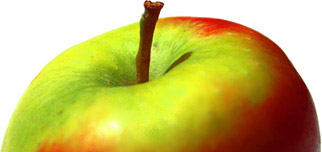

James Grieve is a justifiably popular dual-purpose apple variety, raised in Scotland at the end of the 19th century, the height of the Victorian period of apple development in the UK. James Grieve is a mid-season variety that is picked in early-mid September. At this stage it is pleasantly acidic and refreshing and if it is too sharp for eating it can be used for cooking (cut it into small chunks, it keeps its shape when cooked). After a few weeks the flavour sweetens and becomes quite mild, and it is then an excellent apple to eat in slices along with a cheese course. The flesh is soft, somewhat like a firm pear in texture.
Our photo shows a 'sport' known as Red James Grieve which was discovered in the 1920s. This is a natural genetic mutation of James Grieve - the shape and size are identical to the parent James Grieve but the red flush is more solid. There are a number of sports of James Grieve, a reflection of how widely it has been grown and the commercial interest shown in the variety in the early part of the 20th century. The photo also makes clear that James Grieve is a very handsome apple, and the skin has a slight satin sheen to it.
James Grieve has been used as the basis of a number of newer varieties, some of which have become successful as garden apple trees or in small-scale commercial plantings. One reason why you might want to use James Grieve in a new variety breeding programme is that it invariably passes on its inherent acidity, which can be an excellent way to stiffen the flavour of a new variety whose other parentage is sweet or bland. Varieties such as Greensleeves, Lord Lambourne, Elton Beauty, and Katy all inherit the acid kick from James Grieve which helps make them so refreshing. Lord Lambourne has also in turn proved popular in breeding programmes so James Grieve is one of a relatively small number of varieties which has 'grand-children' - Topaz is probably the most well-known of these. Like James Grieve these are all early to mid-season varieties.
Another important James Grieve characteristic is its juiciness - bite into one and the flesh glistens with juice. This makes it a great apple variety if you want to make your own apple juice - a feature also inherited by Katy.
Interestingly the parentage of James Grieve itself has not been fully established. Cox's Orange Pippin is a possible candidate, as it was a popular apple for amateur breeders at the time (as it still is). James Grieve has a very similar shape, which is a good indication, but it appears to have none of the aromatic sweetness of Cox. This is not necessarily a reason to reject Cox as a parent, since we do not know the other parent, and Ribston Pippin (the likely parent of Cox) has a robust flavour which is not dissimilar to James Grieve. The other possible candidate is Pott's Seedling, a popular commercial cooking apple of the period.
James Grieve apple identification images
All images copyright Orange Pippin unless otherwise stated.


USDA identification images for James Grieve
The identification paintings in the USDA Pomological Watercolor Collection span the years 1886 to 1942.
Citation: U.S. Department of Agriculture Pomological Watercolor Collection. Rare and Special Collections, National Agricultural Library, Beltsville, MD 20705.
Parents and other ancestors of this variety
- Pott's Seedling (parent)
Offspring of this variety
- Broadholme Beauty
- Elton Beauty
- Falstaff
- Greensleeves
- Katy
- Lord Lambourne
- Meridian(distant descendant)
- Prince William
- Red Falstaff
- Three Counties
- Topaz(distant descendant)
Visitor reviews
- 30 Aug 2017 WALES, United Kingdomwonderful apple! Fell in love with it as a child, when our neighbour used to let me have one now & then, so insisted in planting it when first married & moved in here (1981) Struggle to keep the espalier shape my husband created but it's still going strong & am still loving those apples (Margot, Cardiff, margot.henery@gmail.com)
- 08 Nov 2015 BERKSHIRE, United KingdomHi Stephen, I have just been helped to identify apple tree in my garden as James Grieve. It has probably been there since 1950's!! I have been away much of intervening time! It has never fruited very well until this year when it was smothered with apples; few last ones still coming down! I think good harvest may be due to my son's pruning two years ago; but not sure. Can you give me some tips for pruning J.G. please. Many thanks, Aurie
- 13 Jul 2015 HERTS, United KingdomLovely apple, good as both an eater and a cooker. My tree is a full-size standard, and must be quite old, as it was already fully grown in 1978, when I moved in to this house. It used to bear biennially, but I seem to have cured it with judicious pruning. Very heavy crop last two years, and it looks like being heavy again this year (2015).
- 22 Jun 2014 W EST SUSSEX, United KingdomI have a James Grieve Apple 3 years old fruits lovely but when the apple is cut open the inside is bruised around the pip area and the apple does not taste very nice
- 26 Oct 2013 HAMPSHIRE, United KingdomWe 'rescued' a much maligned specimen from B&Q a few years ago. With a touch of TLC and the pollination by our bees we have had to support the branches such has been the crop each year. This year has been the heaviest crop of all with the average apple being some 11 cm in diameter. Harvesting has been late this year - 20 October - and the apples are sweet and flavoursome.
- 21 Sep 2013 ABINGDON, United KingdomI have a James Grieve and an Egremont russet. They are good pollinating partners as they both flower quite early. The russet harvests later too, so avoids too much of a glut. However, what a bumper crop I have had from both this year!
- 08 Mar 2012 DERBYSHIRE, United KingdomMy second favourite after Fuji. They have a wonderful unique flavour, better than Fuji but I don't like the skins which are a bit waxy and thick. Incredible crisp and crunch, hard even. Its the flavour that draws them apart but they are very expensive - probably the most expensive in the UK.
- 25 Jul 2011 WEST MIDLANDS, United KingdomI have a James Grieve apple tree in my small back garden.I live in the middle of the city and there are no pollinator trees around at all,but this lovely tree never fails to produce lots of big apples.One year we get a good crop,and every second year we get a bumper crop that I sometimes have to thin,I think it does really well considering there are no other apple trees about.
- 18 Mar 2011 CHESTER, United StatesI have recently purchased a James Greive and was wondering where to plant it? I have a west-facing sheltered wall. The southern aspect gets slightly more hours of sunlight than the northern aspect. Does the tree need the maximum amount of sun, or will it tolerate a bit of shade to enable me to use the sunnier part of my wall for other plants?
- 30 Sep 2010 PEMBROKESHIRE, United KingdomI grow James Grieve in Pembrokeshire and it often gets some scab - but this year has been disease-free and the fruits have been excellent. It makes excellent tarte tatin and very tasty dried apple rings but does not keep.
- 26 Jul 2010 WEST SUSSEX, United KingdomI have a james grieve apple which in its first year of fruiting they looked perfect on the treebut when they where cut open they had gone brown from the core. any comments please.
- 14 Feb 2010 CAERDYDD, United KingdomI have found a very useful little site on pruning, if anyone's interested - http://www.gardenaction.co.uk/fruit_veg_diary/fruit_veg_mini_project_september_2d_apple.asp
- 06 Nov 2009 CAERDYDD, United KingdomWe had some lovely apples (about 20) from our first year harvest - I harvested throughout September and into the beginning of October - I was a bit worried about the wind blowing them off the tree!! I would be grateful for any advice on pruning, as the tree is still a bit "straggly" - should I take out the lower branches, for instance - about a foot or two from the ground? It has reached about six feet high now, but still thin and supported by bamboos.
- 05 Sep 2009 BACKBARROW, CUMBRIA, United KingdomTook two varieties to Acorn Bank, near Temple Sowerby for identification. One was James Grieve. Small tree with southerly aspect. Intertwined with Egremont Russett. We get so many that we juice them at nearby communal pressing day. Lovely drink. Sharp initial taste.
- 30 Aug 2009 HAMPSHIRE, United KingdomDo james grieve apples store well as we are moving house ?
- 01 Aug 2009 BOLTON, LANCS, United KingdomQuestion! I Have A James Grieve Apple Tree, And Would Like To Know If I Will Need Another Apple Tree For Polination Kind Regards Brian
- 31 May 2009 PERTH, SCOTLAND, United KingdomI have a james grieve trained as an espalier against my garage wall. It is 7 years old and gives me loads of beautiful apples every year. Very reliable. Can be kept into the new year if stored carefully in a cool place.The photo is very misleading, its not the typical one. There is an old one outside the shop at RBG Edinburgh.Lots of flowers thie year, i will need to thin the fruit. The best apple for Scotland!
- 14 Dec 2008 IDAHO, United StatesJohn, Can you tell me anything about James Grieve's resistance (or lack of resistance) to apple diseases? In particular, does it get scab? Not grown much in USA. I may plant test trees in my commercial orchard. Thanks. --Robb
- 24 Sep 2008 SALSBURGH SHOTTS LANARKSHIRE, United Kingdomi have a james grieves at one end of my garden and a orange cox pippin at the outher end, will they complement each outher? The James Grieve has just started to bear fruit this year and so has the Cox although sparse, how do i know when to harvest and what can i do to get the best from my apples as my wife and i can,not eat them all.
- 13 Aug 2008 WORCESTER, United KingdomI inheriated a james grieve tree with my house, and have yet to try the apples but i have a bumper load on it, so this website has been good for me to find out what it can be used for.
- 27 Jul 2008 DEVON, United KingdomMy Grandfather planted a Grieve during the war, my greatest memories as a two year old was my grandmothe scraping the flesh with a spoon to give to me. I have just planted one last autumn and have wo to eat this year. I am getting very exited about re-living my childhood.
- 14 Apr 2008 ESSEX, ENGLAND, United Kingdomi have had conflicting comments as to whether James Grieve is self pollinating. Can someone please advise me. Answer: it is partially self-fertile.
- 05 Apr 2008 YORK, United KingdomThis is my favourite apple. We have a good shaped tree in our garden. The apples are early and do not store very well. Wonderful flavour for eating straight from the tree. They also dry well and make a fantastic dried apple ring (I make these on my woodstove) and these store well in an airtight jar.... and really make my muesli lovely!
- 04 Mar 2008 JERSEY CI, United StatesSo.. J.Grieve needs a pollinator....what is the best? we have a couple of non descript apples close by and a Crab .. q2 how close need the pollinator be? all comments appreciated.
- 30 Jan 2008 SUSSEX, United KingdomDoes James Grieve need a pollinator? OP: Yes - it is partially self-fertile so a separate pollinator is best.
- 27 Sep 2007 SCOTLAND, United KingdomThats my great grandads apple
- 14 Sep 2007 HAMPSHIRE, United KingdomWe inherited two James Grieve when we moved into our house a year or so ago. We have enjoyed two bumper seasons and picked the apples early and late. This year we crushed and pressed about half of them and found that the earlies were slightly dry and produced an aromatic slightly acidic juice that is extremely light and refreshing. We hope the juice freezes well but cannot tell as yet. There is evidence of fire blight on the trees, which will be cut away hard this year after the last of the apples are used. Let's hope the trees are as resistant to disease as you indicate.
- 12 Sep 2007 DEVON, United KingdomWe inherited this apple which we have just identified. Agree totally. Vey sharp when just ripe but quickly yellows and softens. Have stewed loads to freeze( yes they keep their shape) and eaten loads with cheese. going to try juicing next year.
Tree register
- United States3
- United Kingdom177
- Belgium 2
- Denmark 1
- France 1
- Ireland9
- Italy 2
- Netherlands 2
- Poland 1
- Spain 1
- Sweden 1
- Australia2
- Switzerland1
- Poland1
- Norway1
United States
- Bruce Stribling in Albuquerque, NEW MEXICO
- g Joseph Jordan in WEST CHESTER, PA
- Nathan Parker in Mount Shasta, CA
United Kingdom
- Reach Community Orchard in Cambridge,
- Reach Community Orchard in Cambridge,
- Adam Norman in Tadcaster, ENGLAND
- Alastair Robinson in Maidstone, KENT
- Alex in Scourie, SUTHERLAND
- Alison Cooke in Lincoln, LINCOLNSHIRE
- Alison Underwood in Colwyn Bay, NORTH WALES
- Amanda in London,
- Andrew Colchester in Bures, SUFFOLK, UK
- Andrew Collins in NEWMACHAR, ABERDEENSHIRE
- Andrew Guille in St Saviour, GUERNSEY
- Andy Chaplin in Sheffield, SOUTH YORKSHIRE
- Angela Beech in Peterborough, CAMBRIDGESHIRE
- Angela Bogle in Bakewell, DERBYSHIRE
- Ann in Nottingham, NOTTS
- Anne Maxwell in Leitholm, BERWICKSHIRE
- Anthony Payne in Bath,
- Atg in London,
- Bill Barker And Sharon Cherry in Smeeton Westerby, LEICESTERSHIRE
- Bill Taylor in Chorley, LANCASHIRE
- Billy Auger in Hopton Wafers, SHROPSHIRE
- Bluemarlin in Burnley, LANCASHIRE
- Bob Horne in York, NORTH YORKSHIRE
- Bruce Nottrodt in Taunton, SOMERSET
- Carol in Lincoln, LINCS
- Catherine in Leeds, W YORKS
- Cathy Heavers in Llanfairfechan, CONWY
- Christopher in Sleaford, LINCS
- Cindy Reynolds in Aldershot, HAMPSHIRE
- Claire in LANCASTER, LANCASHIRE
- Clare in Birmingham, WEST MIDLANDS
- Clifford Darby in Griffydam, LEICS
- Clive Rowlands in Northampton, NORTHANTS
- Connor in Southampton,
- Corinne Dewson in Redhill, SURREY
- Craig Bridge in Lincoln, LINCOLNSHIRE
- Dale Reynolds in Wisbech, CAMBS
- Dave Alston in Belper, DERBYSHIRE
- David in Hereford,
- David Carpenter in Banbury, OXFORDSHIRE
- David Harmston in Sleaford, LINCS
- David Haynes in Catterall, LANCASHIRE
- David Hill in Braintree, ESSEX
- David Price in Ayr, SOUTH AYRSHIRE
- David Price in Ayr, SOUTH AYRSHIRE
- David Scholes in Saddleworth,
- David Scholes in Saddleworth,
- David Scholes in Saddleworth,
- David Smith in Leeds, YORKSHIRE ENGLAND
- David Styles in Hove, EAST SUSSEX
- David Wright in Sheffield, SOUTH YORKSHIRE
- Deborah Kaufmann in Hyde,
- Deborah Kaufmann in Mossley,
- Deborah Kaufmann in Ashton Under Lyne,
- Diane in Chudleigh, DEVON
- Dianne Trembath in Newport, SHROPSHIRE
- Dominic in WEDNESBURY,
- Dougas Wilson in Perth,
- Dr Mairi Rennie in Petersfield, WEST SUSSEX
- Elaine Evans in Mold, FLINTSHIRE
- Elizabeth Gaffney in Berwick Upon Tweed,
- Elizabeth Gray in Melton Mowbray, LEICESTERSHIRE
- Elizabeth Hodge in Evesham, WORCESTERSHIRE
- Ellen Graves in St Andrews, FIFE
- Fiona Worby in Newbury, BERKSHIRE
- g Sidnell in Pinner, MIDDX
- Geoff Jones in TRURO, CORNWALL
- Georgia Brown in London, LONDON
- Gillian Pottermerrigan in Manchester, LANCASHIRE
- Graeme Stockdale in Pilsley, Chesterfield, DERBYSHIRE
- Graham Charles Schofield in Newmarket, SUFFLOK
- Graham Hinchliffe in Eastbourne, EAST SUSSEX
- Graham Jackson-Pitt in Arkholme, LANCASHIRE
- Hans Butler in Loughborough, LEIESTERSHIRE
- Heidi Saxby in Yorks, NORTH YORKS
- Helen Orme in Altrincham, CHESHIRE
- Henryc in Andover, HAMPSHIRE
- Ian Crook in Edinburgh, LOTHIAN
- Ian Dimery in Ripon, NORTH YORKSHIRE
- Ian Harvey in Fetcham, SURREY
- Ian Mcintyre in Wakefield, WEST YORKSHIRE
- Ivor Kiverstein in Pulborough, WEST SUSSEX
- J D James in Caerdydd,
- j Stiles in Histon, Cambridge, CAMBRIDGESHIRE
- James in Melbourne, DERBYSHIRE
- James C. Porteous in York, NORTH YORKSHIRE
- James Carroll in LUTON, ENGLAND
- James Kidd in Hightae, DUMFRIES AND GALLOWAY
- Jane f in Boxford, SUFFOLK
- Janet Brown in Carnoustie, ANGUS
- Jean Lippett in Martock, SOMERSET
- Jean Lippett in Martock, SOMERSET
- Jill Wheelden in Craven Arms, SHROPSHIRE
- Jock Nicol in Stonehaven, ABERDEENSHIRE
- John Ellis in Salisbury, WILTSHIRE
- John Leitch in Ayr, AYRSHIRE
- Jonathan Morgan in Cambridge,
- Julia Lindsey in Durham, DURHAM
- Julian Harrop in Durham, CO DURHAM
- Julie Quantrill in INVERURIE, ABERDEENSHIRE
- June Russell in Stockport, CHESHIRE
- Kate Bagenal-Lowe in Wooler, NORTHUMBERLAND
- Keith Johnston in Abaerdeen, ABERDEENSHIRE
- Kerry Evert in Chedzoy, SOMERSET
- Laura in Abingdon, OXOFRDSHIRE
- Lenore Greensides in Beverley, EAST YORKS
- Linda Robinson in Darlington, DURHAM
- Linda Twidle in Nuneaton, WARWICKSHIRE
- Lindsay Barnes in Penrith, CUMBRIA
- Lorraine Leckenby in London,
- Lyn Eryl Jones in Cambridge, CAMBRIDGESHIRE
- Malcolm Whitmore in Loughborough, LEICS
- margaret in Stonehaven,
- Margaret Brooker in Ellerker, EAST YORKSHIRE
- Margaret Parsons in Hull, EAST YORKSHIRE
- Margot Henery in Cardiff, WALES
- Mariska Van Loenen in ABERDEEN, ABERDEENSHIRE
- Mark in Chippenham, WILTS
- Mark in Chippenham, WILTS
- Mark Crook in Lincoln, LINCS
- Mark Davies in Saddleworth, YORKSHIRE
- Mark Sheard in Leyburn, NORTH YORKS
- Mark Shirley in Market Harborough, LEICESTERSHIRE
- Martin_UK in Basingstoke, HAMPSHIRE
- Mary Burt in Begbroke, OXFORDSHIRE
- Mary Fielding in LEDBURY, HEREFORDSHIRE
- Matthew Pennington in Bristol, NORTH SOMERSET
- Melanie Francis in St Helens, MERSEYSIDE
- Michelle in London,
- Mike in Rottingdean,
- Mike in Bridge Of Tilt, PERTHSHIRE
- Mike Fox in Brede, E.SUSSEX
- Mike Galtrey in Godalming, SURREY
- Mike Snelgrove in Abergavenny, MONMOUTHSHIRE
- Mrs Jane Brown in Settle, NORTH YORKSHIRE
- N. Buck in Cambridge, CAMBRIDGESHIRE
- N. Buck in Cambridge, CAMBRIDGESHIRE
- Neil Poulsom in Alford, LINCOLNSHHIRE
- Neil Smith in KIPPEN, STIRLING
- Nick Burrows in Helmsley, NORTH YORKSHIRE
- Nick Burrows in Doncaster, NORTH YORKSHIRE
- Nickkk in Oldham, LANCASHIRE
- Nigel in Ryton Dorrington Shrewsbury, SHROPSHIRE
- Nora Boswell in BRADFORD, WEST YORKSHIRE
- P Venner in WORTHING, WEST SUSSEX
- Pamela in Bressingham, NORFOLK
- Peter Revell in Hemel Hempstead, HERTS
- Phil in Stoke-On-Trent, STAFFS
- Phil Martin in Bath, SOMERSET
- Phil Mcintyre in Widnes, CHESHIRE
- Philip Baldock in Eastbourne, EAST SUSSEX
- Rebecca Gilmour-Jones in PEEBLES,
- Robert h in Enfield, MIDDLESEX
- Robert Mchattie in Ayr, AYRSHIRE
- Robert Wagner in Nr Kilmarnock, AYRSHIRE
- Roy Stephenson in Shiremoor, Newcastle, TYNE AND WEAR
- Rupert in Holnest, DORSET
- Sally in DERBYSHIRE
- Sarah Alexander in Shrewsbury, SHROPSHIRE
- Scott in Edinburgh,
- Sedgie in SALTBURN BY THE SEA, NORTH YORKSHIRE
- stanwatt2008@hotmail.co.uk in Gardenstown, ABERDEENSHIRE
- Stella Van Zwanenberg in Durham City, COUNTY DURHAM
- Stephen Horsfall in Hemel Hempstead, HERTS,
- Steve Stoodley in Glastonbury, SOMERSET
- Steve Webster in Truro, CORNWALL
- Sue Kendall in ILFRACOMBE, DEVON
- Suzanne Mcnally in Banbury, OXON
- Terry Smith in Huntingford, DORSET
- Tony in Glasgow, SCOTLAND
- Tony Cuthbert in Wolverhampton, WEST MIDLANDS
- Tv15 in Basingstoke,
- Tw in KENT
- Vanessa Brooks (Mrs) in Stevenage, ENGLAND
- Victoria in Edinburgh, LOTHIAN
- Victoria Birkett in Aberdeen, SCOTLAND
- Wayne Seagate in Watlington, NORFOLK
Belgium
- Frank De Prins in Kapellen, ANTWERPEN
- Skycraper in Haasrode, VLAAMS-BRABANT
Denmark
- Hanne Olsen in Kgs. Lyngby,
France
- Andrew Dalby in Saint-Coutant, DEUX-SèVRES
Ireland
- Chris in Cork, CORK
- Ja Cannon in Malahide,, CO. DUBLIN
- James A Nolan in Glynn,, WEXFORD.
- Nikolai in Dublin, DUBLIN
- Patsy Connolly in Galway, IRELAND
- Ronan Connolly in Dublin, DUBLIN
- Shirley Cobbe in Portarlington, LAOIS
- Simon Clarke in Duleek, COUNTY MEATH
- Ute Bohnsack in Kilfenora, CLARE
Italy
- Jan Huston in Castel D'Aiano, BOLOGNA
- Jan Huston in Castel D'Aiano, BOLOGNA
Netherlands
- Bas Cretskens in Stevensweert, LIMBURG
- Nynke Zijlstra in Eastermar, FRIESLAND
Poland
- Sebastian in Krakow, MALOPOLSKA
Spain
- Judith Rhind in Plencia, SPAIN
Sweden
- Kent in Gothenburg, SWEDEN
Switzerland
- Helmut Mueller in Neukirch, THURGAU
Poland
- Richard in Krakow,
Norway
- Jennifer Mcconachie in Horten, VESTFOLD
Spring blossom records for this variety
2025 season
- 18th April 2025 - tree owned by Wayne in Watlington, United Kingdom
2022 season
- 25th April 2022 - tree owned by Mike in Godalming, United Kingdom
- 25th April 2022 - tree owned by James in Glynn,, Ireland
2020 season
- 25th April 2020 - tree owned by Mike in Godalming, United Kingdom
2019 season
- 7th May 2019 - tree owned by Mike in Godalming, United Kingdom
2018 season
- 7th May 2018 - tree owned by Bill in Smeeton Westerby, United Kingdom
- 4th May 2018 - tree owned by Mike in Godalming, United Kingdom
- May 2018 - tree owned by Nora in BRADFORD, United Kingdom
- 27th April 2018 - tree owned by David in Hove, United Kingdom
2017 season
- 1st May 2017 - tree owned by Georgia in London, United Kingdom
- 25th April 2017 - tree owned by Bill in Smeeton Westerby, United Kingdom
- 19th April 2017 - tree owned by Mike in Godalming, United Kingdom
2016 season
- 22nd May 2016 - tree owned by Andrew in St Saviour, United Kingdom
- 17th May 2016 - tree owned by Bill in Smeeton Westerby, United Kingdom
- 10th May 2016 - tree owned by Mike in Godalming, United Kingdom
- 5th May 2016 - tree owned by James in York, United Kingdom
- 16th March 2016 - tree owned by Bruce in Albuquerque, United States
2015 season
- 11th June 2015 - tree owned by Bill in Smeeton Westerby, United Kingdom
- 20th May 2015 - tree owned by Lindsay in Penrith, United Kingdom
- 2nd May 2015 - tree owned by Stephen in Hemel Hempstead, United Kingdom
- May 2015 - tree owned by Andrew in St Saviour, United Kingdom
- 29th April 2015 - tree owned by Mark in Lincoln, United Kingdom
- 29th April 2015 - tree owned by Mike in Godalming, United Kingdom
- 13th April 2015 - tree owned by James in York, United Kingdom
2014 season
- 14th May 2014 - tree owned by stanwatt2008@hotmail.co.uk in Gardenstown, United Kingdom
- 12th May 2014 - tree owned by Mark in Leyburn, United Kingdom
- 8th May 2014 - tree owned by Keith in Abaerdeen, United Kingdom
- 7th May 2014 - tree owned by Andrew in St Saviour, United Kingdom
- 4th May 2014 - tree owned by Bruce in Taunton, United Kingdom
- 4th May 2014 - tree owned by Ja in Malahide,, Ireland
- May 2014 - tree owned by Robert in Ayr, United Kingdom
- 26th April 2014 - tree owned by Hanne in Kgs. Lyngby, Denmark
- 24th April 2014 - tree owned by Mike in Godalming, United Kingdom
- 18th April 2014 - tree owned by James in York, United Kingdom
- April 2014 - tree owned by Cathy in Llanfairfechan, United Kingdom
- April 2014 - tree owned by Steve in Glastonbury, United Kingdom
2013 season
- 30th May 2013 - tree owned by Robert in Ayr, United Kingdom
- 22nd May 2013 - tree owned by Andrew in St Saviour, United Kingdom
- 20th May 2013 - tree owned by Hanne in Kgs. Lyngby, Denmark
- 20th May 2013 - tree owned by Graham in Arkholme, United Kingdom
- 18th May 2013 - tree owned by David in Sleaford, United Kingdom
- 16th May 2013 - tree owned by Mike in Godalming, United Kingdom
- 14th May 2013 - tree owned by Jean in Martock, United Kingdom
- 9th May 2013 - tree owned by Bruce in Taunton, United Kingdom
- 7th May 2013 - tree owned by Linda in Nuneaton, United Kingdom
- 3rd May 2013 - tree owned by stanwatt2008@hotmail.co.uk in Gardenstown, United Kingdom
- 1st May 2013 - tree owned by Georgia in London, United Kingdom
- 14th April 2013 - tree owned by James in York, United Kingdom
- April 2013 - tree owned by John in Ayr, United Kingdom
2012 season
- 26th May 2012 - tree owned by Robert in Ayr, United Kingdom
- 14th May 2012 - tree owned by Nickkk in Oldham, United Kingdom
- 12th May 2012 - tree owned by margaret in Stonehaven, United Kingdom
- 7th May 2012 - tree owned by Andrew in St Saviour, United Kingdom
- 30th April 2012 - tree owned by Kate in Wooler, United Kingdom
- 25th April 2012 - tree owned by Linda in Nuneaton, United Kingdom
- 23rd April 2012 - tree owned by Lenore in Beverley, United Kingdom
- 20th April 2012 - tree owned by Simon in Duleek, Ireland
- 16th April 2012 - tree owned by James in York, United Kingdom
- 16th April 2012 - tree owned by Bruce in Taunton, United Kingdom
- 25th March 2012 - tree owned by Georgia in London, United Kingdom
- 19th March 2012 - tree owned by Chris in Cork, Ireland
- March 2012 - tree owned by Vanessa in Stevenage, United Kingdom
2011 season
- 3rd May 2011 - tree owned by Keith in Abaerdeen, United Kingdom
- 3rd May 2011 - tree owned by stanwatt2008@hotmail.co.uk in Gardenstown, United Kingdom
- 3rd May 2011 - tree owned by June in Stockport, United Kingdom
- 27th April 2011 - tree owned by Ellen in St Andrews, United Kingdom
- 27th April 2011 - tree owned by Robert in Ayr, United Kingdom
- 25th April 2011 - tree owned by Malcolm in Loughborough, United Kingdom
- 20th April 2011 - tree owned by Dave in Belper, United Kingdom
- 20th April 2011 - tree owned by David in Sleaford, United Kingdom
- 17th April 2011 - tree owned by Bruce in Taunton, United Kingdom
- 16th April 2011 - tree owned by James in York, United Kingdom
- 15th April 2011 - tree owned by Lenore in Beverley, United Kingdom
- 14th April 2011 - tree owned by Ronan in Dublin, Ireland
- 13th April 2011 - tree owned by James in Melbourne, United Kingdom
- 13th April 2011 - tree owned by Dr in Petersfield, United Kingdom
- 12th April 2011 - tree owned by Simon in Duleek, Ireland
- March 2011 - tree owned by Vanessa in Stevenage, United Kingdom
2010 season
- 20th May 2010 - tree owned by Mrs J in Settle, United Kingdom
- 15th May 2010 - tree owned by June in Stockport, United Kingdom
- 1st May 2010 - tree owned by David in Sleaford, United Kingdom
- May 2010 - tree owned by David in Sheffield, United Kingdom
- 30th April 2010 - tree owned by Robert in Ayr, United Kingdom
- 29th April 2010 - tree owned by Elizabeth in Evesham, United Kingdom
- 27th April 2010 - tree owned by Cindy in Aldershot, United Kingdom
- 3rd April 2010 - tree owned by Nikolai in Dublin, Ireland
- April 2010 - tree owned by Fiona in Newbury, United Kingdom
2009 season
- May 2009 - tree owned by Mary in Begbroke, United Kingdom
- 11th April 2009 - tree owned by N. in Cambridge, United Kingdom
- April 2009 - tree owned by Malcolm in Loughborough, United Kingdom
- March 2009 - tree owned by Vanessa in Stevenage, United Kingdom
Record your blossom dates in our Fruit Tree Register - more >>.
Harvest records for this variety
2020 season
- 3rd week October 2020 - tree owned by Mike in Godalming, United Kingdom
2018 season
- 2nd week October 2018 - tree owned by Mike in Godalming, United Kingdom
- 1st week September 2018 - tree owned by Ann in Nottingham, United Kingdom
2017 season
- 1st week October 2017 - tree owned by Mike in Godalming, United Kingdom
- 1st week September 2017 - tree owned by Ann in Nottingham, United Kingdom
2016 season
- 3rd week October 2016 - tree owned by Mike in Godalming, United Kingdom
- 4th week September 2016 - tree owned by James in York, United Kingdom
- 3rd week September 2016 - tree owned by Bill in Smeeton Westerby, United Kingdom
- 1st week September 2016 - tree owned by Nigel in Ryton Dorrington Shrewsbury, United Kingdom
- September 2016 - tree owned by Elaine in Mold, United Kingdom
2015 season
- 3rd week October 2015 - tree owned by Mike in Godalming, United Kingdom
- 4th week September 2015 - tree owned by Ian in Fetcham, United Kingdom
- 3rd week September 2015 - tree owned by James in York, United Kingdom
- 3rd week September 2015 - tree owned by Ann in Nottingham, United Kingdom
- 3rd week September 2015 - tree owned by Bill in Smeeton Westerby, United Kingdom
- 1st week September 2015 - tree owned by Andrew in St Saviour, United Kingdom
2014 season
- 2nd week September 2014 - tree owned by Mike in Godalming, United Kingdom
- 2nd week September 2014 - tree owned by James in York, United Kingdom
- 1st week September 2014 - tree owned by Andrew in St Saviour, United Kingdom
2013 season
- 4th week October 2013 - tree owned by Mike in Godalming, United Kingdom
- 1st week October 2013 - tree owned by Robert in Ayr, United Kingdom
- October 2013 - tree owned by John in Ayr, United Kingdom
- 3rd week September 2013 - tree owned by Bruce in Taunton, United Kingdom
- 3rd week September 2013 - tree owned by James in York, United Kingdom
2012 season
- 2nd week October 2012 - tree owned by Mike in Godalming, United Kingdom
- 2nd week October 2012 - tree owned by Georgia in London, United Kingdom
- 4th week September 2012 - tree owned by James in York, United Kingdom
- 3rd week September 2012 - tree owned by Lenore in Beverley, United Kingdom
- 2nd week September 2012 - tree owned by Andrew in St Saviour, United Kingdom
- 1st week September 2012 - tree owned by Chris in Cork, Ireland
- September 2012 - tree owned by Jennifer in Horten, Norway
- September 2012 - tree owned by Julia in Durham, United Kingdom
2011 season
- 1st week October 2011 - tree owned by June in Stockport, United Kingdom
- 2nd week September 2011 - tree owned by Bruce in Taunton, United Kingdom
- 1st week September 2011 - tree owned by James in Melbourne, United Kingdom
- 4th week August 2011 - tree owned by Bas in Stevensweert, Netherlands
2010 season
- 3rd week September 2010 - tree owned by Bluemarlin in Burnley, United Kingdom
- 3rd week September 2010 - tree owned by James in York, United Kingdom
- 2nd week September 2010 - tree owned by Nikolai in Dublin, Ireland
- 2nd week September 2010 - tree owned by Dianne in Newport, United Kingdom
- 2nd week September 2010 - tree owned by Robert in Ayr, United Kingdom
- 2nd week September 2010 - tree owned by David in Banbury, United Kingdom
- 2nd week September 2010 - tree owned by June in Stockport, United Kingdom
- September 2010 - tree owned by Fiona in Newbury, United Kingdom
- 3rd week August 2010 - tree owned by Dr in Petersfield, United Kingdom
- August 2010 - tree owned by Vanessa in Stevenage, United Kingdom
2009 season
- 3rd week September 2009 - tree owned by James in York, United Kingdom
- 3rd week September 2009 - tree owned by Nikolai in Dublin, Ireland
- 2nd week September 2009 - tree owned by David in Banbury, United Kingdom
- 1st week September 2009 - tree owned by Bas in Stevensweert, Netherlands
- 1st week September 2009 - tree owned by Jean in Martock, United Kingdom
- 1st week September 2009 - tree owned by Dianne in Newport, United Kingdom
- September 2009 - tree owned by N. in Cambridge, United Kingdom
- 3rd week August 2009 - tree owned by Vanessa in Stevenage, United Kingdom
- August 2009 - tree owned by Malcolm in Loughborough, United Kingdom
- August 2009 - tree owned by Mary in Begbroke, United Kingdom
Origins
- Species: Malus domestica - Apple
- Parentage: Potts Seedling ?
- Originates from: Scotland, United Kingdom
- Introduced: 1893
- UK National Fruit Collection accession: 1974-349
Identification
- Awards: RHS AGM (current)
- Country of origin: United Kingdom
- Period of origin: 1850 - 1899
- Fruit colour: Orange flush
- Flower colour: White
- Leaf colour: Green
- Popularity: Best sellers
- Annual cycle: Deciduous
Using
- Picking season: Mid
- Keeping (of fruit): 1-2 months
- Flavour quality: Average
- Flavour style (apples): Sharper
- Cooking result: Keeps shape
- Discoloration of fruit: No discoloration (Good for drying)
- Cropping: Good
- Fruit persistence: Fruit drops when ripe
- Food uses: Eating fresh
- Food uses: Culinary
- Food uses: Juice
- Food uses: Hard cider
- Food uses: Dual purpose
- Picking period: early September
- Wildlife: RHS Plants for Pollinators
Growing
- Gardening skill: Beginner
- Flowering group: 3
- Pollinating others: Good
- Ploidy: Diploid
- Vigour: Average vigour
- Precocity: Precocious
- Bearing regularity: Regular
- Fruit bearing: Spur-bearer
- Self-fertility: Partially self-fertile
Climate
- Frost resistance of blossom: Good resistance
- Frost resistance of blossom: Some resistance
- Cold hardiness (USDA): Zone 5 (-29C)
- Climate suitability: Temperate climates
- Summer average maximum temperatures: Cool ( 20-24C / 68-75F)
- Cold hardiness (RHS): H6 (to -20C)
- Summer average maximum temperatures: Cold (< 20C / 67F)
Other qualities
- Disease resistance: Average
- Canker: Some resistance
- Scab (Apple and Pear): Some susceptibility
- Fire blight: Some susceptibility
Where to buy trees
The following tree nurseries offer James Grieve apple trees for sale:
- Orange Pippin Fruit Trees (UK) United Kingdom
James Grieve apple trees
Where to buy fresh fruit
The following orchards grow James Grieve:
United Kingdom
England - midlands
- Meynell Langley Trials Gardens, Derby
- The Vyne, Basingstoke
- Walsgrove Farm, Worcester
England - north
- Coulton Mill, York
- Lockwood Hey Orchard, Saddleworth
England - south-east
- Kimpton Manor Apple Press, Andover
- The Apple Farm, Freshwater
- Holton Orchards, Halesworth
England - south-west
- Trevalon Organic Cooperative, Liskeard
Canada
British Columbia
- Riley Creek Farm, Lillooet
- Salt Spring Apple Company, Salt Spring Island
Australia
Victoria
- Heritage Fruits Society, Fairfield
References
- Apples of England (1948)
Author: Taylor - Fruit Expert
Author: Hessayon