
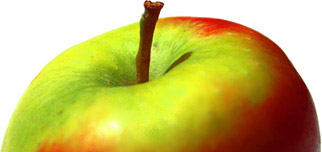

Adams's Pearmain is a an old-fashioned late dessert apple, one of the most popular varieties in Victorian England, probably originating from Norfolk. It has an attractive 'pearmain' shape.
This is a fairly dry apple - which is perhaps not regarded as a desirable attribute today. Inspite of this it is actually a very enjoyable apple, with a rich aromatic flavour which in apple terms is usually described as 'nutty' - a quality it shares with another popular Victorian apple, the Egremont Russet.
There is some evidence that Adam's Pearmain is a triploid variety, with 3 sets of chromosomes instead of the usual 2 - or perhaps a partial triploid. However it does not possess many of the typical features seen in triploid varieties (such as large size and vigour).
Although it had 'shelf appeal' for the Victorian housewife, its autumnal colouring is probably too subdued to compete with the bright young things of the modern supermarket shelves. Perhaps this is part of its appeal; it recalls a bygone era where subtlety of flavour was appreciated - a lovely apple to savour in front of an open fire on a cold winter's day.
Adams's Pearmain apple identification images
All images copyright Orange Pippin unless otherwise stated.
USDA identification images for Adams's Pearmain
The identification paintings in the USDA Pomological Watercolor Collection span the years 1886 to 1942.
Citation: U.S. Department of Agriculture Pomological Watercolor Collection. Rare and Special Collections, National Agricultural Library, Beltsville, MD 20705.
Visitor reviews
- 21 Aug 2024First fruit from our 3 year old tree
- 11 Oct 2022I grew up with this apple in my nana’s yard She wouldn’t let me eat it early but I’d sneak back and steal an early feast - so yummy
- 24 Oct 2016 SOMERSET, United Kingdomjust bought a couple to try at North Perrott fruit farm near Crewkerne in Somerset. I struggle with really tart apples but my partner loves them and this is a good compromise as it has the flavour and tang without being too much for me. I agree with previous comments. Lovely fruit.
- 11 Nov 2014 United KingdomBought this variety on Fakenham Market, Norfolk last week. Very large fruit with delicious flavour - will definitely buy again.
- 11 Dec 2011 GLOUCESTERSHIRE, United KingdomI bought these from a local orchard. I agree with the earlier comments, but would go further and say that the intensity of the flavour beats even the Cox's Orange Pippin, with which it is quite similar. One of my favourites.
- 16 Nov 2010 CO ANTRIM, NORTHERN IRELAND, United KingdomRecently I inherited my late grand father's Victorian house. There is the remains of an orchard which still contains four original apple trees. One of the trees this year bore copious apples which I had never seen before. I was looking through the web tonight and came upon your web site and I am delighted to find that my apple tree is definitely an Adam's Pearman variety. It has the shape shown in this article and looks identical when sliced having little stars mainly five pointed and a few four pointed 'stars'. I would agree with the comments of David from Leeds, Yorkshire when says " The texture is appealing and unusual - you could call it 'dry' but the apple is not short of juice. The flavours are enhanced by acids which seem to get better as you eat more of the fruit. Not unlike a good Mosel wine!". Please find some photos which I took this evening.
- 11 Nov 2010 WESTMEATH, IrelandInfo on olde pearmain apple trees and where to purchase them in Ireland
- 05 Nov 2008 RUTLAND, ENGLAND, United KingdomOur neighbour has this tree in the garden, which used to form part of an orchard to 'the Hall' The fruit is very tasty and makes an excellent apple juice, pink and slightly tart. Keeps well. Nice to be able to identify it from this website.
- 29 Oct 2008 LEEDS, YORKSHIRE, United KingdomI tasted this apple at an orchard near York last weekend and bought a couple of kilos. The texture is appealing and unusual - you could call it 'dry' but the apple is not short of juice. The flavours are enhanced by acids which seem to get better as you eat more of the fruit. Not unlike a good Mosel wine! I'm looking forward to eating more.
- 20 Oct 2008 SHEFFIELD, United KingdomJust bought some of these from the Sheffield Wholesale Market to sell in our shop - Beanies. They were grown at Brogdale. I would agree with the comment above - they are tart and tasty with a good crisp flesh. The fruit is quite small but that might be to do with the age of the trees they came from.
- 29 Sep 2008 ALEXANDRIA, OH, United StatesI just bought a peck of these delicious apples today. I would describe them as tart and very flavorful. My favorite!
Tree register
United States
- Alison Gardner in Albion, CALIFORNIA
- Gil Schieber in Snohomish, WASHINGTON
- Justin Piper in Oakland, OREGON
- Lynnae Boudreau in Blairsville, GA
- Stephen Sain in Los Lunas, NEW MEXICO
- Tom & Diane Davidson in Salt Lake City, UTAH
- Velvie Mckenzie in Jackson, OH
United Kingdom
- Reach Community Orchard in Cambridge,
- Adam Savage in Alloa, CLACKMANNANSHIRE
- Adrian Hodge in Dereham, NORFOLK
- Andrew Barnes in Hereford, HEREFORDSHIRE
- Andrew Freeth in TAVISTOCK, DEVON
- Anita Lee in Cambridge, CAMBS
- Barry Mcnamara in Salisbury, WILTSHIRE
- Bill Barker And Sharon Cherry in Smeeton Westerby, LEICESTERSHIRE
- Billy Auger in HOPTON WAFERS, SHROPSHIRE
- Clifford Cain in Doncaster, SOUTH YORKSHIRE
- David Lewis in Selby, NORTH YORKSHIRE
- David Rolfe in Doncaster, SOUTH YORKSHIRE
- Des Kelly in Inverness,
- Des Kelly in INVERNESS,
- E.Scott in Plymouth, DEVON
- Eirene Hunter in Ballachulish,
- Elise Langley in ST IVES, CORNWALL
- Graham Charles Schofield in Newmarket, SUFFLOK
- Henry Sears in Newport (Pembs), PEMBROKESHIRE
- Jayne Hannon in Eardisley, HEREFORDSHIRE
- Jim in Exeter, DEVON
- John Dench in Etchingham, EAST SUSSEX
- John Leitch in Ayr, AYRSHIRE
- John Throssell in Plymouth, DEVON
- John Throssell in Plymouth, DEVON
- Jon Hutton in Prudhoe, NORTHUMBERLAND
- Lynn Ireson in East Dereham, NORFOLK
- Mark in Chippenham, WILTS
- Mark in Chippenham, WILTS
- Mark in Chippenham, WILTS
- Matthew Pennington in Bristol, NORTH SOMERSET
- Michele Young in Bath, AVON
- Mrs Hilary Ward in Malvern, WORCESTERSHIRE
- Nigel in Ryton Dorrington Shrewsbury, SHROPSHIRE
- nigel@purchon.com in Shepton Mallet, SOMERSET
- Peter Barnard in Doncaster, LINCOLNSHIRE
- Rhiannon Harrington in Reading, BERKSHIRE
- Richard Ayling in Swansea,
- Richard Borrie in York,
- Robert Waterhouse in Crediton, DEVON
- Ron Bell in MELROSE, SCOTLAND
- Sally in DERBYSHIRE
- Silvia Haytack in Stranraer,
- Steve Sim in Grange Over Sands, CUMBRIA
- Sue Carter in Chippenham, WILTSHIRE
- Sue Jarvis in Worcester, WORCESTERSHIRE
- Tv15 in Basingstoke,
- Victoria Birkett in Aberdeen, SCOTLAND
Ireland
- Dan Kissane in Killarney, CO KERRY
Netherlands
- Cheuk A Lam in Amsterdam, NOORD-HOLLAND
Australia
- Fiona in Mt Barker, WA
- Hayden in Winslow, VICTORIA, AUSTRALIA
- John Adams in Port Melbourne, VICTORIA
New Zealand
- Giles in HAMILTON, WAIKATO
Switzerland
- Helmut Mueller in Neukirch, THURGAU
India
- Sanjeev Chauhan in SHIMLA, HIMACHAL PRADESH
Spring blossom records for this variety
2018 season
- 7th May 2018 - tree owned by Bill in Smeeton Westerby, United Kingdom
2017 season
- 25th April 2017 - tree owned by Bill in Smeeton Westerby, United Kingdom
2016 season
- 13th May 2016 - tree owned by Bill in Smeeton Westerby, United Kingdom
2015 season
- 11th May 2015 - tree owned by Bill in Smeeton Westerby, United Kingdom
2013 season
- 22nd April 2013 - tree owned by John in Ayr, United Kingdom
Record your blossom dates in our Fruit Tree Register - more >>.
Harvest records for this variety
2017 season
- 1st week October 2017 - tree owned by Bill in Smeeton Westerby, United Kingdom
2016 season
- November 2016 - tree owned by Robert in Crediton, United Kingdom
- 3rd week October 2016 - tree owned by Nigel in Ryton Dorrington Shrewsbury, United Kingdom
- 2nd week October 2016 - tree owned by Bill in Smeeton Westerby, United Kingdom
2015 season
- 2nd week October 2015 - tree owned by Bill in Smeeton Westerby, United Kingdom
2013 season
- 2nd week March 2013 - tree owned by Fiona in Mt Barker, Australia
2012 season
- 2nd week October 2012 - tree owned by Dan in Killarney, Ireland
2011 season
- 2nd week October 2011 - tree owned by Henry in Newport (Pembs), United Kingdom
2010 season
- 2nd week October 2010 - tree owned by Adam in Alloa, United Kingdom
- 2nd week October 2010 - tree owned by Henry in Newport (Pembs), United Kingdom
2009 season
- 2nd week October 2009 - tree owned by Henry in Newport (Pembs), United Kingdom
Origins
- Species: Malus domestica - Apple
- Parentage: Unknown
- Originates from: England, United Kingdom
- Introduced: 1826
- UK National Fruit Collection accession: 1976-137
Identification
- Country of origin: United Kingdom
- Period of origin: 1800 - 1849
- Fruit colour: Orange flush
- Leaf colour: Green
- Popularity: Best sellers
- Annual cycle: Deciduous
- Alleles: 1
- Alleles: 3
- Alleles: 10
Using
- Picking season: Late
- Keeping (of fruit): 3 months or more
- Flavour quality: Good
- Flavour style (apples): Sweeter
- Discoloration of fruit: Slightly oxidising (browns slowly)
- Cropping: Good
- Fruit persistence: Normal ripening
- Food uses: Eating fresh
- Picking period: mid-October
- Wildlife: RHS Plants for Pollinators
Growing
- Gardening skill: Average
- Flowering group: 3
- Pollinating others: Poor
- Ploidy: Diploid
- Vigour: Weak growing
- Bearing regularity: Biennial tendency
- Fruit bearing: Partial tip-bearer
- Self-fertility: Not self-fertile
Climate
- Frost resistance of blossom: Good resistance
- Cold hardiness (USDA): Zone 5 (-29C)
- Cold hardiness (USDA): Zone 6 (-23C)
- Cold hardiness (USDA): Zone 7 (-18C)
- Cold hardiness (USDA): Zone 8 (-12C)
- Climate suitability: Temperate climates
- Climate suitability: Mild damp climates
- Summer average maximum temperatures: Cool ( 20-24C / 68-75F)
- Summer average maximum temperatures: Cold (< 20C / 67F)
Other qualities
- Disease resistance: Good
Where to buy trees
The following tree nurseries offer Adams's Pearmain apple trees for sale:
- Orange Pippin Fruit Trees (UK) United Kingdom
Adams Pearmain apple trees - Cummins Nursery
United States More >>
Where to buy fresh fruit
The following orchards grow Adams's Pearmain:
United Kingdom
England - midlands
- Meynell Langley Trials Gardens, Derby
- The Vyne, Basingstoke
England - south-east
- Lavenham Brook Vineyard and Orchard, Sudbury
References
- Apples of England (1948)
Author: Taylor