
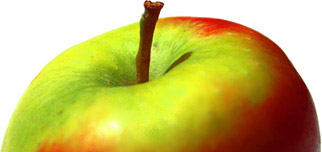
Northern Greening is a very old English apple, already widely-grown by the early 19th century. It was rated by the Victorian author Hogg as "an excellent culinary apple of first-rate quality" and it cooks to juicy puree.
Whilst one disagrees with Hogg at one's peril, it is perhaps safe to say that its descendants have a better flavour when cooked. The true importance of Northern Greening lies in its historical significance, as it is the probable parent of Dumelow's Seedling which was in turn one of the most influential Victorian culinary apples.
Northern Greening is in some ways a more "primitive" apple than other culinary apples of the Victorian era. It has a rather un-prepossesing appearance, and is smaller than the norm for a cooking apple. However it has the key qualities necessary in a cooking apple: it stores very well (a crucial attribute before the advent of refrigeration), it has a good acidic flavour (the base of all English-style apple cooking), and the tree is very reliable, disease resistant, and productive. These qualities, along with better size and visual appearance, are to be found in many of its descendants.
USDA identification images for Northern Greening
The identification paintings in the USDA Pomological Watercolor Collection span the years 1886 to 1942.
Citation: U.S. Department of Agriculture Pomological Watercolor Collection. Rare and Special Collections, National Agricultural Library, Beltsville, MD 20705.
Offspring of this variety
Visitor reviews
- 19 Mar 2024If you have never had a apple pie made from a GREENING you are missing one if not the best. This is an old variety and difficult to find these days.
- 30 Aug 2022I believe this is the variety of a very old tree in my garden, my parents bought the house in the 1970s and the tree was mature at that time, the elderly lady said the variety was ‘improved northern green’. We have bumper crops every year!
- 25 Sep 2013 NC, United StatesI have been driving 2 hours to the NC/VA area to purchase Northern Greenings. It is the only place I have found them. It is the very best apple I and my grown kids have found for dried apples. They keep their color without treating and are so wonderful tasting when dried. There is no better or more healthy snack.
- 14 May 2013 CA, United StatesThis(the greening) is one of my childhood favorites. Crunchy and tart for eating (the kind of apples I like) and does make superb sauce and pies. The tree we pick from has been in my family for 50+ years and is a great producer. When in cold storage the apples last for months before losing integrity then you just make sauce. Great apple!
- 18 Sep 2009 WEST CHESTER, BUTLER, OH, United StatesThe greening has long been a favorite in our family for making pies. Oh, sure. The Granny Smith's are all the rage these days, but the firm, tart greening makes a much better pie. A bit hard for just eating though.
- 14 Sep 2008 IOWA SIDNEY, FREMONT CO., United StatesI am not 100% certain that this is a Northern Greening but my source who worked for USDA for many years thought it was. This tree is probably 10 years old and this is the first year that the fruit was outstanding. It makes wonderful apple sauce and pies.
Tree register
United States
- Charley Rae in Grantsburg, WI
- Dianne Dieter in St Germain, WI
- Jo Elsmore in BLOORS,
- Melanie Church in Armour, SOUTH DAKOTA
Spring blossom records for this variety
2017 season
- June 2017 - tree owned by Dianne in St Germain, United States
2013 season
- April 2013 - tree owned by Melanie in Armour, United States
Record your blossom dates in our Fruit Tree Register - more >>.
Harvest records for this variety
2013 season
- August 2013 - tree owned by Melanie in Armour, United States
Origins
- Species: Malus domestica - Apple
- Parentage: Unknown
- Originates from: England, United Kingdom
- Introduced: 18th century
- UK National Fruit Collection accession: 1956-031
Identification
- Annual cycle: Deciduous
Using
- Food uses: Culinary
- Food uses: Traditional cooker
- Picking period: mid-October
- Wildlife: RHS Plants for Pollinators
Growing
- Pollinating others: Average
- Ploidy: Diploid
- Bearing regularity: Regular
Climate
- Summer average maximum temperatures: Cool ( 20-24C / 68-75F)
- Summer average maximum temperatures: Cold (< 20C / 67F)
Where to buy fresh fruit
The following orchards grow Northern Greening:
United States
Minnesota
- Maple Hills Orchard, Frazee
Oregon
- B&P Hitz Fruit Farm, Woodburn
United Kingdom
England - north
- Coulton Mill, York
References
- Apples of England (1948)
Author: Taylor