
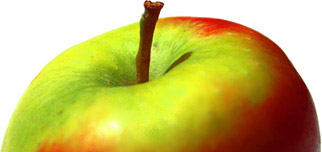

England is the only country where a major distinction is made between cooking and dessert apples, but these days only one variety remains to maintain the tradition of English cooking apples - the famous Bramley apple. However before the supermarket era the choice was wider, with a whole range of culinary or cooking apple varieties grown, each with their own characteristics and season. Chief amongst the early cooking apples is Grenadier, which ripens by mid-August in the UK.
Not much is known of the origins of Grenadier, but it was discovered during the mid-19th century in England and was quite widely grown by the end of the century, although it is no longer grown commercially.
Two reasons probably account for Grenadier's fall from favour. Firstly, like all early apple varieties it does not store particularly well, a serious drawback for modern distribution methods. Secondly, it is not the most attractive of apples - it is a lumpen green, often with a pronounced ribbed effect. However, this ugliness is transformed in the pot, where it easily cooks down to cream-coloured puree with a superb apple flavour. Grenadier is also a good base for apple jam.
Grenadier is also quite an easy apple tree to grow in the garden, being reliable, resistant to the common apple diseases, and not likely to grow as vigorously as a Bramley. Growing your own is also the easiest way to get over its poor keeping qualities, as you can pick it over a number of weeks.
So if you want to make a light English-style apple pie for a summer picnic then Grenadier is exactly what you need.
Grenadier apple identification images
All images copyright Orange Pippin unless otherwise stated.


USDA identification images for Grenadier
The identification paintings in the USDA Pomological Watercolor Collection span the years 1886 to 1942.
Citation: U.S. Department of Agriculture Pomological Watercolor Collection. Rare and Special Collections, National Agricultural Library, Beltsville, MD 20705.
Visitor reviews
- 21 Aug 2024We have a grenadier apple tree and of all our trees (we have about 14-15 I think) it is "Old Faithful". It always produces a good crop and pretty much every other year a bumper crop. Great for applesauce where we only add a minimum of sugar.
- 15 Feb 2024 LONDON, United KingdomWe inherited what I believe was a Grenadier cooking apple tree when we moved in here in Dulwich London I think 60 years old then. It has just blown down after another 50 years . It almost always provided many more great cooking apples than we could eat ( baked and in pies and crumble) and in time to combine with the blackberries also at the end of the garden - . Only problem was that the apples did not keep more than a few weeks, max about a month. I greatly regret its passing - vigorous to the end, despite turning out to be completely hollowed out
- 08 Sep 2022Grenadier is superior to Bramley for cooking and delicious for eating if you like a slightly tart apple. many grow to over 1lb in weight. Why don't more growers sell these trees. We have a Bramley and Grenadier I much prefer the Grenadier for all my apple cooking.
- 06 Sep 2020 WORCESTERSHIRE, United KingdomI didn't have quite enough Grenadiers when cooking the last of this years crop so added an early Bramley. This was the first time i had compared the two directly. The heady scent of the Grenadier really shone through - much the better apple. I'll show this tree more respect in future! And free up freezer space at the beginning of August - they really have to be used straight from the tree.
- 24 Jun 2018 United KingdomPretty sure we have one. We peel and core and section after picking and then freeze so can use throughout the year in crumble, Apple plat and devised red cabbage. As others have said early picker and fabulous taste.
- 29 Sep 2016 KENT, United KingdomMoved into my new house in February and have just found out (from the huge ripening apples and help from Brogdales identification service) that I have a Grenadier . What a lovely cooking apple. Puree, crumble and pie so far. Good flavour cooked and raw . Very different to a Bramley which I also love.
- 11 May 2014 DEVON, United KingdomAlmost an eater when ripe.Possibly easiest tree to grow i have (out of 20)Always crops well,growth is manageable,always disease free,brilliant starter apple.Apple pie & sauce from early August in UK.Commend without hesitation
- 10 Apr 2011 Co. Meath, IrelandThere is a Grenadier in our garden since the 1880s (four generations of apple tarts, stewed apples.... and 'free' apples for neighbouring children); 9 ft high - produces more than we can use, is 'pruned' by clippers or loppers every second year (more or less)..any tips for the next 130 years ?
- 14 Oct 2009 WILTSHIRE, United KingdomI have a 40 ft Grenadier tree and have just made 5 gallons of cider, all from the one tree
- 31 Jul 2009 LANCS, United KingdomRestricted non vigorous growth when well cropped. Splendid apple for small gardens. I find it very reliable and keen to fruit.
- 13 Dec 2008 SOUTH HAMPSHIRE, United KingdomWe have had a Grenadier apple tree for over 20 years now and it has always been a good cropper. The glory is we get (sometimes) apples at the end of July and we can pick them until early September. Its only a small tree but we get plenty of apples for our needs and some left over for friends and neighbours.This means we then benefit by neighbours receprocating in September and October with Bramleys etc. So we have 'fresh' apples deep into November and December.
- 19 Oct 2008 SHROPSHIRE, United KingdomWe have an old Grenadier at the end of our garden that produces fruit every year, with every other year being a real bumper crop that we struggle to keep up with! As it doesn't keep too long we get peeling, freeze it up, and enjoy fantastic crumbles and purees all through the winter.
- 06 Oct 2008 WARWICKSHIRE, United KingdomHave a tree (70 years old) which we have been trying to identify - this sounds like it. In our opinion beats the Bramley hands down! Does anyone have a picture so we could compare and does anyone know of a nursery still selling this variety?
- 14 Sep 2008 LIVERPOOL, United KingdomWe have two of these in our garden in South Liverpool and they will generally fruit every year. Like Vivien in Bristol 2008 has been a great crop. Superb apple for all sorts of uses!
- 17 Aug 2008 BRISTOL, United KingdomWe love our Grenadier apples - our small tree does not produce fruit every year but when it does, the flavour and cooking properties are second to none. This year (2008) has seen a wonderful crop.
- 07 Oct 2007 ABERDEENSHIRE, United KingdomGrows reasonably well here in Eastern Scotland. Almost an eater when really ripe. , but makes great pies also.
Tree register
United States
- Jady Morelli in Allendale, MI
- Jo Elsmore in BLOORS,
United Kingdom
- Alex in Scourie, SUTHERLAND
- Alex Hamilton in London, LONDON
- Bill Potter in Crosby, Maryport, CUMBRIA
- Bridget Evans in Barnsley, SOUTH YORKSHIRE
- C Hannan-Bobe in Sleaford, LINCS
- Chris Wiseman in Looe, CORNWALL
- Christine Woolass in Goole, YORKSHIRE
- Daniel in DUNDEE, SCOTLAND
- David (Dai) Howells in Swansea, WEST GLAMORGAN
- Deborah Kaufmann in Ashton Under Lyne,
- Deborah Kaufmann in Hyde,
- Dougas Wilson in Perth,
- Douglas Silverstone in Chesham, BUCKS
- Elizabeth Hodge in Evesham, WORCESTERSHIRE
- Ian Crook in Edinburgh, LOTHIAN
- Jacqueline Lawrence in Milford Haven, PEMBROKESHIRE
- Janet in St Austell, CORNWALL
- Karen Clarke in Portsmouth, HAMPSHIRE
- Kevinincornwall in Liskeard, UNITED KINGDOM
- Leah in Southampton, HAMPSHIRE
- Maggie Clark in Abbots Langley, HERTS
- Margaret Brooker in Ellerker, EAST YORKSHIRE
- Mariska Van Loenen in Aberdeen, SCOTLAND
- Mark Cook in Coventry,
- Mike in Rottingdean,
- N. Buck in Cambridge, CAMBRIDGESHIRE
- Nick in LONDON, LONDON
- Nick Burrows in Helmsley, NORTH YORKSHIRE
- Nickkk in Oldham, LANCASHIRE
- Paul F Darlington in Preston, LANCS
- Paul Mckean in Southport, MERSEYSIDE
- Penny Kitching in Melling, LANCASHIRE
- Philip Bartram in Stourbridge, WEST MIDLANDS
- Pippa Lloyd Owen in Dorking, SURREY
- Rhiannon Harrington in Reading, BERKSHIRE
- Rhiannon Harrington in Reading, BERKSHIRE
- Richard Borrie in York, YORKSHIRE
- Robert in Midgham, BERKS
- Robert Waterhouse in Crediton, DEVON
- Robin Livermore in Carmarthen, CARMARTHENSHIRE, WALES
- Sam in Halesowen, WEST MIDLANDS
- Stella Van Zwanenberg in Durham City, COUNTY DURHAM
- Steve Sim in Grange Over Sands, CUMBRIA
- Stuart Logan in Newbury, BERKSHIRE
- Stuart Sullivan in Worcester, WIRCESTERSHIRE
- Tim Brown in Randalstown, CO ANTRIM
- Wayne Seagate in Watlington, NORFOLK
France
- Paul Kendall in Poupas, TARN-ET-GARONNE
Ireland
- Frank And Susan Jacoby in Clontarf, DUBLIN
- Gearoid in Glenfarne, LEITRIM
- James A Nolan in Glynn, WEXFORD
- Maurico Pipistrello in Gort, CO GALWAY
- Sean Cremin in NEWCASTLE WEST,
- Simon Clarke in Duleek, COUNTY MEATH
- Ute Bohnsack in Kilfenora, CLARE
New Zealand
- Giles in HAMILTON, WAIKATO
Spring blossom records for this variety
2025 season
- 22nd April 2025 - tree owned by Wayne in Watlington, United Kingdom
2022 season
- 7th May 2022 - tree owned by James in Glynn, Ireland
2018 season
- 5th May 2018 - tree owned by Paul in Southport, United Kingdom
2016 season
- 9th May 2016 - tree owned by Paul in Southport, United Kingdom
2014 season
- April 2014 - tree owned by Philip in Stourbridge, United Kingdom
2013 season
- 16th May 2013 - tree owned by Paul in Southport, United Kingdom
- 12th May 2013 - tree owned by Richard in York, United Kingdom
2010 season
- October 2010 - tree owned by Nickkk in Oldham, United Kingdom
- 9th May 2010 - tree owned by N. in Cambridge, United Kingdom
- 7th May 2010 - tree owned by Christine in Goole, United Kingdom
- 7th May 2010 - tree owned by Stuart in Newbury, United Kingdom
- 6th May 2010 - tree owned by Elizabeth in Evesham, United Kingdom
2009 season
- 18th April 2009 - tree owned by N. in Cambridge, United Kingdom
- April 2009 - tree owned by Christine in Goole, United Kingdom
Record your blossom dates in our Fruit Tree Register - more >>.
Harvest records for this variety
2014 season
- 2nd week September 2014 - tree owned by Philip in Stourbridge, United Kingdom
- September 2014 - tree owned by Paul in Southport, United Kingdom
2013 season
- 3rd week September 2013 - tree owned by Richard in York, United Kingdom
2012 season
- 2nd week September 2012 - tree owned by Janet in St Austell, United Kingdom
- 4th week August 2012 - tree owned by Richard in York, United Kingdom
- 4th week August 2012 - tree owned by Nickkk in Oldham, United Kingdom
2011 season
- 3rd week August 2011 - tree owned by Ute in Kilfenora, Ireland
2010 season
- 3rd week September 2010 - tree owned by Chris in Looe, United Kingdom
- 2nd week August 2010 - tree owned by Ute in Kilfenora, Ireland
2009 season
Origins
- Species: Malus domestica - Apple
- Originates from: Buckinghamshire, England, United Kingdom
- Introduced: 1800
- UK National Fruit Collection accession: 1974-347
Identification
- Awards: RHS AGM (current) 1993
- Country of origin: United Kingdom
- Period of origin: 1800 - 1849
- Fruit colour: Green
- Fruit colour: Green - light
- Flower colour: Pink - light
- Leaf colour: Green
- Popularity: Best sellers
- Annual cycle: Deciduous
Using
- Picking season: Early
- Keeping (of fruit): 1 week
- Flavour quality: Good
- Flavour style (apples): Sharper
- Cooking result: Puree
- Discoloration of fruit: Oxidising
- Cropping: Heavy
- Fruit persistence: Normal ripening
- Food uses: Culinary
- Food uses: Juice
- Food uses: Traditional cooker
- Picking period: mid-August
- Wildlife: RHS Plants for Pollinators
Growing
- Gardening skill: Beginner
- Flowering group: 3
- Pollinating others: Good
- Ploidy: Diploid
- Vigour: Average vigour
- Bearing regularity: Regular
- Fruit bearing: Partial tip-bearer
- Self-fertility: Partially self-fertile
- Sunlight: Tolerates shade
- Sunlight: Prefers full sun
- Sunlight: Some shade
Climate
- Frost resistance of blossom: Some resistance
- Climate suitability: Temperate climates
- Climate suitability: Mild damp climates
- Summer average maximum temperatures: Cool ( 20-24C / 68-75F)
- Summer average maximum temperatures: Warm (25-30C / 76-85F)
- Cold hardiness (RHS): H6 (to -20C)
- Summer average maximum temperatures: Cold (< 20C / 67F)
- Climate - UK region: Southern England, Midlands, Eastern England
- Climate - UK region: Northern England, East Scotland, North-East Scotland
- Climate - UK region: Devon, Cornwall, Wales, Cumbria, South-West Scotland
- Climate - UK region: Moorland, areas above 300m / 1000ft
Other qualities
- Disease resistance: Good
Where to buy trees
The following tree nurseries offer Grenadier apple trees for sale:
- Orange Pippin Fruit Trees (UK) United Kingdom
Grenadier apple trees
Where to buy fresh fruit
The following orchards grow Grenadier:
United Kingdom
England - midlands
- Cotteridge Community Orchard, Birmingham
- Walsgrove Farm, Worcester
England - south-east
- Holton Orchards, Halesworth
England - south-west
- Charlton Orchards, Taunton
References
- Apples of England (1948)
Author: Taylor - Fruit Expert
Author: Hessayon