
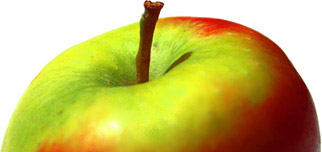
Cellini sounds like it must be a modern international dessert apple. In fact it is a rather unusual dual-purpose apple, originating from England in the early Victorian era. Rated by the Victorian writer Hogg as a "fine, showy, and handsome apple" - a description which fits it perfectly even though by 21st century standards it looks a bit old-fashioned.
Cellini is now little-known but it is an interesting variety because it is one of the best examples of the importance of the flavour of aniseed in apples. Aniseed or balsam is an important trace component in the make-up of many of the best-flavoured English-style apples, including Cox's Orange Pippin, Ellison's Orange, and Scrumptious. Whilst aniseed does not perhaps sound that attractive in an apple, it seems to have a role in bringing out the richness of flavour associated with the most aromatic apple varieties. If you want to study this flavour, then Cellini is the best way to experience it.
USDA identification images for Cellini
The identification paintings in the USDA Pomological Watercolor Collection span the years 1886 to 1942.
Citation: U.S. Department of Agriculture Pomological Watercolor Collection. Rare and Special Collections, National Agricultural Library, Beltsville, MD 20705.
Visitor reviews
Tree register
United Kingdom
- Graeme Stockdale in Pilsley, Chesterfield, DERBYSHIRE
Sweden
- Bjorn Wallentin in Visby, GOTLAND
Origins
- Species: Malus domestica - Apple
- Parentage: Possibly Nonsuch
- Originates from: London, England, United Kingdom
- Introduced: Early 19th century
- Developed by: Mr Leonard Phillips of Vauxhall
- UK National Fruit Collection accession: 1947-310
Identification
- Country of origin: United Kingdom
- Period of origin: 1800 - 1849
- Fruit colour: Red
- Flower colour: White
- Leaf colour: Green
- Popularity: Rarely grown
- Annual cycle: Deciduous
Using
- Picking season: Late
- Keeping (of fruit): 2-3 weeks
- Flavour quality: Good
- Flavour style (apples): Aromatic
- Cooking result: Puree
- Cropping: Heavy
- Food uses: Eating fresh
- Food uses: Culinary
- Food uses: Juice
- Wildlife: RHS Plants for Pollinators
Growing
- Gardening skill: Average
- Flowering group: 4
- Pollinating others: Average
- Ploidy: Diploid
- Vigour: Average vigour
- Bearing regularity: Regular
- Fruit bearing: Spur-bearer
- Attractive features: Attractive fruit
- Self-fertility: Not self-fertile
Climate
- Climate suitability: Temperate climates
- Summer average maximum temperatures: Cool ( 20-24C / 68-75F)
Other qualities
- Canker: Some susceptibility
Where to buy fresh fruit
No orchards have registered as growing this variety. If you grow this and want to register please go to our Orchard Registration form.
References
- Apples of England (1948)
Author: Taylor